
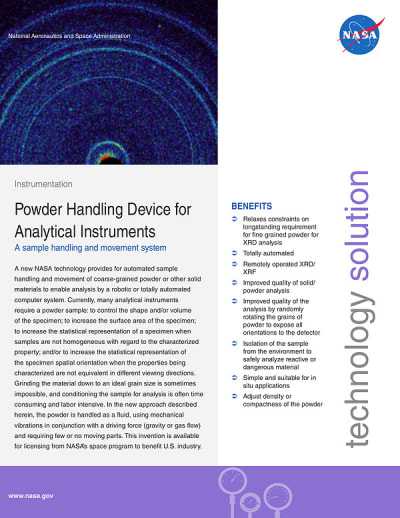
Powder Handling Device for Analytical Instruments
This technology provides automated sample handling and movement of coarse-grained powder or other solid materials to enable analysis by a robotic or totally automated computer system. The powder is handled as a fluid, using mechanical vibrations in conjunction with a driving force, and requiring few or no moving parts.
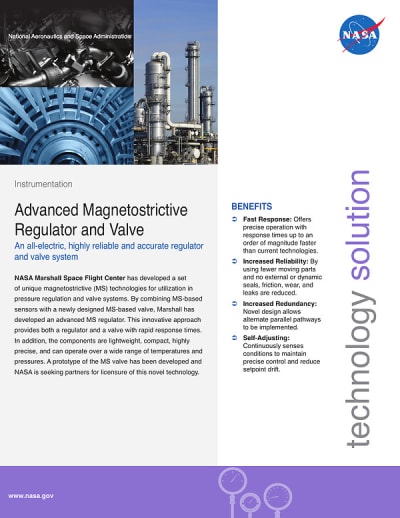
Advanced Magnetostrictive Regulator and Valve
An advanced magnetostrictive (MS) regulator was developed by combining MS-based sensors with a MS-based valve. This approach provides both a regulator and a valve with rapid response times. The components are lightweight, compact, highly precise, and can operate over a wide range of temperatures and pressures. Applications include aircraft engines, automotive fuel systems, and biomedical devices such as implants and drug metering systems.
Handheld Hydrogen Flame Imager
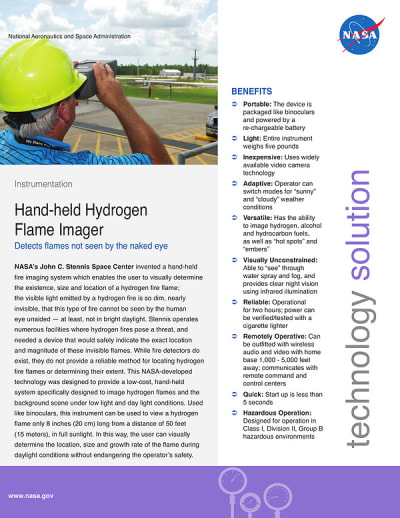
 This fire imaging system enables users to visually determine the existence, size, and location of a hydrogen fire flame. The visible light emitted by a hydrogen fire is so dim that the fire cannot be seen by the human eye. Used like binoculars, this instrument can view a hydrogen flame only 8" long from a distance of 50' in full sunlight.
Overview
The document describes a hand-held Hydrogen Flame Imager developed by NASA's John C. Stennis Space Center, designed to detect hydrogen flames that are nearly invisible to the naked eye. Traditional fire detectors often fail to provide reliable information about the size and location of hydrogen flames, especially in bright daylight conditions. This innovative device addresses these limitations by utilizing advanced infrared technology.
The imager consists of two low-light, black and white silicon charge-coupled-device (CCD) cameras that operate simultaneously. One camera is optimized for overcast conditions, using an 800 nm long-wavelength pass filter to enhance the visibility of hydrogen flames against background light. The other camera is tailored for sunny conditions, employing a 1,100 nm long-wavelength pass filter to block solar background light. This dual-camera system allows users to effectively detect hydrogen flames regardless of environmental lighting.
The device is designed for portability, resembling binoculars, and weighs only five pounds. It is powered by a rechargeable 12-volt battery, providing operational reliability for up to two hours. The imager can also be outfitted with wireless audio and video capabilities, enabling remote operation from command centers located 1,000 to 5,000 feet away. The quick start-up time of less than five seconds enhances its usability in emergency situations.
Applications for the Hydrogen Flame Imager span various industries, including transportation, automotive, power generation, chemical manufacturing, and research. It is particularly beneficial for fire fighters, chemical plant response teams, and hazardous materials teams, allowing them to safely navigate and assess environments where hydrogen flames may pose a risk. The device can also detect smoldering embers and hot spots in traditional fires, making it a versatile tool for fire safety and prevention.
In summary, the hand-held Hydrogen Flame Imager represents a significant advancement in fire detection technology, providing a cost-effective, reliable, and user-friendly solution for identifying hydrogen flames in various conditions. Its development exemplifies NASA's commitment to transferring technology for practical applications that enhance safety and improve quality of life.