

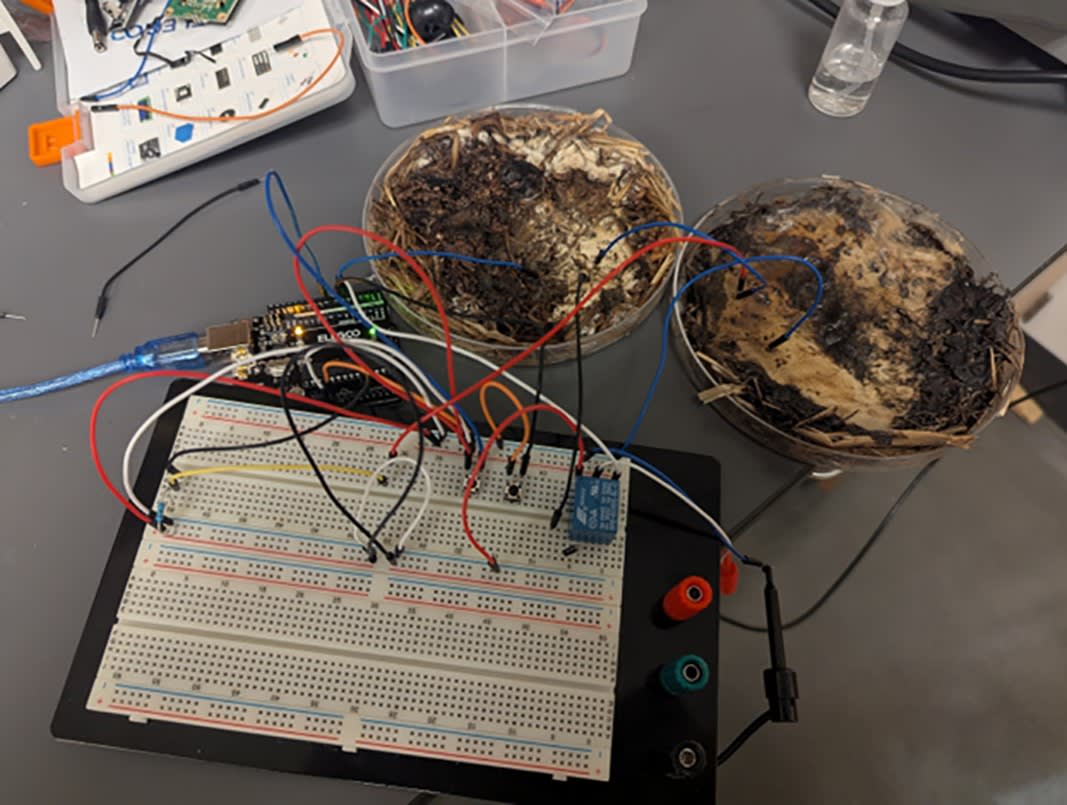
Fungal networks may be a promising alternative to tiny metal devices used in processing and storing digital memories and other computer data, according to a new study.
Mushrooms have long been recognized for their extreme resilience and unique properties. Their innate abilities make them perfect specimens for bioelectronics, an emerging field that, for next-gen computing, could help develop exciting new materials.
As one example, researchers from The Ohio State University recently discovered that common edible fungi, such as shiitake mushrooms, can be grown and trained to act as organic memristors, a type of data processor that can remember past electrical states.
Their findings showed that these shiitake-based devices not only demonstrated similar reproducible memory effects to semiconductor-based chips but could also be used to create other types of low-cost, environmentally friendly, brain-inspired computing components.
“Being able to develop microchips that mimic actual neural activity means you don't need a lot of power for standby or when the machine isn't being used,” said Lead Author John LaRocco, Research Scientist, Psychiatry, Ohio State’s College of Medicine. “That's something that can be a huge potential computational and economic advantage.”
Fungal electronics aren’t a new concept, but they have become ideal candidates for developing sustainable computing systems, said LaRocco. This is because they minimize electrical waste by being biodegradable and cheaper to fabricate than conventional memristors and semiconductors, which often require costly rare-earth minerals and high amounts of energy from data centers.
“Mycelium as a computing substrate has been explored before in less intuitive setups, but our work tries to push one of these memristive systems to its limits,” he said.

The study was recently published in the journal PLOS ONE.
Here is an exclusive Tech Briefs interview, edited for length and clarity, with LaRocco and Co-Authors John Simonis and Qudsia Tahmina, Associate Professor, Electrical and Computer Engineering, Ohio State.
Tech Briefs: The article I read says, “Researchers from The Ohio State University recently discovered that common edible fungi, such as shiitake mushrooms, can be grown and trained to act as organic memristors, a type of data processor that can remember past electrical states.” My question is: How did you come about this discovery?
LaRocco: The short version is that we've known that fungi can mimic similar actions to neurons in terms of electrochemical spikes for almost 50 years. There was a guy in the U.K. a few years ago, who made similar discoveries and that he used some toxic, not-very-nice type of fungi. But we had evidence for cursory evidence from some other papers that shiitake and nice, edible, non-toxic mushrooms could have similar properties. So that's why we explored those for use of these analog computers. These members, there's resistors that can vary with signal strength, just like neurons in the brain do.
Tech Briefs: What was the biggest technical challenge you faced while developing this mushroom-powered computer?
Simonis: One of the biggest complaints we had while we were doing our experiments was the smell. But speaking more from the actual experimental side of things, I think one of the biggest challenges that we had was really in terms of figuring out where in our specific samples specific properties that we were looking for occurred.
It was interesting that these fungal samples exhibited a multitude of different characteristics in different locations. We had to figure out different ways of probing our samples and mapping out where our samples had specific properties and specific areas as well as figuring out the specific operating voltages involved and the specific operating characteristics involved. There was a lot of exploration and some trial and error there.
Tech Briefs: Do you have any set plans for further research, work, etc.? If not, what are your next steps?
Tahmina: After this study, we submitted another proposal to our sponsors to continue this work. It’s in process, but at the same time we want to mention something that we are grateful for: our sponsors. Because without their support this wouldn't have been possible.
There were some challenges with this current study, we want to see if we can avoid or overcome those challenges to be able to store our samples in appropriate temperatures to make sure that we can retrieve their behavior.










