

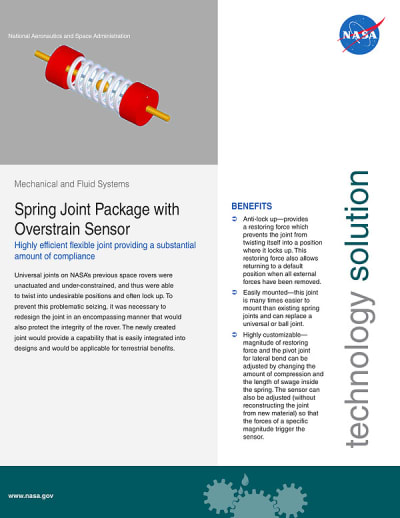
Spring Joint Package with Overstrain Sensor
 This flexible joint provides two degrees of freedom and a tremendous amount of compliance. The overstrain sensor joint has a passive and restoring force that allows the joint to return to a default position, and is also proportional to the amount of lateral deflection the spring has undergone; this allows the OS sensor joint to be used in many of the under-constrained situations that cause universal joints to lock up.
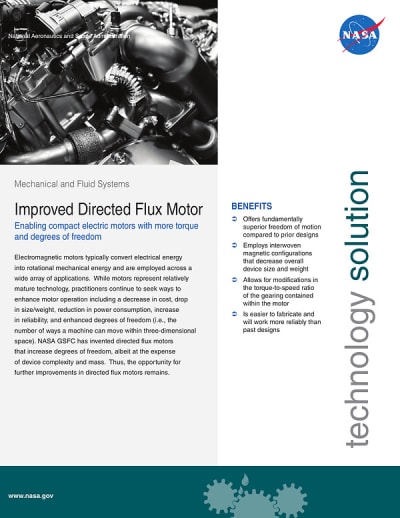
Improved Directed Flux Motor
 This directed flux motor utilizes the directed magnetic flux of at least one magnet through ferrous material to drive different planetary gear sets to achieve capabilities in six actuated shafts that are grouped three to each side of the motor. The motor allows for simple changes to modify the torque-to-speed ratio of the gearing contained, as well as simple configurations for up to six output shafts.
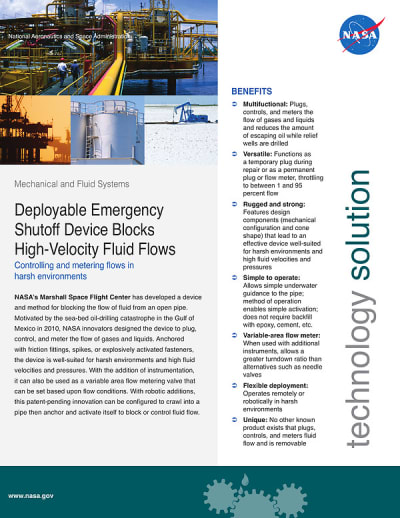
Deployable Emergency Shutoff Device Blocks High-Velocity Fluid Flows
A device and method block the flow of fluid from an open pipe. The device was designed to plug, control, and meter the flow of gases and liquids. Anchored with friction fittings, spikes, or explosively activated fasteners, the device is suited for harsh environments and high fluid velocities and pressures. With robotic additions, it can be configured to crawl into a pipe, then anchor and activate itself to block or control fluid flow.
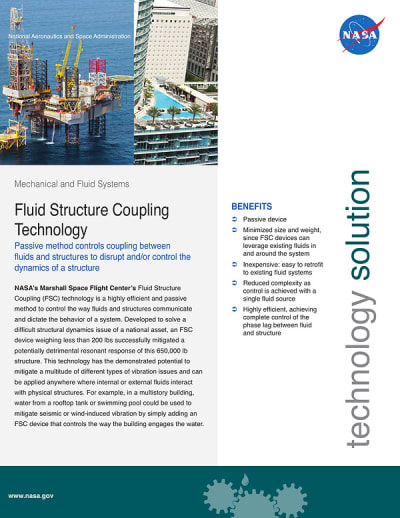
Fluid Structure Coupling Technology
 FSC technology controls the way fluids and structures communicate, and dictates the behavior of a system. It can mitigate different types of vibration issues, and can be applied anywhere internal or external fluids interact with physical structures. For example, in a multistory building, water from a rooftop tank or swimming pool could be used to mitigate seismic or wind-induced vibration. It can also be used to control vibration transmission from wet wings and fuel sloshing in aircraft.
Harsh Environment Protective Housings
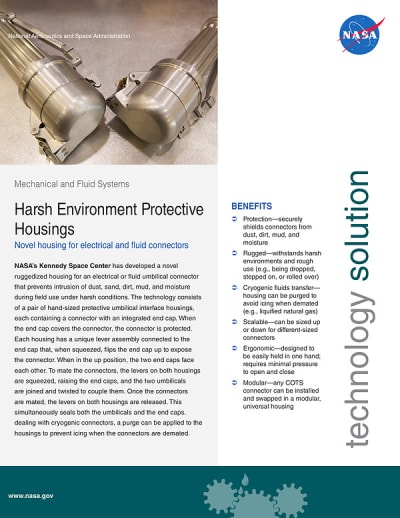
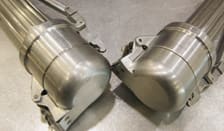 A ruggedized housing for an electrical or fluid umbilical connector prevents intrusion of dust, sand, dirt, mud, and moisture during field use under harsh conditions. The technology consists of a pair of hand-sized protective umbilical interface housings, each containing a connector with an integrated end cap. When the end cap covers the connector, the connector is protected. The housings can be used in military and space operations, mining, and desert operations.
Conical Seat Shut-Off Valve
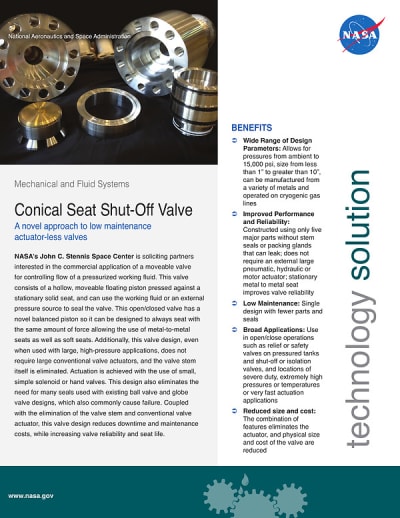
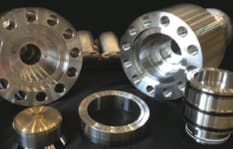 A movable valve controls flow of a pressurized working fluid. This valve consists of a hollow, movable floating piston pressed against a stationary solid seat, and can use the working fluid or an external pressure source to seal the valve. The valve design does not require large conventional valve actuators, and the valve stem itself is eliminated.
Overview
The document presents a novel valve technology developed by NASA's John C. Stennis Space Center, specifically the Conical Seat Shut-Off Valve. This valve features a unique design that utilizes a hollow, moveable piston pressed against a stationary solid seat to control the flow of a pressurized working fluid. The operation of the valve is achieved by applying pressure to a specific area of the piston while venting an equal area, allowing the piston to either seal against the seat or move away to open the valve. This mechanism significantly reduces the energy required for operation, making it feasible to use internal pressure or small accumulators for remote valve actuation, potentially incorporating wireless technology for ease of use.
The valve is designed to handle a wide range of pressures, from ambient up to 15,000 psi, and can be manufactured in various sizes and materials, including those suitable for cryogenic applications. Its construction involves only five major parts, eliminating the need for traditional stem seals or packing glands that are prone to leakage. This streamlined design enhances the valve's reliability and performance, making it suitable for applications in power plants, petrochemical and chemical industries, refineries, pressurized storage tanks, and pharmaceutical manufacturing.
Key benefits of the Conical Seat Shut-Off Valve include improved performance and reliability due to its metal-to-metal seating, low maintenance requirements stemming from fewer parts and seals, and reduced physical size and cost by eliminating the need for large actuators. The valve is applicable in open/close operations, such as relief or safety valves on pressurized tanks and shut-off or isolation valves in high-pressure or high-temperature environments.
The document emphasizes NASA's commitment to technology transfer, aiming to leverage its research for broader applications that benefit the economy and improve quality of life. Through partnerships and licensing agreements, NASA seeks to ensure that its technological advancements find practical uses in various industries, ultimately contributing to job creation and economic growth. The Conical Seat Shut-Off Valve exemplifies this mission by offering a reliable, efficient, and innovative solution for fluid control in demanding applications.