An improved packaging approach has been devised for filling a hollow-core photonic-crystal fiber (HC-PCF) with a gas, sealing the HC-PCF to retain the gas, and providing for optical connections and, optionally, a plumbing fitting for changing or augmenting the gas filling. Gas-filled HC-PCFs can be many meters long and have been found to be attractive as relatively compact, lightweight, rugged alternatives to conventional gas-filled glass cells for use as molecular-resonance frequency references for stabilization of lasers in some optical-metrology, lidar, optical-communication, and other advanced applications. Prior approaches to gas filling and sealing of HC-PCFs have involved, variously, omission of any attempt to connectorize the PCF, connectorization inside a vacuum chamber (an awkward and expensive process), or temporary exposure of one end of an HC-PCF to the atmosphere, potentially resulting in contamination of the gas filling. Prior approaches have also involved, variously, fusion splicing of HC-PCFs with other optical fibers or other termination techniques that give rise to Fresnel reflections of about 4 percent, which results in output intensity noise.
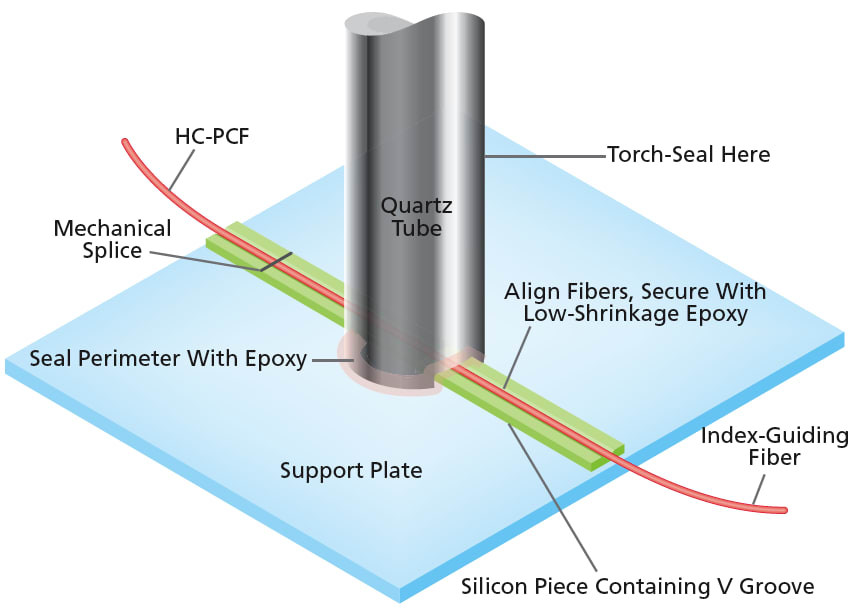
In the improved approach (see figure), at first, one end of an HC-PCF is mechanically spliced to one end of an index-guiding optical fiber, the end face of which has been cleaved at an angle to suppress Fresnel reflections. The fibers are placed in a V-cross-section groove in a piece of silicon with a gap of 30 to 100 μm between their end faces. The fibers are fixed in place in the groove by use of a low-shrinkage epoxy. The gap between the end faces of the fibers is small enough to ensure adequate optical coupling, yet it accommodates flow of gas into and out of the HC-PCF.
The V-groove silicon piece that supports the mechanical splice rests on a support plate. One end of a quartz tube is prepared by contouring it to fit over the V-groove silicon piece and support plate. This end of the tube is put in place to cover the splice region, and an epoxy is used to seal the tube to the V-groove silicon piece, the optical fibers, and the support plate.
The other end of the quartz tube is inserted into a plumbing fitting of a vacuum chamber, which is equipped with valves and connected to a vacuum pump for removal of air from the interior of the HC-PCF, and to a gas cylinder and pressure gauge for filling the interior of the HC-PCF with the desired gas. In a typical application, once the HC-PCF has been filled with the gas, the quartz tube is torch-sealed, forming a relatively compact hermetic junction. Alternatively, if the plumbing fitting includes a valve, it can be left in place to enable re-evacuation and/or refilling of the HC-PCF without the necessity of breaking and remaking the splice.
This work was done by Ilya Poberezhskiy, Patrick Meras, Daniel Chang, and Gary Spiers of Caltech for NASA's Jet Propulsion Laboratory.
NPO-45193
This Brief includes a Technical Support Package (TSP).
Improved Gas Filling and Sealing of an HC-PCF
(reference NPO-45193) is currently available for download from the TSP library.
Don't have an account?
Overview
The document titled "Improved Gas Filling and Sealing of an HC-PCF" is a Technical Support Package from NASA's Jet Propulsion Laboratory (JPL) that discusses advancements in the technology of hollow-core photonic crystal fibers (HC-PCF). These fibers are notable for their ability to guide light through a gas-filled core, making them useful for various applications, including sensing and telecommunications.
The document outlines the significance of HC-PCF in providing stable and efficient gas cells, which are essential for precise measurements in scientific and industrial settings. It references key studies and developments in the field, including works by Tuominen et al. (2005) and Benabid et al. (2005), which highlight the use of gas-filled photonic bandgap fibers as wavelength references and the creation of compact, stable gas cells using hollow-core fibers.
A major focus of the document is on the improved techniques for gas filling and sealing these fibers, which are critical for maintaining the integrity and performance of the gas cells. The authors, I.Y. Poberezhskiy, P. Meras, D.H. Chang, and G.D. Spiers, present a compact and robust method for refilling and connectorizing HC-PCF gas reference cells, which enhances their usability in various applications.
The document includes figures that illustrate the mechanical splice of HC-PCF with multimode fibers and the transmission characteristics of gases like CO2 through the fibers. These visual aids help to clarify the technical processes involved in the construction and operation of the gas cells.
Additionally, the document emphasizes the broader implications of these advancements, suggesting that the technology developed could have significant applications beyond aerospace, potentially benefiting fields such as environmental monitoring, medical diagnostics, and telecommunications.
Overall, this Technical Support Package serves as a comprehensive overview of the current state of research and development in HC-PCF technology, highlighting NASA's commitment to advancing scientific knowledge and fostering innovative solutions that can be applied across various sectors. The document is intended for stakeholders interested in the commercial and technological potential of these advancements, and it encourages collaboration and further exploration in this promising area of research.