

The carnivorous plant known as the Venus flytrap catches its prey through a sophisticated mechanism: The flytrap’s sensitive hairs, when touched, trigger two leaf lobes to snap shut and ensnare any insect inside.
Using stimuli-responsive materials and geometric principles, researchers created an artificial Venus flytrap with its own “embodied logic.”
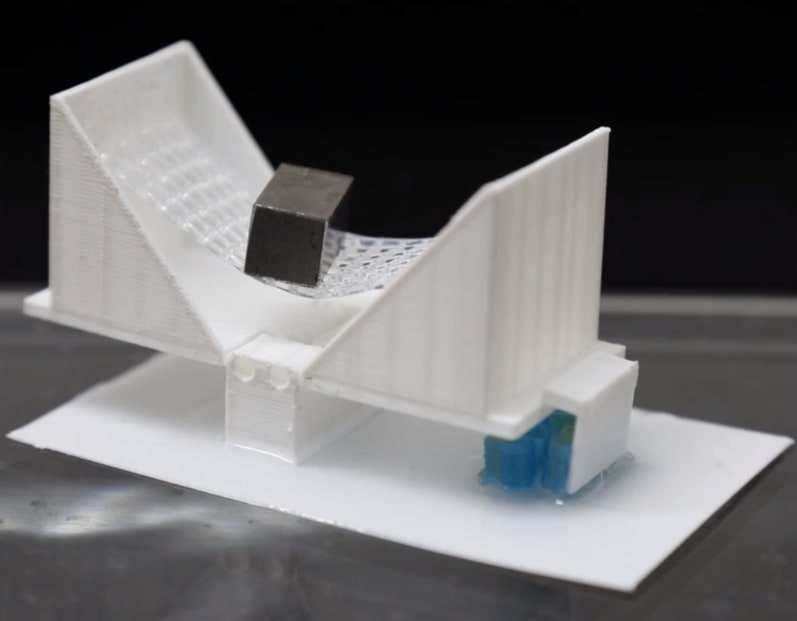
The flytrap-like system closes only if a mechanical load is applied and an actuator is exposed to a solvent.
A team at the University of Pennsylvania’s School of Engineering and Applied Science used multi-materials 3D printers to make the active structure. With simple changes in the environment, controllable “if/then” logic gates activate the complicated mechanical behaviors.
The study was led by Jordan Raney, assistant professor in Penn Engineering’s Department of Mechanical Engineering and Applied Mechanics, and Yijie Jiang, a postdoctoral researcher in his lab. Lucia Korpas, a graduate student in Raney’s lab, also contributed to the study.
Professor Raney spoke with Tech Briefs, via email, about how his team's flytrap works, and what’s possible when you can embody 3D-printed objects with logic.
Tech Briefs: What inspired this idea?
Prof. Jordan Raney: This work was inspired by observing how efficiently and effectively natural systems can respond to their environment. Many of these systems (such as the Venus flytrap) can use relatively simple cues from the environment to do complex things. Of course, robotic systems can be built to perform similar actions, but these typically require microprocessors, batteries, sensors, and actuators. Natural systems respond intelligently to their environment without any of those.
Tech Briefs: What is “embodied logic?”
Prof. Raney: Natural systems respond to their environment in sophisticated ways without needing microprocessors, batteries, sensors, or actuators. Instead, all of these sensing, processing, and actuating functions are "embodied" by the material and structural features of which the system is composed. This is what we mean by embodied logic.
Tech Briefs: How did the systems that you developed “embody” this kind of logic?
Prof. Raney: The systems we developed "embodied" all necessary sensing, logic, and actuation capabilities in the material/structure combination of which the system was composed. We did not have wires, batteries, microprocessors, or other electronics that you would typically expect in systems that respond in programmed ways to their environment. Instead, we used materials that partly swell in response to particular cues in the environment (like moisture), and we used this swelling to trigger instabilities and rapid rearrangement in the structure (like flipping a switch). We can also control when these instabilities are triggered, allowing us to produce controlled sequences of logic.
Tech Briefs: How do your 3D printed smart objects enable a kind of “ fine-grained control? ”
Prof. Raney: By "fine-grained control" we are really referring to two unique aspects of this technology. First, 3D printable materials can be developed that respond to a large variety of specific cues, like moisture, temperature, pH, and light.
In principle any number of these could be printed, integrated into a single system, and programmed with very complex logic (e.g., "actuate if the temperature is between 300 and 312 K and the pH > 8, or if exposed to sunlight").
Second, we are able to control the time of actuation, which is a fairly unique attribute in the realm of stimuli-responsive materials. This allows us to pre-program a sequence of events, or to require a sequence of stimuli be encountered to actuate.
Tech Briefs: How does your artificial Venus Fly Trap work, and how does the trap embody logic?
Prof. Raney: We used two different kinds of materials in our work: a silicone elastomer, which is like a "sensor" for hydrophobic things (certain solvents or oils), and a hydrogel, which swells in the presence of water.
We devised a couple types of artificial Venus flytraps that would only enclose after certain pre-defined cues (oil, water, etc.) were introduced. For example, to test the principles of embodied logic, we made a Venus flytrap that only closes if exposed to solvents. That is, you can set a mass inside the trap, but the trap does not close unless a solvent is introduced, which causes one of our bistable switches to flip.
At that point the mass is able to trigger closure of the trap. We made more complex versions as well, such as traps that would only activate for a period of, say, 10 seconds, and then deactivate. If a mass was not introduced within that precise 10 second window it would never close. This control over timing can be difficult to achieve in engineering without using electronics.
Tech Briefs: What are the most exciting applications that you can envision with this type of technology?
Prof. Raney: To me one of the most interesting features of this technology is its ability to monitor its environment for a very long period of time without needing continued input of energy. For example, with a microfluidic chip you might be interested in confirming that there is no contaminant entering into one of its inputs. Rather than continuously monitoring the input with a solid-state sensor and a constant power source, this technology could passively wait for weeks or months without power, and then suddenly close off the channel as soon as contaminant was detected. Similar applications could be envisioned in remote monitoring or deployable structures.
What do you think? What kind of applications do you envision? Share your comments and questions below.
Transcript
00:00:00 Scientists studying remote environments have long had to rely on battery-powered devices, but researchers at Penn have developed 3D-printed smart structures that self-actuate without any electronics. The exciting thing about this approach is that we are embodying some degree of intelligence or logic into a 3D-printed structure. Not requiring a battery, a motor, or an actuator, can open up some new design areas in how we even construct devices for things like remote monitoring or ocean sensors. This idea is kind of inspired from nature, like the Venus flytrap. This is something without very complicated circuits, designs, or external energy input. There's some level of intelligence or logic embodied into the system,
00:00:52 into the leaf, or into the plant, saying, "If this happens, then close. If not, then don't." There's some very rudimentary logic here. There are lots of advantages to 3D printing. You can have a very quick prototype. You basically design, process, and build up the 3D objects you want. It's a very quick and very nice testing and fabrication method. Our actuators are designed to have these "if" statements, these logic statements that are internal to the construction based on the shape and the material we use. The material that we use will be a composite material. Basically, we have microfibers in the softer material.
00:01:31 For fabricating this, we have to go through a mixing process. We have a powerful mixer in our lab and we have a 3D printing setup. The printing process would be extruding this material from a small nozzle, which in our case is several hundred microns in size, which is a pretty small and precise fabricating process. It's the material that governs, what are the stimuli that the system responds to? What we have working in the lab right now are these silicon-based materials that swell in response to non-polar solvents, things like industrial solvents, oil, things that maybe you don't want in your environment. These will swell in response to that, and that's what we use to trigger our system.
00:02:12 We also have a hydrogel-based material. These are materials that respond similarly, but to water instead of these sorts of solvents. These are materials that can be programmed to actuate when moisture is at a certain level. Our goal in putting logic into this material and structure is not to make a mechanical computer, but there are simple sorts of functions analogous to those in nature that we're hoping to be able to capture. We can build structures, for example, that will stay collapsed in a particular configuration, and could float in the ocean for a year. Then suddenly, when it encounters the conditions we've programmed in, like an oil spill, or a change in pH, it will open or this actuator will spring.
00:02:54 That could be used, for example, in an environmental monitoring kind of capacity to automatically obtain a sample from an environment when specific conditions are met, and to be able to do this without having to have a battery and a microprocessor.











