

Additive Manufacturing - June 2018
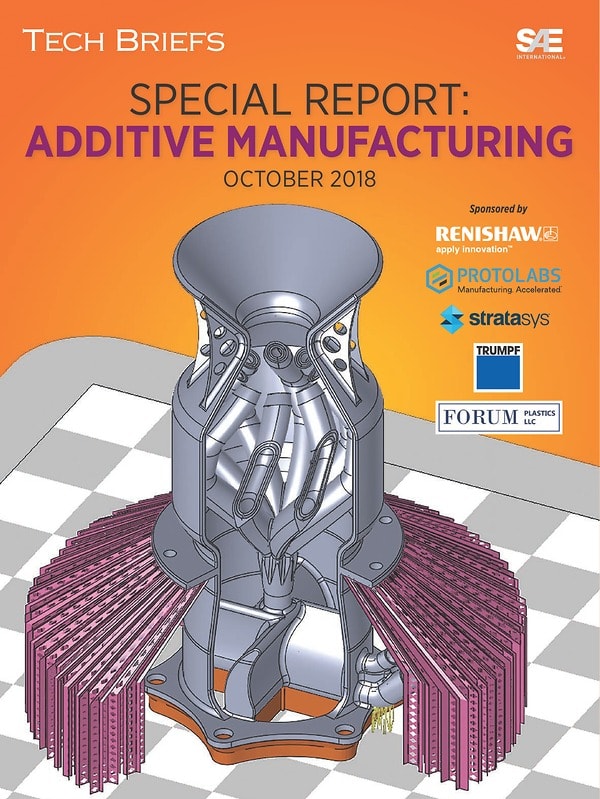
AM/3D Printing is fundamentally changing how products are prototyped and produced in aerospace, medical, automotive, and many other fields. To help you keep pace with the latest advances, we present this compendium of recent articles from the editors of Tech Briefs, Aerospace & Defense Technology, Medical Design Briefs, and Automotive Engineering magazines.
Don't have an account?
Overview
The Additive Manufacturing Special Report from October 2018 provides a comprehensive overview of the advancements and implications of additive manufacturing (AM), particularly in the aerospace sector. This report highlights the transformative potential of AM technologies, emphasizing their ability to revolutionize traditional manufacturing processes.
Key Highlights:
-
Definition and Overview: Additive manufacturing, commonly known as 3D printing, involves creating objects layer by layer from digital models. This method contrasts sharply with traditional subtractive manufacturing, which often involves cutting away material from a solid block.
-
Benefits of Additive Manufacturing:
- Weight Reduction: AM allows for the design of lighter components without compromising strength. For instance, parts can be reduced in weight by up to 25% while maintaining required tensile strength.
- Cost Efficiency: The report notes significant reductions in production costs, attributed to decreased material waste and the ability to produce complex geometries that would be difficult or impossible to achieve with traditional methods.
- Time Savings: Production times can be reduced by more than 50%, enabling faster prototyping and quicker time-to-market for new products.
-
Applications in Aerospace: The aerospace industry is a primary beneficiary of AM technologies. The report discusses how companies are leveraging AM for producing lightweight components, which is crucial for improving fuel efficiency and overall performance of aircraft. The ability to create customized parts on-demand also enhances maintenance and repair processes.
-
Technological Innovations: The report outlines various AM technologies, including selective laser sintering (SLS), fused deposition modeling (FDM), and stereolithography (SLA). Each technology has unique advantages and is suited for different applications, from prototyping to final production.
-
Quality Control and Standards: As AM becomes more prevalent, ensuring the quality and reliability of printed parts is paramount. The report emphasizes the need for rigorous quality control measures and the establishment of industry standards to ensure safety and performance, particularly in critical applications like aerospace.
-
Future Trends: The report anticipates continued growth in the adoption of AM technologies across various industries. It highlights the potential for further innovations, such as the integration of artificial intelligence and machine learning to optimize design and production processes.
-
Challenges and Considerations: Despite its advantages, the report acknowledges challenges such as material limitations, regulatory hurdles, and the need for skilled personnel to operate advanced AM systems. Addressing these challenges will be crucial for the widespread adoption of AM technologies.
In conclusion, the Additive Manufacturing Special Report underscores the significant impact of AM on the manufacturing landscape, particularly in aerospace. By enabling lighter, more efficient, and cost-effective production methods, AM is poised to reshape how industries approach design and manufacturing. The report serves as a valuable resource for stakeholders looking to understand the current state and future potential of additive manufacturing technologies.










