

Vehicle Electrification - June 2019
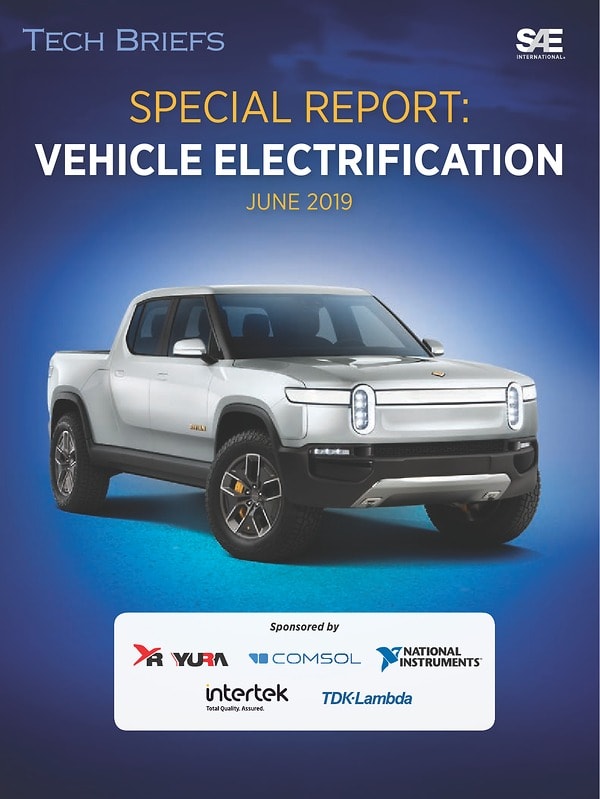
Demand for electric vehicles is accelerating, with several automakers announcing that their entire lineups will either be hybrid or all-electric by the 2020's. To help you keep pace with the rapid changes in vehicle electrification technology, we present this compendium of recent articles from the editors of Automotive Engineering, Truck & Off-Highway Engineering, and Tech Briefs magazines.
Don't have an account?
Overview
The "Vehicle Electrification Special Report" from June 2019 provides a comprehensive overview of the advancements and trends in electric vehicle (EV) technology, highlighting key players and innovations shaping the industry.
The report opens with a focus on Rivian, a Michigan-based electric vehicle startup led by CEO R.J. Scaringe. Rivian is positioned as a significant contender in the EV market, particularly with its R1T pickup and R1S sport-utility vehicle, set to launch in late 2020. The company has garnered substantial investment from major players like Amazon and Ford, indicating strong confidence in its potential to resonate with mainstream consumers.
BorgWarner is featured prominently for its innovative electric drive module (eDM) technology, showcased through the 2018 C30 from Great Wall Motors’ ORA brand. This technology integrates the electric motor and transmission, offering benefits such as weight reduction, cost savings, and improved efficiency, which are crucial for the development of competitive EVs.
The report also discusses Nissan's all-electric concept sports sedan, emphasizing the brand's commitment to electrification and its vision for future mobility. Additionally, it highlights China's NIO, which is pioneering battery swapping technology, addressing one of the significant challenges of EV ownership—charging time and infrastructure.
Volkswagen's MEB platform is presented as a modular solution that enables various vehicle designs while streamlining production processes. This platform is part of VW's broader strategy to enhance its electric vehicle offerings and meet growing consumer demand.
The report addresses the impact of cold temperatures on EV performance, noting studies that show how frigid conditions can significantly reduce driving range. This is a critical consideration for manufacturers as they design vehicles that can perform reliably in diverse climates.
Honda's E prototype is highlighted for its user-friendly design, aiming to simplify the electric vehicle experience for consumers. The report underscores the importance of intuitive design in making EVs more accessible and appealing to a broader audience.
Caterpillar's investment in Fisker is also noted, reflecting the growing interest from various sectors in the electric vehicle market. This move signifies a shift towards electrification in industries traditionally dominated by fossil fuels.
The report concludes with a discussion on the importance of fast charging systems, which present unique challenges in circuit protection. As the demand for EVs grows, ensuring efficient and safe charging infrastructure will be vital for widespread adoption.
Overall, the "Vehicle Electrification Special Report" encapsulates the dynamic landscape of the electric vehicle industry, showcasing technological advancements, strategic investments, and the ongoing efforts to overcome challenges associated with EV adoption. It serves as a valuable resource for understanding the future of mobility and the critical role electrification will play in shaping it.










