Vehicle Electrification - June 2019
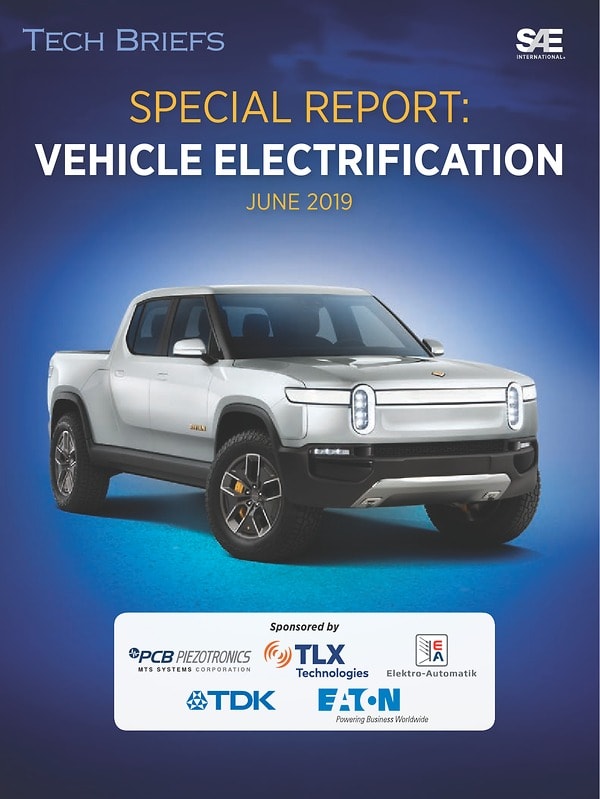
Demand for electric vehicles is accelerating, with several automakers announcing that their entire lineups will either be hybrid or all-electric by the 2020's. To help you keep pace with the rapid changes in vehicle electrification technology, we present this compendium of recent articles from the editors of Automotive Engineering, Truck & Off-Highway Engineering, and Tech Briefs magazines.
Don't have an account?
Overview
The June 2019 Special Report on Vehicle Electrification provides a comprehensive overview of the advancements and innovations in the electric vehicle (EV) sector, highlighting key technologies, industry trends, and emerging players.
The report opens with a focus on Rivian, a Michigan-based electric vehicle startup, which is poised to launch its R1T pickup and R1S sport-utility vehicle in late 2020. Rivian's founder and CEO, R.J. Scaringe, is noted for his vision to create electric vehicles that resonate with mainstream consumers, suggesting a potential shift in the automotive landscape.
BorgWarner is featured prominently for its demonstration of next-step electrification components, particularly its electric drive module (eDM) technology. This innovation integrates the electric motor and transmission, offering significant benefits in terms of weight, cost, and space efficiency, which are critical for the development of compact EVs. The report highlights the C30, a compact sedan from Great Wall Motors’ ORA brand, as the first EV in China to utilize this technology.
The Nissan concept sports sedan is another focal point, showcasing a fully electrified design that emphasizes the potential for driver-optional features. This aligns with the growing trend of automakers exploring autonomous driving capabilities alongside electrification.
China's NIO is discussed for its innovative approach to battery swapping, which addresses one of the significant challenges of EV ownership—charging time. This method allows for quick battery exchanges, potentially enhancing the convenience and appeal of electric vehicles in urban environments.
Volkswagen's MEB platform is introduced as a modular architecture that enables various vehicle types to be built on a single platform, streamlining production and reducing costs. This modularity is seen as a key enabler for the mass adoption of electric vehicles.
The report also addresses the challenges posed by cold temperatures on EV range, noting studies that show how low temperatures can significantly impact battery performance and overall vehicle range. This is a critical consideration for manufacturers as they design vehicles for diverse climates.
Additionally, the report touches on the importance of fast charging systems, which present unique circuit protection challenges that need to be addressed to ensure the reliability and safety of EV charging infrastructure.
The report concludes with insights into the future of electric propulsion, emphasizing the role of new designs and materials in the next generation of electric machines. It suggests that while electric drive systems are not a panacea for all environmental concerns, they represent a significant step towards reducing emissions and promoting sustainable transportation.
Overall, the Special Report on Vehicle Electrification encapsulates the dynamic changes occurring in the automotive industry, driven by technological advancements and a growing commitment to sustainability. It highlights the collaborative efforts of established automakers and innovative startups in shaping a future where electric vehicles become a mainstream choice for consumers.