

Additive Manufacturing - October 2019
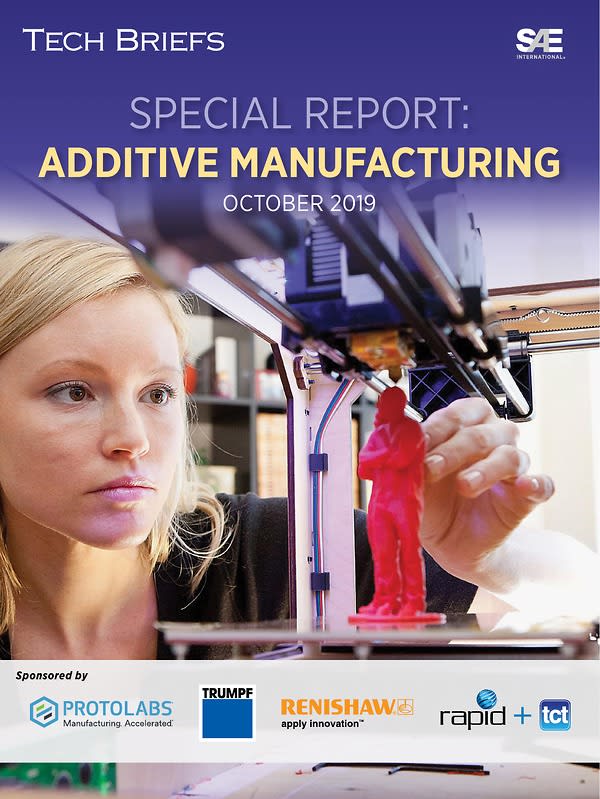
AM/3D Printing is fundamentally changing how products are prototyped and produced in aerospace, medical, automotive, and many other fields. To help you keep pace with the latest advances, we present this compendium of recent articles from the editors of Tech Briefs, Aerospace & Defense Technology, and Medical Design Briefs.
Don't have an account?
Overview
The Special Report on Additive Manufacturing from October 2019 explores the transformative impact of 3D printing across various industries, highlighting its evolution, current applications, and future potential. The report emphasizes that while additive manufacturing has been around for two decades, significant advancements in software and technology have recently accelerated its adoption, particularly in lightweighting parts and enhancing productivity.
One of the key features discussed is the lightweighting of parts using 3D metal printing. This process allows manufacturers to create components that are not only lighter but also more efficient, which is crucial in industries such as aerospace and automotive where weight reduction can lead to improved fuel efficiency and performance.
The report also delves into the role of advanced printers, such as the RenAM 500Q, which utilizes multiple high-power lasers to enhance productivity and reduce costs per part. This multi-laser technology enables manufacturers to achieve consistent performance and quality in their production processes, making it a valuable asset in the competitive landscape of additive manufacturing.
Another significant aspect covered is the shift in mindset among business leaders regarding 3D printing. Rather than merely comparing it to traditional manufacturing methods, companies are increasingly looking to integrate additive manufacturing into their existing processes or develop entirely new ones. This shift is driven by the realization that 3D printing can streamline product development, reduce time to market, and lower costs across various stages of manufacturing, engineering, and logistics.
The report outlines several benefits of adopting 3D printing, including reduced process times, less waste, and improved flexibility in maintenance and production. It highlights how additive manufacturing can facilitate individualized products tailored to consumer needs, thereby enhancing customer satisfaction and engagement.
Additionally, the report discusses the implications of 3D printing for after-sales support, noting that it can lead to increased flexibility in spare parts delivery and reduced production costs. This capability is particularly important for industries that require rapid response times and efficient inventory management.
The future of 3D printing is portrayed as promising, with ongoing innovations expected to further expand its applications. The report suggests that businesses must not only invest in 3D printing technology but also consider strategic integration into their operations to fully leverage its potential.
In summary, the Special Report on Additive Manufacturing presents a comprehensive overview of the current state and future prospects of 3D printing. It underscores the technology's ability to revolutionize manufacturing processes, enhance product development, and meet the evolving demands of consumers. As industries continue to explore the possibilities of additive manufacturing, the report positions 3D printing as a critical component of modern manufacturing strategies, poised for significant growth and innovation in the years to come.










