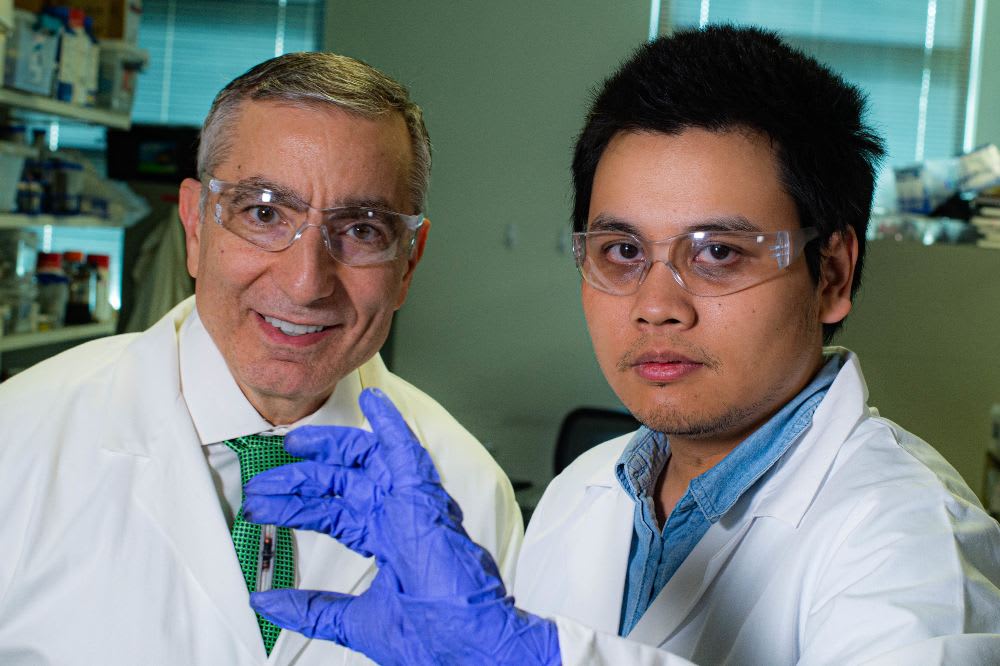
James Tour, T. T. and W. F. Chao Chair in Chemistry; Professor of Computer Science, Materials Science, and NanoEngineering at Rice University, and his team have developed a process that will reduce the cost of manufacturing graphene by a factor of more than 100.
The Rice University scientists are turning waste into turbostratic graphene via a process they say can be scaled up to produce industrial-scale quantities.
Tech Briefs: What started you thinking about this process?
Professor James Tour: A student of mine named Duy Luong read an article about flash Joule heating, which is a process that’s been around for at least 75 years. People were flash-Joule- heating nanoparticles and getting different phases. He tried putting carbon between two electrodes hooked up to a capacitor on a little cart next to his desk and started flashing it and saw that graphene was forming. Then he brought those results to me and I thought that could be really important.
Tech Briefs: How do you recognize graphene?
Professor Tour: You run what’s called a Raman spectrum and you know instantly.
Tech Briefs: Do you have to control the energy that goes into it?
Professor Tour: Yes, we control everything: the voltage, the current, the time of the pulse. We put any sort of carbon between two electrodes and apply a few hundred volts at about 100 amps. That turns it into graphene in about 10 milliseconds. We can vary the sheet size of the graphene that forms, depending on how we apply the voltage and how long the duration — we can control the parameters for any carbon source. What’s nice about this, we can take plastic waste, which is a big problem, and turn it into graphene. We can turn coal into graphene, so it provides something to do with coal and keeps the coal industry alive by turning coal into graphene without having to burn it.
{youtube} https://www.youtube.com/watch?v=GzDrnoGdLO4 {/youtube}
What human beings blow out into the air from combustion is 30 billion tons of carbon dioxide. If you were to convert all of that into carbon solids, you would get eight billion tons of carbon. You could convert that into graphene for $100 a ton, which is very, very little. To put that in perspective, petroleum coke, which comes out of the bottom of the distillation towers and doesn’t even get transferred to anything useful is about $200 a ton. If you put it into a useful form: calcined petroleum coke, it’s about $400 a ton. For producing graphene with our process, the cost is about $100 a ton in electricity. There’s no solvent, no mess — and you’re converting carbon to a form that doesn’t enter our world anymore. What we do now is bring up huge amounts of oil, natural gas, and coal from under the ground that becomes part of our world — we carbonize the world. But once you convert those fossil fuels to graphene, it doesn’t enter the carbon cycle again. Microbes don’t eat graphene. In fact, graphene’s already part of our environment in the form of graphite and about 10 to 20% of coal is graphene anyway. It’s a terminal point and it’s non-toxic. So, you could continue to pull up these assets without creating CO2 — it’s enormous what this can do.
Thirty to forty percent of all food in the world is thrown out and forms not just CO2 in landfills, but methane, which is a much worse greenhouse gas. Probably 95% of human trash is carbon-based, so you turn all that carbon into graphene for $100 a ton. Today you can’t even throw out waste for $100 a ton.
Tech Briefs: Have you tried this in the lab with different source materials?
Professor Tour: Of course, so many things: coal, coke, biochar, food, mixed plastics. The reason recycled plastic costs more than fresh plastic, is because of the human element of separating it into the different types because you can’t mix plastics and then recycle them. We just take the mixed plastic waste. We’ve also used hair, coconuts — it works with every source of carbon.
Tech Briefs: Do you have to adjust the pulse parameters for the different materials?
Professor Tour: Yes, you adjust it a bit depending upon the feed source coming in. If you do half a day or a day of tweaking, you can get really nice graphene out of this. But now we’re using artificial intelligence (AI) to help us to tune it depending upon what the feed source is. So, it won’t take us a day to do the optimization, it will all be done in a few seconds.
Tech Briefs: If you scale this up, wouldn’t it take rather large apparatus?
Professor Tour: Yes, if you want to create tons, you have to build a factory. That’s the way the world works. If you want to do things in a big way, you need a big machine. If you look at an aluminum factory, for example, they use high voltage — they build a power plant right next door. But we will probably be doing just 100 grams at a time. That way we use about 500 volts at about 10,000 amps for 1 millisecond and then it comes down to about 1000 amps for another 20 or 30 milliseconds. You have a series of pistons, where the stuff comes in, one second residence time in each piston, and then graphene just comes popping out. So, if you have 100 pistons, each putting out 100 grams at a time, you’ll be making tons in minutes.
Tech Briefs: How do you collect the graphene and make it usable?
Professor Tour: All of that is figured out. It blends beautifully into composites; you can put it in concrete. Eight percent of all CO2 emissions come from the making of concrete. You could put all that carbon in the form of graphene into concrete. It’s been shown that if you put 0.1% by weight of graphene into concrete, it strengthens it by 35%. So, you could use one-third less concrete for the same strength.
Tech Briefs: How come making concrete causes so much CO2?
Professor Tour: Because you take metal carbonates and heat them up to 2100°C, blowing out CO2 to make them into metal oxides from metal carbonates. Heating the furnace to 2100°C, takes a lot of burning of fuel. Then you put it in a truck with water, which is extremely heavy, and you bring it out to a site and pour it. You combine all of that and you get eight percent of all CO2 emissions in the world coming from the making of concrete.
Tech Briefs: In what way would graphene enhance the properties of things like paint, plastics, and composites?
Professor Tour: It increases the toughness, which is the area under the stress/strain curve. Since the materials are stronger, you can use less of them and still have the same strength.
Tech Briefs: This sounds great.
Professor Tour: It is great. The start-up company, Universal Matter, Ltd had its seed round over-subscribed. People are contacting the company every day, who want to be part of the series A. But just the seed round provided enough money to run another 10 months. That will be followed a series A, but by that time, we’ll be scaling and automating.
Tech Briefs: Won’t this take a huge amount of scaling and building up of infrastructure?
Professor Tour: Yes, but it doesn’t take that much initially to make a lot of money. Right now, graphene sells for $67,000 to $200,000 per ton. We can make graphene for $100 per ton in electricity. The world-wide production of graphene is probably about six or eight tons. That’s only because the cost doesn’t let it enter lots of applications. Ford Motor Company buys all the graphene it can get — it’s in many late-model Fords already. So, with the price coming down, lots and lots of people will use it — this is not engineering-hard. We’re building a system in my nano-laboratory to do 100 grams a shot. I got a million dollars from the Department of Energy to scale this to a kilo per day. We’ll have to do just ten shots of 100 grams in a day to reach that quota. Next, the system has to be automated, so you go to companies who do automation — that’s all they do. They will take this 100-gram unit that we do in our lab and automate it. With one-second residence time per shot, that would mean that they’d be getting a kilo out every 10 seconds. That means every 1000 seconds, they’re getting a ton just from one piston firing every few minutes — and once you automate this, you would never have just one piston firing.
Tech Briefs: You also have to deal with the graphene once it’s made.
Professor Tour: Right, it’s a powder, so after the one-second residence time, it’s pushed out into a feed line.
Tech Briefs: I didn’t realize it’s a powder — it’s always referred to in terms of sheets.
Professor Tour: Yes, it’s sheet-like, but the sheet is one atom thick and maybe 10 microns in diameter — tiny little sheets. Then, all the sheets pile up into a powder that you can stir into whatever you want to mix it with.
Tech Briefs: What kind of timeframe do you see before you’re making a commercial product?
Professor Tour: The start-up company, Universal Matter, is already sending out materials for testing. If you want tons scale, I think they’re talking about 2023 or 2024, something like that. And when you’re talking under five years, that’s lightning fast.
Tech Briefs: How do you bring in waste streams to process into the graphene?
Professor Tour: There’s a ton of people doing this. We turn rubber tires into graphene, so rubber companies are contacting us to just give us waste rubber, they’ll even pay us to take it. We have trash companies calling us who’ll pay us to take their trash. They don’t have landfills to put it in anymore. We will get paid to take starting material to turn into graphene!
An edited version of this interview appeared in the May 2020 issue of Tech Briefs.
Transcript
00:00:03 in the bottom of this cart there there are Bay's of capacitors that get charged up from the wall current charges up these capacitors then what happens is that is that goes through some electronics and then it goes to two electrodes and then when Dewey will push the button we have a high voltage across this and then a current will pass
00:00:30 through this with enough energy to break every carbon-carbon bond in the system and then when that breaks it's going to reconstruct as graphene so right now we have carbon black in there which is an amorphous carbon and you're going to see a bright flash when that takes place because most of the energy is going into not heat but but this blackbody radiation which is breaking every
00:00:55 carbon-carbon bond in there reconstructing and then the excess is coming out as a bright flash of light the count of three we're going to cause us to flash one two three the pioneers you hit up and when you cool it down you make graphene so that's why I've come up with the ideas of you doing something similar to laser induced graphene but we others different Carbon
00:01:24 sauce and use different sorts of energies which is electrics Cities previously we had taken a copper foil and we could grow graphene on that from many different carbon sources one of them for example being cookies Girl Scout cookies or from dead roaches but the problem with that is we could only make about a picogram of graphene a very very small amount of graphene that might
00:01:50 be suitable for electronics here we can do it in bulk this is a process that we call flash graphene because we can take essentially any carbon material and turn it into graphene domestic us coal the coal industry is just hurting so bad so can we take coal continue to mine it in large quantities but use that coal for a much higher value product so that we can put that coal into concrete we can put
00:02:18 that coal into building materials we can put that coal into paints into films into asphalt and now use that and keep that industry going just taking a very such inexpensive material that's like $100 a ton and convert that to a higher value material and then we only need a little bit of it to put it into all these different applications it's just enormous what we're going to be able to
00:02:41 do with this you