LIDAR Technology - February 2021
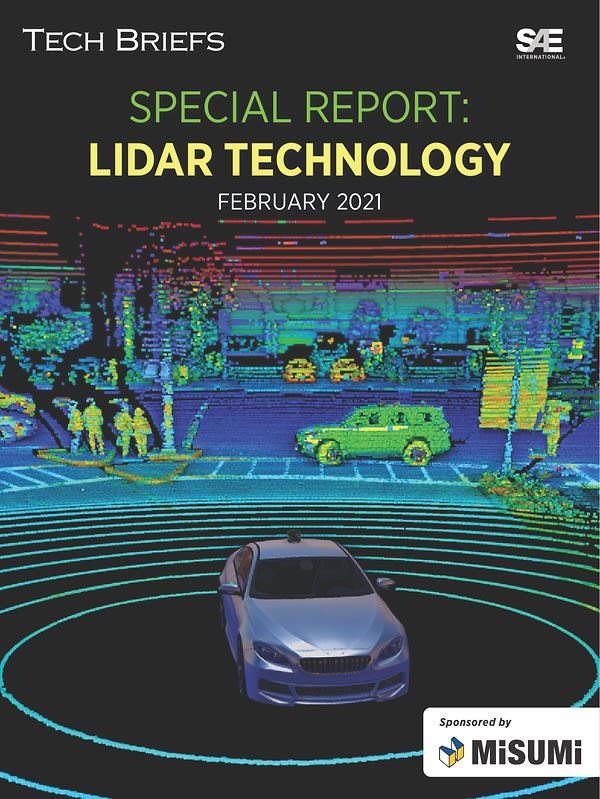
LIDAR sensors and systems are the "eyes" of ADAS and autonomous vehicles. Read about the latest advances in this compendium of articles from the editors of Automotive Engineering and Autonomous Vehicle Engineering.
Don't have an account?
Overview
The Lidar Technology Special Report from February 2021 delves into the transformative role of light detection and ranging (lidar) systems in various technological applications, particularly in the automotive industry. Lidar technology is crucial for enabling vehicles to perceive their surroundings in real-time, facilitating advancements in autonomous driving, augmented reality, and 3D mapping.
The report highlights the challenges faced by current lidar systems, which are often bulky, expensive, and difficult to miniaturize for emerging applications. Researchers from the University of Colorado have made significant strides in addressing these issues by developing a new silicon chip that enhances resolution and scanning speed without the need for moving parts or traditional electronics. This innovation employs a technique called wavelength steering, where different colors of laser light are directed at unique angles, allowing for simultaneous two-dimensional scanning and improved 3D imaging capabilities.
The report emphasizes the growing importance of lidar in the autonomous vehicle sector, which is currently valued at $50 billion and projected to exceed $500 billion by 2026. While many vehicles today incorporate elements of autonomous assistance, such as adaptive cruise control and lane-centering, the ultimate goal is to create fully autonomous cars that require no human intervention. To achieve this, vehicles must integrate lidar technology alongside cameras and radar systems to ensure comprehensive environmental awareness.
Additionally, the report discusses the development of high-resolution 3D flash lidar (HFL) sensors designed for close-range applications (up to 50 meters). These sensors are essential for providing precise three-dimensional profiles of a vehicle's surroundings, which is critical for safe and effective automated driving. Thomas Laux, head of business development for Continental’s Advanced Driver Assistance Systems (ADAS), underscores the importance of these sensors in enhancing vehicle safety and functionality.
The report also touches on the broader implications of lidar technology beyond automotive applications, including its potential uses in robotics, agriculture, and urban planning. As lidar systems become more compact and affordable, their integration into various devices and systems is expected to expand, paving the way for innovative applications in multiple fields.
In summary, the Lidar Technology Special Report presents a comprehensive overview of the current state and future prospects of lidar technology, particularly in the context of autonomous vehicles. It highlights key innovations, such as the new silicon chip and high-resolution sensors, that are set to revolutionize how vehicles perceive and interact with their environment. As the industry moves towards fully autonomous driving, the integration of advanced lidar systems will be pivotal in ensuring safety, efficiency, and reliability on the roads.