

Medical Manufacturing & Outsourcing - April 2021
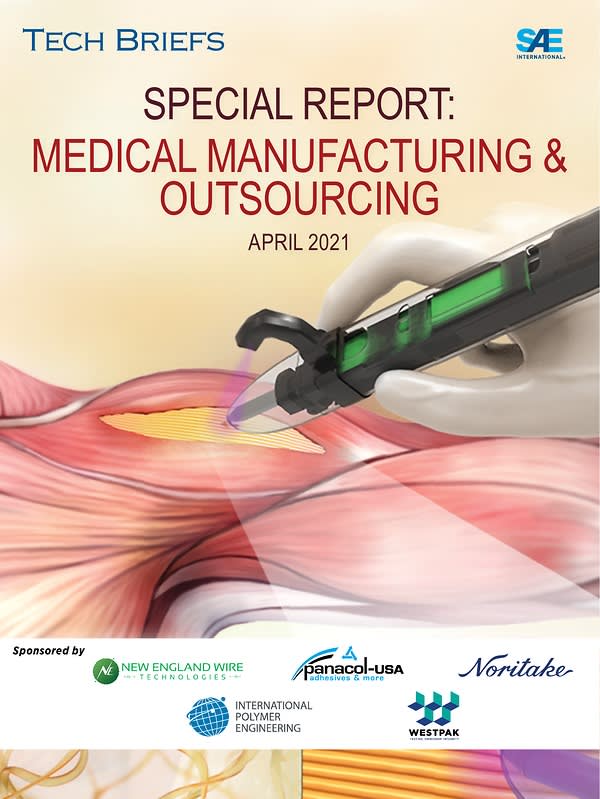
How 3D printing is transforming the medical industry...adapting to the manufacturing challenges of COVID-19...improving quality and reliability in PCB production. These are just a few of the articles you'll read in this new report from the editors of Medical Design Briefs and Tech Briefs magazines.
Don't have an account?
Overview
The April 2021 Special Report on Medical Manufacturing and Outsourcing provides a comprehensive overview of the significant changes and challenges faced by the medical manufacturing industry, particularly in light of the COVID-19 pandemic. The report highlights the disruption of global supply chains and the urgent need for personal protective equipment (PPE), especially nonwoven materials used in surgical-grade and N95 masks.
Before the pandemic, a substantial portion of nonwoven materials and PPE was produced in Asian countries, particularly China. However, the global spread of COVID-19 prompted many countries to enhance or establish regional production capabilities to meet local demand. This shift was crucial for ensuring that medical professionals and the general public had access to necessary protective gear, thereby playing a vital role in the global response to the pandemic.
The report also discusses the broader implications of the pandemic on the medical manufacturing landscape. It emphasizes the strain on supply chains and the increased demand for infection control gear and hygienic products made from nonwoven thermoplastic fabrics. The pandemic has accelerated trends that were already in motion, leading to a reevaluation of manufacturing strategies and a push towards more localized production.
In addition to the challenges posed by the pandemic, the report explores the transformative impact of 3D printing technology on the medical design industry. It highlights advancements in 3D printing techniques, including the development of cellular metallic materials created by fusing powder particles at supersonic speeds. This innovation represents a significant leap forward in material science, enabling the production of complex structures that can be tailored for specific medical applications.
The report underscores the importance of adapting to manufacturing challenges and the need for the industry to innovate in response to evolving demands. It suggests that the lessons learned during the pandemic could lead to more resilient supply chains and improved manufacturing practices in the future.
Overall, the Special Report serves as a valuable resource for understanding the current state of medical manufacturing and outsourcing, the impact of COVID-19 on the industry, and the potential for future advancements driven by technology and changing market dynamics. It highlights the critical role of the medical manufacturing sector in ensuring public health and safety, particularly during times of crisis, and emphasizes the need for ongoing innovation and adaptation in the face of new challenges.










