

ADAS/Connected Car - June 2021
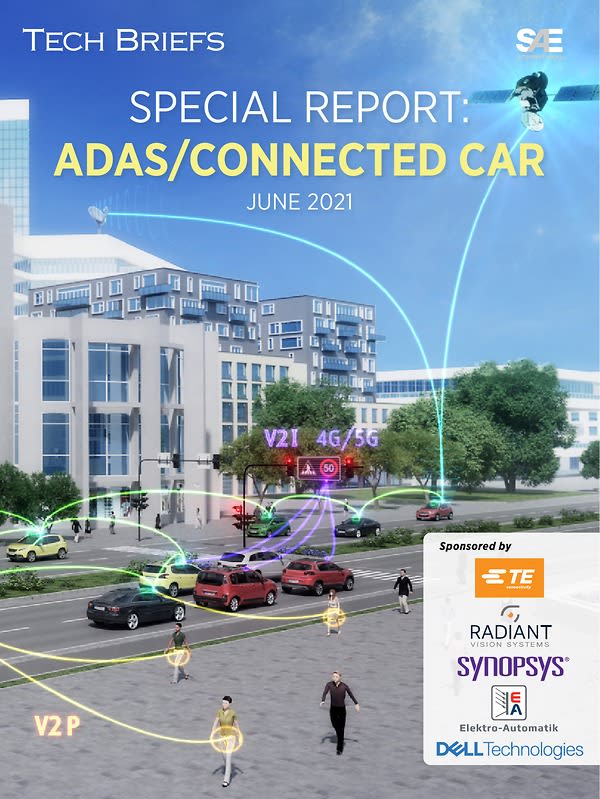
Today's Advanced Driver Assistance Systems (ADAS) and connected cars are paving the way for tomorrow's automated vehicles. To help you keep pace with the latest technology developments, we present this compendium of recent articles from the editors of Automotive Engineering, Autonomous Vehicle Engineering, and Truck & Off-Highway Engineering.
Don't have an account?
Overview
The Special Report on ADAS (Advanced Driver Assistance Systems) and Connected Cars, published in June 2021, provides a comprehensive overview of the current landscape of automotive technology, focusing on the implications of recent regulatory changes, advancements in vehicle communication systems, and best practices for testing and implementation.
A significant highlight of the report is the Federal Communications Commission (FCC) ruling from November 2020, which reallocated a portion of the 5.9GHz "Safety Spectrum" that had been reserved for vehicle communications. This decision allows for unlicensed private usage, such as WiFi, effectively sidelining the previously favored Dedicated Short Range Communications (DSRC) technology in favor of cellular vehicle-to-everything (C V2X) communications. The ruling has sparked debate within the industry, as many experts express concerns about the potential for interference from other radio signals and the adequacy of research supporting the decision. The report notes that the automotive industry has been slow to adopt DSRC, with few manufacturers deploying DSRC-equipped vehicles, leading to the FCC's decision to favor C V2X as the future standard for automotive safety communications.
The report emphasizes the importance of partnerships in the development and testing of ADAS technologies. It suggests that companies should collaborate with experienced partners to optimize resources and achieve common goals such as flexibility, cost-effectiveness, and speed in their testing approaches. The report also highlights the need for a direct data pipeline from vehicle loggers to the cloud, enabling real-time sharing of critical information during test drives. This approach allows engineers to quickly address issues and refine their systems based on immediate feedback.
In addition to regulatory and partnership insights, the report discusses the significance of data diversity in training datasets for ADAS systems. It stresses that having a well-defined dataset and clear metrics for evaluation is crucial for achieving successful outcomes. Tools that allow for the exploration of data, such as heatmaps for traffic signs or pedestrian movement, are also recommended to enhance the understanding of driving environments.
The report further explores the future of automotive technology, advocating for the adoption of industry standards like Open Drive, Open Scenario, and Open Label to ensure interoperability and future-proofing of toolchains. It underscores the role of drivers in the data collection process, suggesting that their active participation can significantly improve the quality of collected data.
Overall, the Special Report presents a forward-looking perspective on the evolution of ADAS and connected car technologies, highlighting the critical role of regulatory decisions, collaborative partnerships, and data management practices in shaping the future of automotive safety and connectivity. As the industry transitions towards C V2X communications, the report calls for continued innovation and adaptation to meet the challenges and opportunities presented by this rapidly evolving landscape.










