

Adas/Connected Car - December 2021
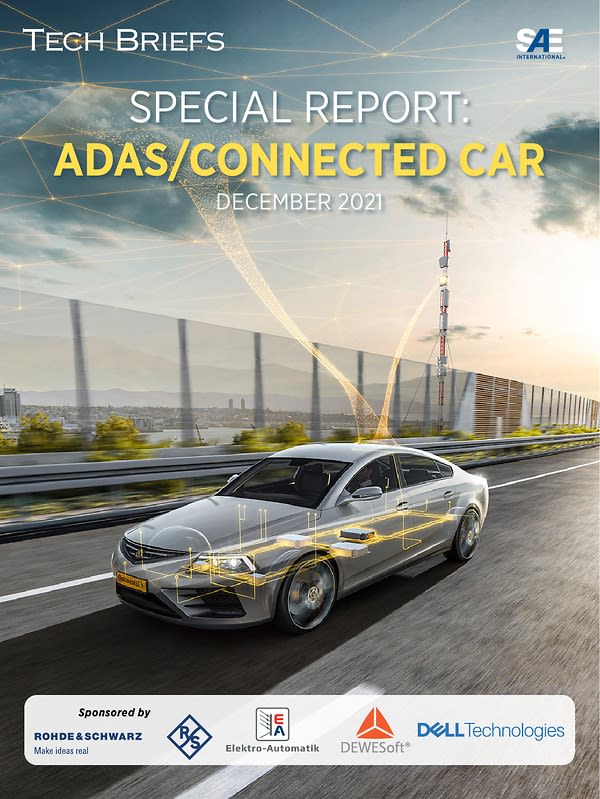
Today's Advanced Driver Assistance Systems (ADAS) and connected cars are paving the way for tomorrow's automated vehicles. To help you keep pace with the latest technology developments, we present this compendium of recent articles from the editors of Automotive Engineering and Autonomous Vehicle Engineering.
Don't have an account?
Overview
The ADAS/Connected Car Special Report from December 2021 provides an in-depth look at the advancements in advanced driver-assistance systems (ADAS) and the integration of connected car technologies. The report emphasizes the critical role of vehicle-to-vehicle (V2X) communication, which aims to enhance safety and enable greater autonomy in vehicles. Engineers are tasked with developing strategies that effectively fuse V2X data with information from vehicle sensors, while also addressing security and signal reliability challenges.
Key highlights from the report include:
-
GM’s Next ADAS: General Motors is advancing its SAE Level 2 system, which is designed to facilitate hands-free operation in approximately 95% of driving scenarios. This innovation aims to reduce driver workload and enhance safety.
-
Ford’s BlueCruise: Ford has introduced its BlueCruise/Active Glide system, which incorporates driver monitoring as a vital component. This hands-free driving technology is intended to alleviate driver stress and fatigue while maintaining safety standards.
-
Sensor Advancements: The report discusses the development of new sensors that provide longer detection ranges and higher resolutions. These advancements are crucial for enhancing ADAS capabilities and supporting higher levels of vehicle automation. At highway speeds, these sensors allow for more time to react to potential hazards, while at lower speeds, they offer wider fields of view.
-
V2X Technology: The report highlights the growing importance of V2X signals, noting that security concerns and the push towards autonomy are driving acceptance of this technology. However, engineers face challenges related to sensor fusion, reliability, and security that must be addressed to ensure successful implementation.
-
Future of ADAS: Continental’s new ADAS leadership is focused on the next steps in automated driving technology, indicating a strong commitment to innovation in this field. The report also mentions Sony's entry into the automated vehicle sector, leveraging its technology for ADAS prototypes and collaborating with AImotive for automated-driving software.
-
Security Considerations: The report underscores the necessity of protecting vehicle network gateways and buses. Security techniques must be implemented to separate and safeguard critical driving and safety functions from non-critical functions, such as infotainment systems.
-
Industry Transition: The report notes that companies like FEV are making significant transitions from traditional combustion-engine engineering to automated vehicle testing, reflecting the industry's shift towards electrification and automation.
Overall, the ADAS/Connected Car Special Report provides a comprehensive overview of the current landscape of ADAS technologies, the challenges faced in their development, and the strategic moves being made by key players in the automotive industry. As the sector continues to evolve, the integration of advanced technologies and a focus on safety and security will be paramount in shaping the future of driving.









