Space Technology - January 2022
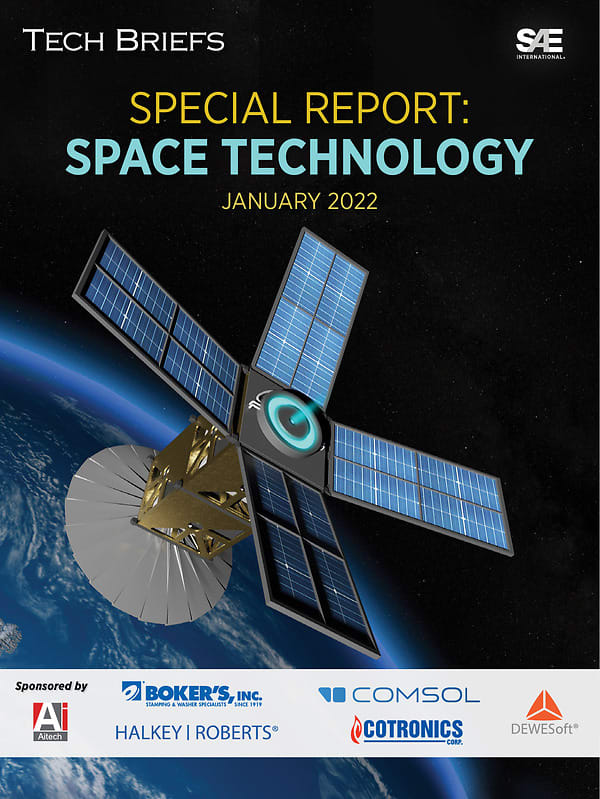
Read about the most powerful telescope ever launched into space, the NASA rocket that will carry humans back to the moon, the nanosatellites that are dramatically reducing the cost of space science, and much more in this compendium of recent articles from the editors of Tech Briefs and Aerospace & Defense Technology magazines.
Don't have an account?
Overview
The "SPACE TECHNOLOGY SPECIAL REPORT" from January 2022 provides an in-depth look at various advancements and missions in space technology, focusing on the James Webb Space Telescope, the Artemis program, and CubeSat technology.
The report begins with an overview of the James Webb Space Telescope, which is designed to observe the universe in infrared, allowing scientists to look back in time and study the formation of stars and galaxies. This telescope represents a significant leap in our ability to explore the cosmos, promising to enhance our understanding of the universe's origins and evolution.
The Artemis program is another focal point, particularly Artemis III, which aims to return humans to the Moon. This mission will involve astronauts wearing the new Exploration Extravehicular Mobility Unit (xEMU) spacesuits, specifically designed for the harsh conditions of the lunar South Pole. The report highlights the importance of developing new technologies to ensure the safety and productivity of astronauts during extravehicular activities (EVAs). Innovations such as the integrated Information Technologies and Informatics Subsystem (IT IS) will allow astronauts to monitor their health and the status of their EVA systems through a display in their helmets, enhancing their operational efficiency.
CubeSat technology is also extensively covered, emphasizing its role in modern space missions. CubeSats are small, lightweight satellites that have become increasingly popular due to their cost-effectiveness and versatility. Initially used for low Earth orbit applications like remote sensing and communications, CubeSats are now being deployed in interplanetary missions. The report discusses the challenges faced by CubeSats, including power consumption optimization and the effects of extreme temperatures and radiation in space, which can impact the lifespan and functionality of their components.
The report also touches on the significance of lunar resources, such as water, which could be crucial for future human exploration of the Moon, Mars, and beyond. The potential for utilizing these resources is seen as a game-changer for sustaining long-term human presence in space.
In addition to these main topics, the report includes application briefs on various technologies, such as compact and robust connectors for CubeSat deployment, solar-powered satellite hardware, ultraviolet detectors, and radiation-hardened integrated circuits (ICs). These innovations are pivotal in enhancing the reliability and efficiency of space missions.
Overall, the "SPACE TECHNOLOGY SPECIAL REPORT" provides a comprehensive overview of the current state of space technology, highlighting the exciting developments that are paving the way for future exploration. It underscores the importance of innovation in ensuring the success of missions aimed at expanding our understanding of the universe and establishing a human presence beyond Earth.