Aerospace Manufacturing - May 2022
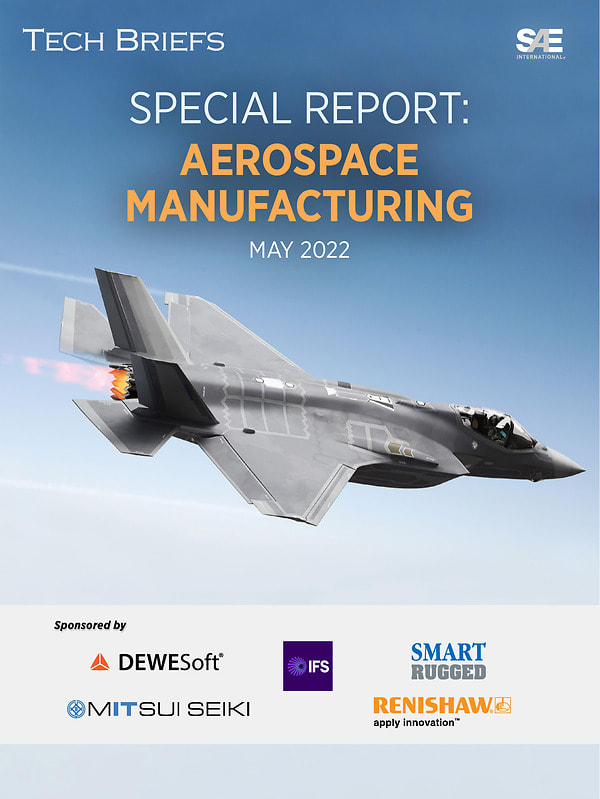
Demanding applications in the aerospace industry require products and systems that are manufactured using advanced technologies – in additive manufacturing, machining, metrology, and more. To help you keep pace with the latest developments, we present this compendium of articles from the editors of Tech Briefs and Aerospace & Defense Technology.
Don't have an account?
Overview
The Aerospace Manufacturing Special Report from May 2022 delves into the latest advancements and methodologies in the aerospace and defense manufacturing sectors, highlighting the critical role of technology in enhancing production efficiency and quality assurance.
One of the key features of the report is the focus on the F-35 Lightning II, an advanced stealth combat aircraft designed for various warfare missions. The report emphasizes the importance of precision in the aircraft's construction, particularly due to its composite materials, which make up 35% of its airframe weight. The materials used, such as bismaleimide and carbon nanotube-reinforced epoxy, offer exceptional strength but require meticulous inspection to ensure that any deviations do not compromise the aircraft's stealth capabilities or safety at supersonic speeds. Currently, inspections are performed manually at Lockheed Martin’s facility in Fort Worth, Texas, which introduces variables and risks for workers. The report advocates for a transition to digital inspection methods to enhance accuracy, speed, and safety in the quality assurance process.
The report also discusses the challenges of scaling up digital measurement technologies to inspect large assemblies like aircraft and ships while maintaining tight tolerances. It highlights the historical reliance on human inspectors in aviation, noting that a significant portion of costs is associated with inspection processes that still require human involvement. This underscores the need for innovative solutions to streamline quality assurance in aerospace manufacturing.
In addition to metrology advancements, the report covers new fabrication methodologies for electronic components. One notable innovation is the development of a thin, double-sided circuitry board that minimizes crosstalk between sensors and reduces transmission line losses. This method utilizes a minimalistic silicon wafer, allowing for efficient use of space and materials while enhancing performance.
The report also touches on various other topics relevant to aerospace manufacturing, including directed energy deposition for additive manufacturing, low distortion titanium in laser powder bed fusion systems, and techniques for machining beryllium. These advancements reflect the industry's ongoing efforts to adopt cutting-edge technologies that improve manufacturing processes and product performance.
Overall, the Aerospace Manufacturing Special Report provides a comprehensive overview of the current state of the aerospace industry, emphasizing the importance of innovation in manufacturing practices. It highlights the need for a shift towards digital solutions and advanced materials to meet the demands of modern aerospace applications while ensuring safety and efficiency. The insights presented in this report are crucial for industry stakeholders looking to navigate the complexities of aerospace manufacturing in an increasingly competitive landscape.