

Special Report: Optics & Photonics Innovations - July 2022
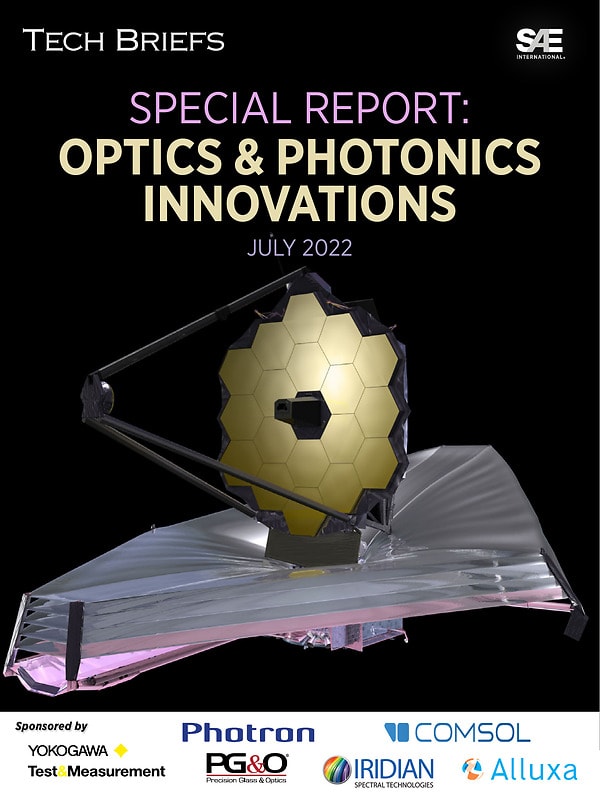
The most powerful telescope ever launched, NASA's James Webb Space Telescope will peer back in time to the birth of the universe's first stars. Learn about its highly advanced optics and other photonics innovations in this report from the editors of Tech Briefs and Photonics & Imaging Technology magazines.
Don't have an account?
Overview
The July 2022 Special Report on Optics & Photonics Innovations highlights significant advancements in optical technologies, focusing on the James Webb Space Telescope (JWST) and other cutting-edge developments in the field.
The JWST, an international collaboration involving NASA, the Canadian Space Agency, and the European Space Agency, is designed to enhance our understanding of the universe by capturing infrared light. Unlike its predecessor, the Hubble Space Telescope, which operates in the optical spectrum, the JWST is specifically engineered to observe the infrared wavelengths that are crucial for studying distant celestial objects. As light from these objects travels through the expanding universe, it shifts to longer wavelengths, making infrared detection essential for observing the earliest stars and galaxies.
The report details the JWST's capabilities, including its advanced instruments like the Near Infrared Spectrograph (NIRSpec) and the Mid-Infrared Instrument (MIRI). NIRSpec can analyze light from multiple objects simultaneously, thanks to its programmable slit masks and micro shutters, while MIRI operates as both a camera and spectrograph, capturing light in a broader infrared range. These instruments are pivotal for conducting high-resolution spectroscopy, which will allow scientists to investigate the composition and formation of celestial bodies.
In addition to the JWST, the report discusses innovations in optical technologies, such as the development of Smartlenses. These lenses can rapidly heat and cool, enabling them to focus on multiple objects at varying distances within the same image. This technology utilizes advanced algorithms and specially engineered resistors to manipulate light with high precision, potentially correcting optical aberrations and enhancing vision correction methods.
Another notable advancement is the creation of a compact device capable of electronically steering and focusing terahertz electromagnetic energy. This device, which is significantly smaller than traditional radar systems, opens new possibilities for high-resolution imaging and communication technologies. Terahertz waves can penetrate certain materials without the harmful effects associated with X-rays, making them valuable for applications in various fields, including security and medical imaging.
The report also touches on the historical context of infrared astronomy, referencing the Infrared Astronomical Satellite (IRAS), which was the first space-based infrared telescope launched in 1983. The success of IRAS paved the way for subsequent missions, including the Spitzer Space Telescope, further establishing the importance of infrared technology in astronomical research.
Overall, the Special Report emphasizes the transformative impact of optics and photonics innovations on our understanding of the universe. The JWST and other emerging technologies are set to revolutionize how we observe and interpret cosmic phenomena, providing deeper insights into the origins and evolution of the universe. As these advancements continue to unfold, they promise to enhance our knowledge and appreciation of the cosmos, showcasing the power of human ingenuity in the pursuit of scientific discovery.











