

ADAS/Connected Car - December 2022
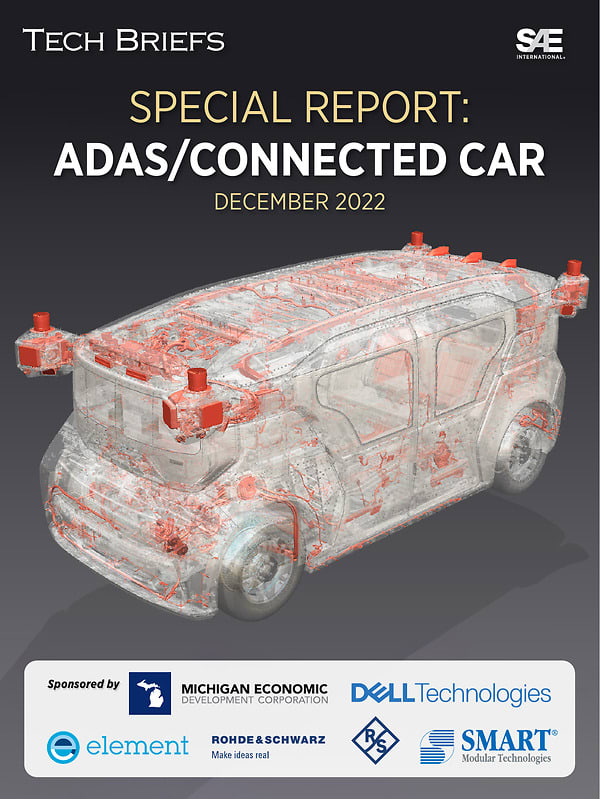
In this compendium of articles from the editors of Automotive Engineering and Autonomous Vehicle Engineering magazines, see how advances in artificial intelligence, quantum computing, lidar and radar, and other critical technologies are driving the evolution of ADAS and autonomous systems.
Don't have an account?
Overview
The ADAS/Connected Car Special Report, published in December 2022, addresses critical advancements in automotive technology, particularly focusing on Advanced Driver Assistance Systems (ADAS) and the future of connected vehicles. The report highlights the pressing issue of roadway safety, noting that over 1.3 million people die on the world’s roads each year, with an additional 50 million suffering injuries. Despite improvements in safety measures, the report emphasizes the ongoing challenges that all countries face in reducing these alarming statistics.
A key objective outlined in the report is the Vision Zero initiative, which aims to eliminate preventable roadway deaths. To achieve this ambitious goal, the report discusses the necessity for vehicles to possess advanced sensing capabilities. Specifically, it posits that vehicles must be able to sense and process environmental information a billion times faster than humans to effectively prevent accidents under the worst conditions. This requirement underscores the importance of developing sophisticated sensors and processing technologies that can enhance vehicle awareness and decision-making.
The report also explores the broader implications of enhanced vehicle accessibility. It discusses how advancements in automotive technology are transforming the way people travel, work, and utilize their time. With improved accessibility, individuals can enjoy greater flexibility in their mobility, allowing them to live and work in locations that may not have been feasible before. This shift is particularly significant as it enables people to engage in activities without the constraints of traditional commuting or urban living.
Furthermore, the report touches on the role of mobile technology in the context of connected cars. It suggests that the integration of mobile devices with vehicle systems can enhance the overall driving experience, providing drivers and passengers with entertainment and connectivity options that were previously unavailable. This integration is part of a larger trend toward creating a seamless interaction between vehicles and the digital world.
The authors, Lawrence Burns, Babek Hassibi, and Behrooz Rezvani, draw on their extensive experience in the automotive industry to provide insights into the future of vehicle technology. They emphasize the need for collaboration among various stakeholders, including automotive manufacturers, technology companies, and policymakers, to foster innovation and ensure the successful implementation of these advanced systems.
In conclusion, the ADAS/Connected Car Special Report serves as a comprehensive overview of the current state and future potential of automotive technology. It highlights the critical need for improved sensing capabilities to enhance roadway safety and reduce fatalities. Additionally, it underscores the transformative impact of these technologies on accessibility and mobility, paving the way for a future where individuals can travel more freely and safely. The report ultimately advocates for a concerted effort to achieve the Vision Zero goal, aiming for a world with zero preventable roadway deaths.










