

Test & Measurement - February 2023
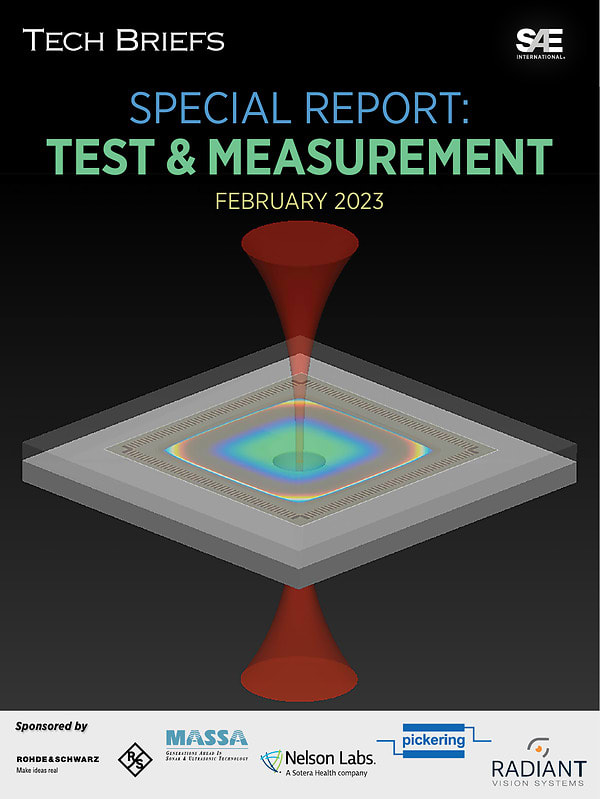
From the racetrack to the battlefield to deep space missions, test innovations are improving device and system reliability while speeding time to market. Read about the latest advances – including the laser-based accelerometer for self-driving cars pictured on the cover – in this compendium of recent articles from the editors of Tech Briefs, Aerospace & Defense Technology, and Medical Design Briefs magazines.
Don't have an account?
Overview
The February 2023 Special Report on Test & Measurement offers a comprehensive overview of the latest advancements and challenges in the field, particularly focusing on semiconductor manufacturing and innovative measurement technologies.
One of the key highlights is the increasing demand for speed in chip production. As semiconductor buyers have more options than ever, manufacturers are under pressure to reduce product development and delivery times from years to just a few months. This rapid pace of innovation is driven by the need for more complex chips that integrate multiple features into a single silicon package. However, this complexity introduces significant challenges in development, testing, and manufacturing processes. Companies that fail to streamline their data and testing strategies risk delays and potential redesigns, which could ultimately lead to losing market share to more efficient competitors.
The report emphasizes the importance of solid data and testing strategies in managing these complexities. Effective strategies can significantly accelerate the time it takes to bring complex chips to market, while inadequate approaches can result in costly setbacks. The evolving landscape of semiconductor manufacturing necessitates a focus on both speed and quality, as buyers increasingly expect faster turnaround times alongside high-performance products.
In addition to semiconductor advancements, the report features a groundbreaking development in optical spectrometry. Researchers from Oregon State University and Aalto University have created a compact, ultra-tiny spectrometer that operates on a microchip and utilizes artificial intelligence. This innovation could revolutionize various applications, including smartphone cameras, environmental monitoring, quality inspection platforms, security sensors, biomedical analyzers, and space telescopes. Unlike traditional spectrometers, which require bulky components, this new device can fit on the end of a human hair, making it a versatile tool for a wide range of technologies.
The report also includes application briefs and tech briefs that delve into specific technologies and methodologies. For instance, it discusses the workings of a UV-Visible-NIR range microscope-spectrometer, the role of measurement technology in vehicle development, and advancements in laser-light-based accelerometers and RFID-enabled wireless instrumentation. These sections provide insights into how measurement technologies are driving innovation across various sectors.
Overall, the Special Report serves as a valuable resource for professionals in the test and measurement industry, offering insights into current trends, challenges, and technological advancements. It underscores the critical need for speed and efficiency in semiconductor manufacturing while showcasing innovative solutions that could shape the future of measurement technologies. As the industry continues to evolve, staying informed about these developments will be essential for companies looking to maintain a competitive edge.









