Optics & Photonics Innovations - April 2023
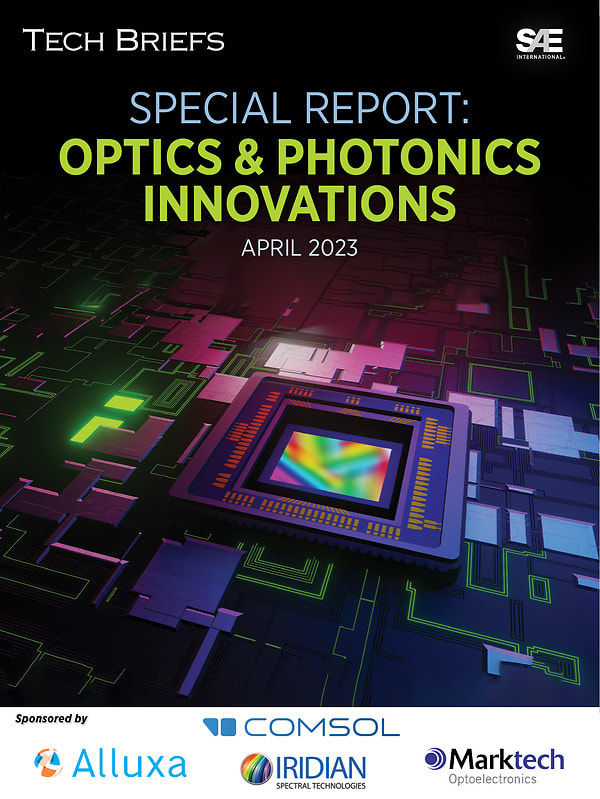
Demand for satellite communications bandwidth is quickly outstripping supply. The solution: optical, laser-based technologies. Read all about it – and other major photonics advances – in this compendium of recent articles from the editors of Tech Briefs and Photonics & Imaging Technology.
Don't have an account?
Overview
The "Optics & Photonics Innovations Special Report" from April 2023 presents a comprehensive overview of the latest advancements in optical technologies, emphasizing their applications across various fields, including healthcare, telecommunications, and space exploration.
One of the standout innovations discussed is the development of non-invasive blood glucose monitoring technology by DiaMonTech AG. This breakthrough utilizes an infrared quantum cascade laser to measure blood glucose levels without the need for skin penetration, offering a significant improvement in comfort for the over 400 million people worldwide living with diabetes. Currently available as a desktop device, a more portable smartphone-sized version is anticipated soon, which could revolutionize diabetes management.
The report also addresses the challenges faced by the European Space Agency (ESA) in optical communication. As demand for high-bandwidth data transfers increases, traditional radio frequency (RF) communication methods are becoming insufficient, particularly in adverse weather conditions. The ESA is exploring optical communication technologies to enhance data transmission capabilities between satellites and Earth, which could lead to more reliable and efficient communication systems.
In the realm of imaging and optics, the report highlights advancements in optical modules that integrate the latest innovations in imaging technology. These modules feature proprietary image sensors mounted on boards with fixed lenses and optional multi-focus lens technology, providing versatile imaging solutions for various applications.
Additionally, the report covers the use of laser transceivers for low Earth orbit (LEO) satellite links, which are crucial for improving global internet connectivity. These transceivers leverage laser technology to facilitate high-speed data transmission between satellites, enhancing the overall performance of satellite communication networks.
The application briefs section introduces compact MEMS-based near-infrared (NIR) spectroscopy for mobile applications, showcasing how miniaturized spectroscopic devices can be utilized in various fields, including environmental monitoring and food safety. This technology allows for rapid and accurate analysis of materials in a portable format.
Technical briefs delve into cutting-edge research, including methods to overcome optical resolution limits and the development of highly sensitive, mass-producible organic photodetectors. These advancements are pivotal for enhancing the performance of optical systems and expanding their applications in areas such as imaging and sensing.
The report also discusses innovative designs like the "dual light-pipe" architecture, which improves light guidance to photodiodes through micro-optical fibers, minimizing light loss and enhancing sensor performance. This technology is crucial for the development of next-generation optical sensors.
Overall, the "Optics & Photonics Innovations Special Report" encapsulates the dynamic landscape of optical technologies, highlighting their potential to transform industries and improve quality of life. From healthcare solutions to advancements in satellite communication, the report underscores the importance of continued innovation in optics and photonics to meet the growing demands of modern society.