Camera & Imaging Innovations - August 2023
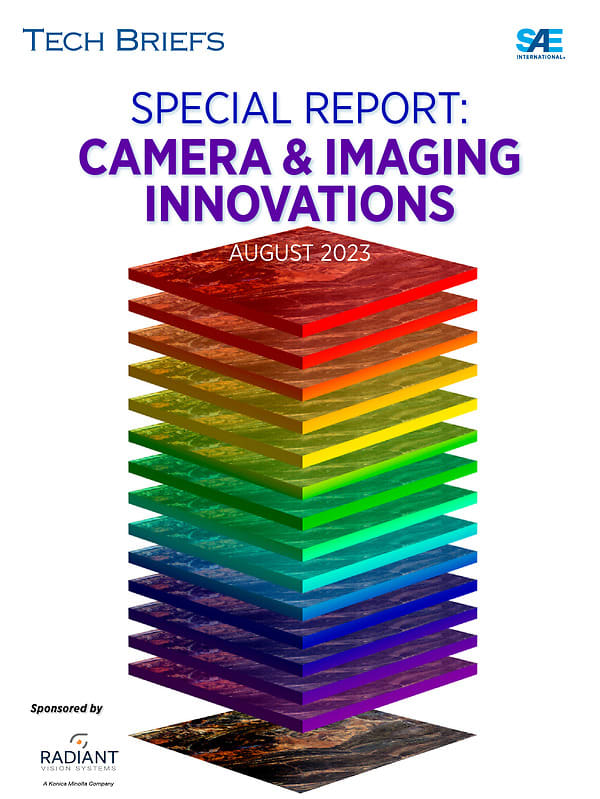
Read about the latest breakthroughs in AI-based machine vision, hyperspectral imaging, x-ray tomography, high-speed cameras, and more in this compilation of recent articles from the editors of Tech Briefs and Photonics & Imaging Technology.
Don't have an account?
Overview
The "Camera & Imaging Innovations Special Report" from August 2023 presents a comprehensive overview of the latest advancements in imaging technology, focusing on various applications and innovations that are shaping the industry. The report is structured into several key sections, including features, application briefs, and tech briefs, each highlighting significant developments in the field.
One of the primary features discussed is the evolution of machine vision, which is increasingly going beyond traditional human programming. This advancement allows for more sophisticated quality inspections and automation in various industries, enhancing efficiency and accuracy in product evaluation. The report emphasizes the importance of visual quality in physical products, noting that consumers expect flawless appearances in items ranging from automobiles to electronics.
Another significant topic covered is hyperspectral imaging, which enables the capture of images across multiple wavelengths of light. This technology is particularly valuable in space-based applications, where it can provide detailed insights into the Earth's surface and atmosphere. The report highlights how hyperspectral sensors are unlocking new advancements in digital camera imagery, allowing for better monitoring of environmental conditions and resource management.
The report also delves into time-of-flight (ToF) imaging, which offers highly reliable 3D imaging capabilities for challenging applications. This technology is crucial for various sectors, including robotics and autonomous vehicles, where accurate depth perception is essential for navigation and interaction with the environment.
In the application briefs section, the report discusses the concept of remote sensing, which has been a cornerstone of space exploration since the launch of Explorer 6 in 1959. Remote sensing technologies have evolved significantly, leading to the development of dedicated weather satellites and the Landsat series. Today, electro-optical imagery is widely available, providing valuable information for weather forecasting, land-use monitoring, agricultural health assessments, and disaster management.
The tech briefs section introduces several innovative imaging technologies, including a new "metalens" that can shift focus without the need for tilting or moving, greatly enhancing the versatility of optical systems. Additionally, advancements in X-ray nanotomography are highlighted, showcasing a new method developed by Argonne National Laboratory that significantly improves resolution, allowing for more detailed imaging at the nanoscale.
The report also addresses the importance of reflection-reducing imaging systems for machine vision applications, which can enhance the clarity and accuracy of images captured in various environments. Furthermore, a high-speed camera capable of capturing signals traveling through nerve cells is discussed, illustrating the potential of imaging technology in biomedical research.
Overall, the "Camera & Imaging Innovations Special Report" provides a thorough exploration of the current state and future directions of imaging technologies. It underscores the critical role these innovations play in enhancing product quality, advancing scientific research, and improving our understanding of the world around us. As imaging technology continues to evolve, it promises to unlock new possibilities across multiple industries, driving progress and innovation.