

Aerospace Manufacturing - October 2023
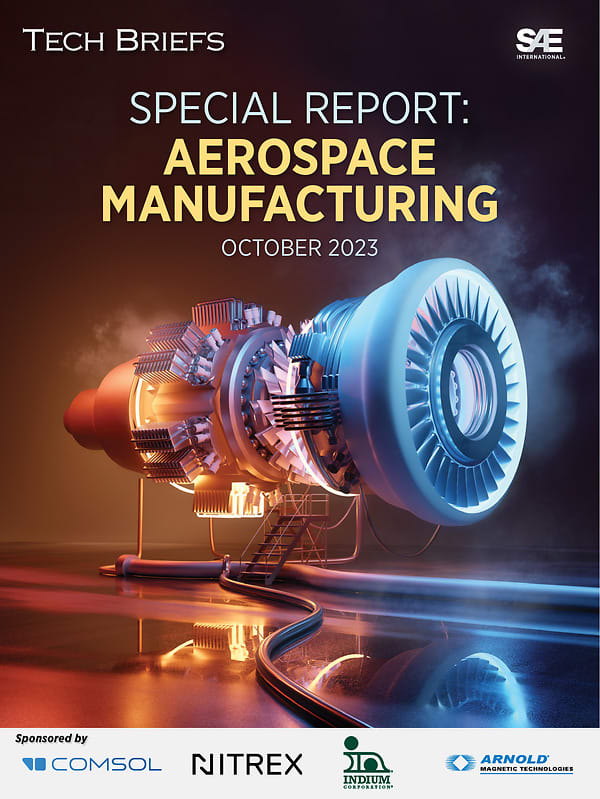
Discover how a unique surface coating technology is enabling lightweighting of aerospace designs, how 3D printing of metal alloys is answering a critical need in the turbomachinery industry, how mil/aero OEMs are leveraging digital twins to streamline manufacturing operations, and much more in this compendium of recent articles from the editors of Tech Briefs and Aerospace & Defense Technology magazines.
Don't have an account?
Overview
The October 2023 Aerospace Manufacturing Special Report delves into the current trends and challenges facing the aerospace industry, particularly in the context of increasing demand for air travel and new aircraft production. As the industry rebounds to pre-pandemic production levels, manufacturers are confronted with significant hurdles, including a skills gap due to workforce changes and supply chain shortages affecting material availability.
One of the key features of this report is the exploration of how the turbomachinery industry is embracing additive manufacturing. This technology is revolutionizing component design and production, allowing for more complex geometries and lightweight structures that enhance performance and efficiency. The report highlights the potential of additive manufacturing to streamline production processes and reduce lead times, which is crucial in meeting the rising demand for aircraft.
Another significant topic covered is robotic rotational molding, which is creating new opportunities for military and aerospace applications. This innovative manufacturing technique allows for the production of lightweight and durable components, essential for modern aerospace requirements.
The report also discusses Plasma Electrolytic Oxidation (PEO), a surface coating technology that offers a promising solution for lightweighting components exposed to extreme environments. PEO enhances the durability and performance of aerospace components, addressing the challenges posed by harsh operational conditions.
Machining productivity challenges are a central theme, as aerospace component manufacturers strive to produce complex parts efficiently. The report emphasizes the importance of using optimized cutting tools and techniques tailored for specific materials, such as titanium and high-temperature resistant superalloys (HRSAs). It suggests that employing specialized tools and high-pressure coolant systems can significantly improve machining performance, tool life, and surface finish.
Additionally, the report addresses the critical issue of workforce shortages in the aerospace sector. Many skilled workers transitioned to other industries during the pandemic, and early retirements have exacerbated the skills gap. This shortage poses a risk to production timelines and quality, making it imperative for manufacturers to invest in training and development to cultivate a new generation of skilled workers.
The report also highlights the importance of leveraging virtual twins in manufacturing processes. This technology allows for real-time simulations and optimizations, enabling manufacturers to enhance their operational efficiency and reduce risks associated with production.
In summary, the October 2023 Aerospace Manufacturing Special Report provides a comprehensive overview of the current landscape in the aerospace industry, focusing on the integration of advanced manufacturing technologies, the challenges of workforce shortages, and the need for innovative solutions to meet the growing demand for aircraft. By embracing these advancements, aerospace manufacturers can improve productivity, reduce costs, and ensure the delivery of high-quality components in a competitive market.










