

ADAS/Connected Car - December 2023
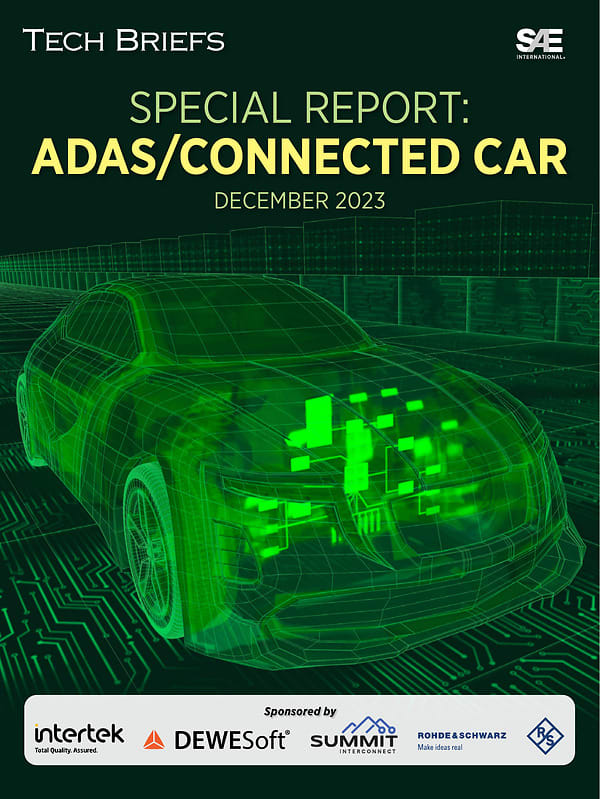
In this compendium of popular articles from the editors of Automotive Engineering and ADAS & Autonomous Vehicle Engineering magazines, see how advances in simulation, testing, lidar/sensors, displays, and other critical technologies are driving the evolution of automated systems.
Don't have an account?
Overview
The ADAS/Connected Car Special Report for December 2023 explores the significant transformations occurring in the automotive industry, primarily driven by advancements in software and connectivity. As vehicles become increasingly software-defined, the report highlights the implications for vehicle functionality, user experience, and data privacy.
One of the central themes is the shift in how vehicles operate. Traditionally, vehicle owners had direct access to their cars' functions and could make modifications as needed. However, modern vehicles integrate complex computer systems that require comprehensive updates to alter any part of their operation. This shift raises concerns about user autonomy and compliance with various regulations, particularly in light of potential violations of U.S. state laws and the General Data Protection Regulation (GDPR) in Europe.
The report emphasizes the growing importance of data privacy in the context of connected vehicles. With the ability to collect vast amounts of data about vehicle occupants, including preferences and behaviors, the automotive industry faces scrutiny from regulators and privacy advocates. Experts warn that the current pace of data collection and sharing—often with third parties such as data brokers and law enforcement—could lead to significant privacy breaches. The report cites John Gilmore, head of research at DeleteMe, who notes that many automakers may be in violation of privacy laws and that consumers often struggle to navigate the multitude of privacy policies presented by different brands.
In addition to privacy concerns, the report discusses the technological advancements in Advanced Driver-Assistance Systems (ADAS). It highlights the use of simulation technologies, such as ray-tracing software, which allows manufacturers to train ADAS systems in a virtual environment. This approach is becoming increasingly popular among major automotive manufacturers, enabling them to enhance safety and functionality while optimizing testing processes.
The report also touches on the evolution of sensor technologies, particularly the development of 4D imaging systems that promise to improve detection ranges and resolution in ADAS applications. These advancements are crucial for enhancing the performance of driver-assistance features and moving towards greater vehicle autonomy.
Furthermore, the report addresses the balance that vehicle owners are willing to strike between data security and the convenience offered by connected features. Many consumers are prepared to share personal data in exchange for enhanced safety and convenience, which complicates the landscape of data privacy and security.
In conclusion, the ADAS/Connected Car Special Report underscores the critical need for the automotive industry to adapt to the challenges posed by software integration and data privacy. As vehicles become more interconnected and reliant on sophisticated software systems, manufacturers must navigate regulatory landscapes, consumer expectations, and technological advancements to ensure a secure and user-friendly driving experience. The report serves as a call to action for stakeholders in the automotive sector to prioritize privacy and security while embracing innovation in vehicle technology.











