Optics & Photonics Innovations - April 2024
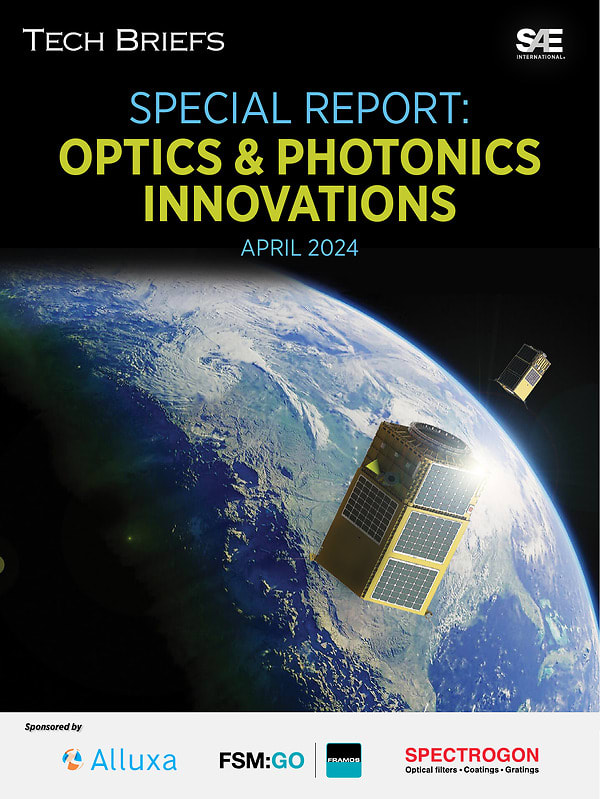
How to turn a mobile phone into a high–resolution microscope…hyperspectral imaging technology spots pipeline leaks from space…a MEMS solution to self–driving cars' LiDAR challenges. Read about these advances and more in this compilation of articles from the editors of Tech Briefs and Photonics & Imaging Technology magazines.
Don't have an account?
Overview
The April 2024 Special Report on "Optics & Photonics Innovations" presents a comprehensive overview of recent advancements in the field, highlighting significant developments that promise to enhance various applications, from environmental monitoring to space exploration.
One of the standout innovations discussed is the creation of the world’s smallest LED and a holographic microscope by researchers at the Singapore-MIT Alliance for Research and Technology (SMART). This breakthrough allows existing mobile phone cameras to be transformed into high-resolution microscopes, utilizing semiconductor nanocrystals known as quantum dots. These devices can achieve a vast spectral range and offer limitless color options, making them highly versatile for spectral sensing applications across consumer, industrial, and medical sectors. The researchers demonstrated that by using an array with multiple colors, they could achieve better spectral resolution, which is crucial for precise spectral measurements.
The report also covers advancements in hyperspectral imaging technology, particularly through the efforts of Corning and the Silicon Valley startup Orbital Sidekick (OSK). OSK's Global Hyperspectral Observation Satellite (GHOSt) constellation, launched in 2023, is equipped with advanced sensors capable of detecting unique spectral signatures from greenhouse gas pollutants. This technology is vital for early detection of environmental threats, especially in the oil and gas industry, where monitoring pipeline leaks can significantly mitigate risks associated with greenhouse gas emissions.
Additionally, the report addresses the challenges faced by photonic integrated circuit (PIC) designers and engineers in transitioning from research and development to high-volume manufacturing. The work at AIM Photonics aims to streamline this process, enabling the production of smaller, faster, and more efficient devices that leverage integrated photonics technologies.
The report also features a section on a MEMS scanning mirror that could potentially resolve the high costs associated with LiDAR technology in autonomous vehicles. This innovation is crucial for enhancing the capabilities of self-driving cars, making them more efficient and cost-effective.
Another notable contribution is from Pratt & Whitney and Virginia Tech, who are pioneering a laser-optical approach for measuring thrust in turbofan engines. This method promises to improve the accuracy and efficiency of thrust measurements, which are critical for aerospace applications.
In summary, the April 2024 Special Report on "Optics & Photonics Innovations" encapsulates a range of cutting-edge technologies and research efforts that are shaping the future of optics and photonics. From enhancing environmental monitoring capabilities to advancing space exploration and improving automotive technologies, these innovations reflect the ongoing commitment to leveraging optics and photonics to address pressing global challenges. The report serves as a testament to the dynamic nature of the field and its potential to drive significant advancements across various sectors.