

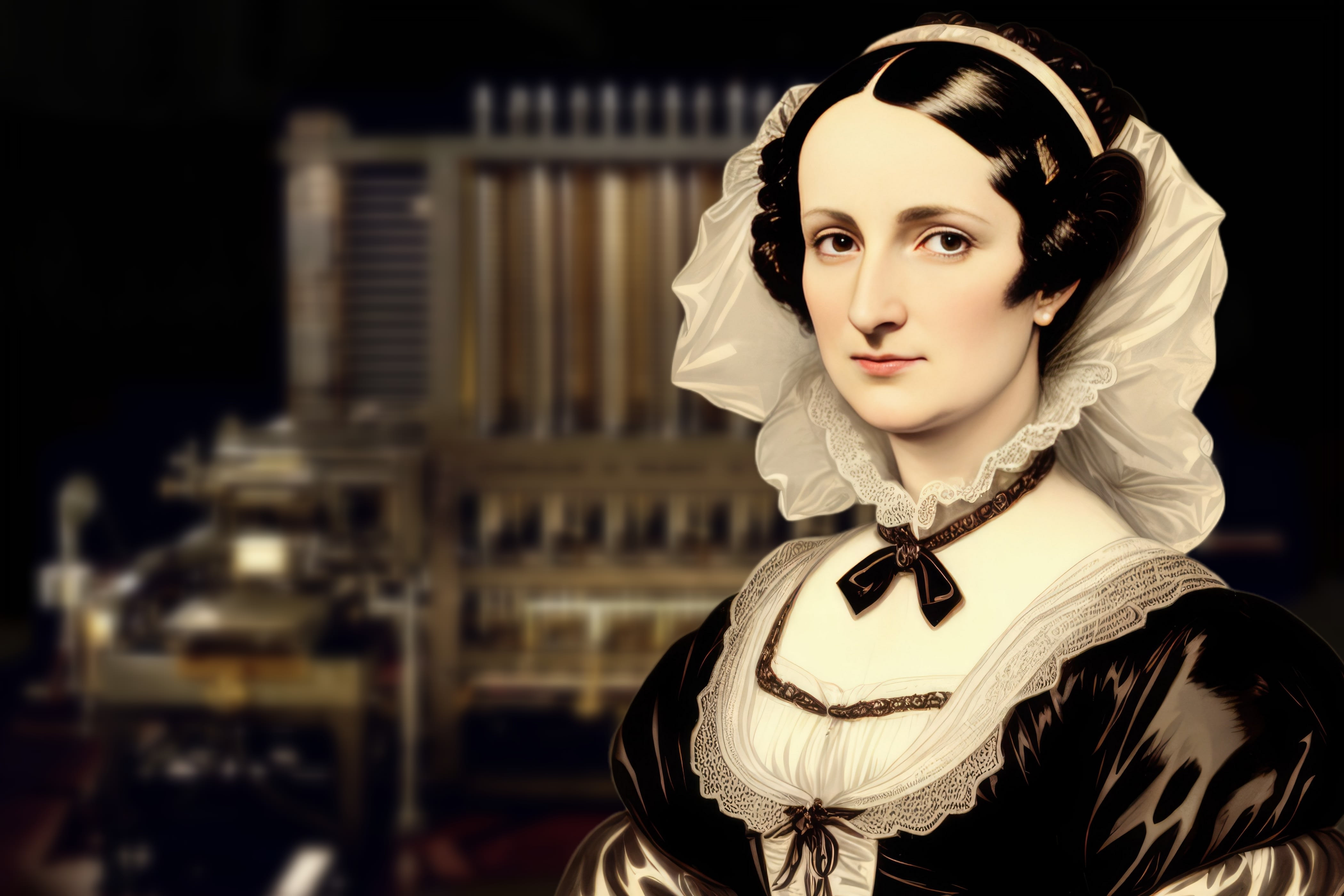
In the Tech Briefs August Q&A, I referred to the Grace Hopper supercomputer. I thought it was great that a supercomputer was named after Rear Admiral Hopper, but when I mentioned it to a number of people, they all said they never heard of her. That surprised me, for not only had she been a Rear Admiral in the U.S. Navy, but she was a pioneer in the development of modern computer programming.
I have therefore decided to nominate her for a Tech Briefs Rising Star Award for Women in Engineering, even though she died in 1992 at the age of 86.
But I have several other posthumous nominations of women who were pioneers in the development of modern computers. My first is Ada Lovelace, who died in 1852 at the age of 36.
Lovelace, a trained mathematician and daughter of the poet Lord Byron, learned of a mechanized digital computer — “Analytical Engine” — that had been devised by Charles Babbage to perform mathematical calculations and joined him to help explain and publicize his work. Over the course of their collaboration, she published a series of “notes” in 1834, suggesting how a machine could do far more than just a single type of calculation. She proposed “a general-purpose machine, one that could not only perform a preset task but could be programmed and reprogrammed to do a limitless and changeable array of tasks. In other words, she envisioned the modern computer… She proposed that the machine could be like the type of computer we now take for granted: one that does not merely do a specific arithmetic task but can be a general-purpose machine.”1
Perhaps her most significant contribution was the idea that these machines could perform operations for manipulating relationships among logically related symbols, not just manipulation of numbers. She also published a method for writing programs, including subroutines, to do logical computations.
Fundamental to modern computing, Lovelace proposed that there was a distinction between the “mechanical aspect” of a computing machine and the “analytic view” — in other words, the difference between hardware and software.
It wasn’t until more than 100 years later, in 1936, that the next major conceptual advance was achieved when Alan Turing published “On Computable Numbers,” in which he described a universal computer that could solve anything that is solvable.
Grace Hopper
Much of the following is from an oral history .
Grace Hopper received her Ph.D. in mathematics from Yale University in 1934. She joined the U.S. Naval Reserve during World War II and was assigned to code the world’s first successful program-controlled computer, the Mark I — a 55-foot-long electromechanical machine. As part of this project, she wrote the world’s first computing manual, a 500-page book.
In 1946, she joined the Harvard faculty as a research fellow in Engineering Sciences and Applied Physics at the Computation Laboratory to continue work on the Mark II (a paper-tape sequenced calculator) and Mark III (an electronic computer with magnetic drum storage).
In 1949, she joined the Eckert-Mauchly Computer Corporation, which later became Sperry Rand, to help design and program UNIVAC I, the first commercial electronic computer.
In 1952, Hopper developed the first compiler for computers. As Director of Automatic Programming Development for the Univac division of Sperry Rand, her work subsequently led her and her staff to create an English-language compiler known as Flow-Matic, a precursor to COBOL. In 1959, she and a group of colleagues began to push for a common language for business applications and, hence, greater compatibility among vendor systems. They organized CODASYL, the Conference on Data Systems Languages, which created COBOL and advanced its development over the years. It is still in use today, primarily by the business community.
Grace Hopper: “[I started to work on the] Mark I, second of July 1944. There was no such thing as a programmer at that point. We had a code book for the machine and that was all. It listed the codes and what they did, and we had to work out all the beginning of programming.
We stayed there through the building of Mark II and Mark III. What was carried over from Mark I was that, after a while, each of us began to build a notebook, what turned out to be subroutines. We didn’t know what they were — we called them programs. If I needed a sine routine, I’d call over a colleague and say, ‘Can I copy your sine routine?’ We’d copy pieces of coding.”
A Brief History
An excerpt from a Yale University biography provides a glimpse of her significance:
“Nicknamed ‘Amazing Grace’ by her subordinates, Hopper remained on active duty for 19 years. She retired from the Navy as a rear admiral at the age of 79 — the oldest serving officer in the U.S. armed forces.
“She was the recipient of more than 40 honorary degrees, and many scholarships, professorships, awards, and conferences are named in her honor. In 1991, President George Bush awarded Hopper the National Medal of Technology.”
She also loved to teach about computers, which she did at the University of Pennsylvania and George Washington University. She organized myriad workshops and conferences to promote the understanding of computers and programming.

“Hopper was not only a brilliant mathematician and computer scientist, she was also a gifted teacher and communicator. In 1959, Hopper was a visiting and then adjunct lecturer at the Moore School of Electrical Engineering at the University of Pennsylvania. In the 1960s and 1970s, she taught and lectured at Penn, George Washington University, and for the U.S. Naval Reserve.
“Outside of academia, she also organized myriad workshops and conferences to promote the understanding of computers and programming. In her remarks upon accepting the National Medal of Technology, Hopper said, ‘If you ask me what accomplishment I’m most proud of, the answer would be all the young people I’ve trained over the years; that’s more important than writing the first compiler.’”
The Women of ENIAC
At the start of World War II, the government created a project at the University of Pennsylvania to calculate firing-angle settings for artillery. This required an immense amount of work, which was done by a team of “more than 170 people, mostly women, known as ‘computers,’ who tackled equations by punching the keys and cranking the handles of desktop adding machines. Women math majors were recruited from around the nation for that job. But even with all of this effort, it took more than a month to complete just one firing table.”2
As a result, to speed up these calculations, a project was undertaken to create the world’s first electronic computer, based on vacuum tubes instead of mechanical relays, ultimately named the Electronic Numerical Integrator and Computer (ENIAC). It wasn’t finally completed until 1945. In that year, a group of six woman mathematicians were given the task of figuring out how to program ENIAC using patch cables. They ultimately developed deep knowledge of its inner workings. They started recording how the cables were configured for each operation, essentially the first use of what would become known as computer programming. They realized that ENIAC could be used to solve many problems beyond just computing artillery trajectories, and it ultimately became the first general purpose electronic computer. As part of their work, they independently developed the idea of creating standardized subroutines, at the same time Hopper was doing that at Harvard, and as Lovelace had proposed 100 years earlier.
Software vs. Hardware
Through all of the earlier stages of computer development, the emphasis was on building hardware, work that was entirely done by men. The designers of the hardware initially thought that programing was only a secondary task, so they left that task to women. It was women, therefore, who developed what was to become known as software. Ironically, today, the hardware is there only to implement the software, which is what modern computing is all about.
1 Isaacson, Walter. The Innovators: How a Group of Hackers, Geniuses, and Geeks Created the Digital Revolution.
2 Isaacson, p. 72.











