

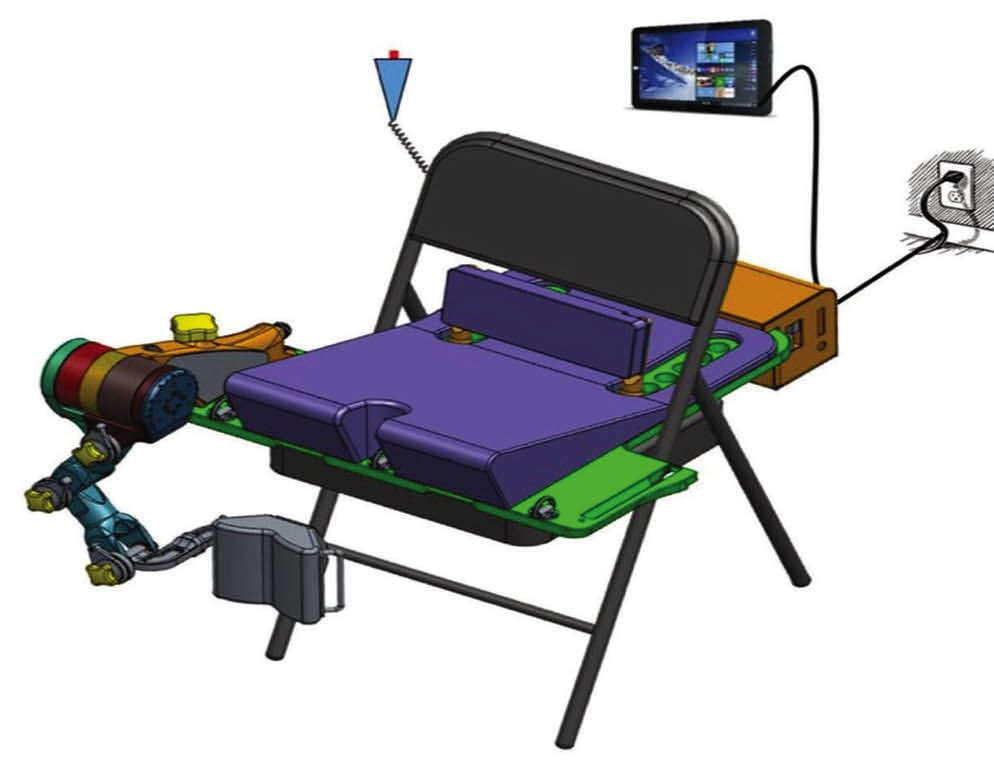
Researchers at NASA Johnson Space Center have developed the Portable Knee Dynamometer, a device that enables quadricep and hamstring strength assessment, rehabilitation, and exercise capabilities for a user outside of a traditional clinical setting. Clinical orthopedic dynamometers for high-strength muscle groups tend to be large, heavy, and typically not readily transportable. NASA’s novel device can be easily carried to a patient who may be homebound or otherwise unable to travel to a clinic due to surgery, injury, or pathology.
The Portable Knee Dynamometer device allows for, or initiates, knee flexion/extension through its actuator. The actuator comprises a brushless DC motor, a motor encoder, a strain-wave gear transmission (80:1 reduction), and a torque sensor mounted to a rigid torque shaft. Internal mechanical static hard-stops prevent the user from exceeding a safe range of motion. The embedded firmware system contains additional safety monitoring to remove motor power in the event of limit exceedance.
The device can operate in three different modes: isometric (device holds position against all user forces), isokinetic (device limits the user’s velocity to a setpoint), and passive (device oscillates back and forth against user resistance). It operates as a system and contains all human-machine interface hardware, electronics, power supply, and embedded firmware to operate the device.
The compact and lightweight device can be mounted on a wide variety of sitting surfaces including folding chairs, and it easily adjusts to a user’s femur and tibia lengths. The device can also be quickly repositioned to facilitate assessment of an opposite leg. Prior state of the art provided no practical means of dynamometry while in orbit for assessing astronauts’ muscular health and tendency for atrophy, and portable knee dynamometry was similarly limited on Earth to clinical environments.
NASA spaceflight doctors and exercise physiologists are interested in collecting this data to determine the time-course change of muscle loss during space operations. Conversely, the Portable Knee Dynamometer can also provide data on recovering muscle during rehabilitation. This device addresses both these needs by enabling data-logging while providing exercise or rehabilitative movement, making it ideal for space and terrestrial applications.
NASA is actively seeking licensees to commercialize this technology. Please contact NASA’s Licensing Concierge at











