

Communities could reduce costs and cut vehicle emissions — all in the name of shortening your trip.
With GPS data from as little as six percent of vehicles on the road, University of Michigan researchers can recalibrate traffic signals to significantly reduce congestion and delays at intersections.
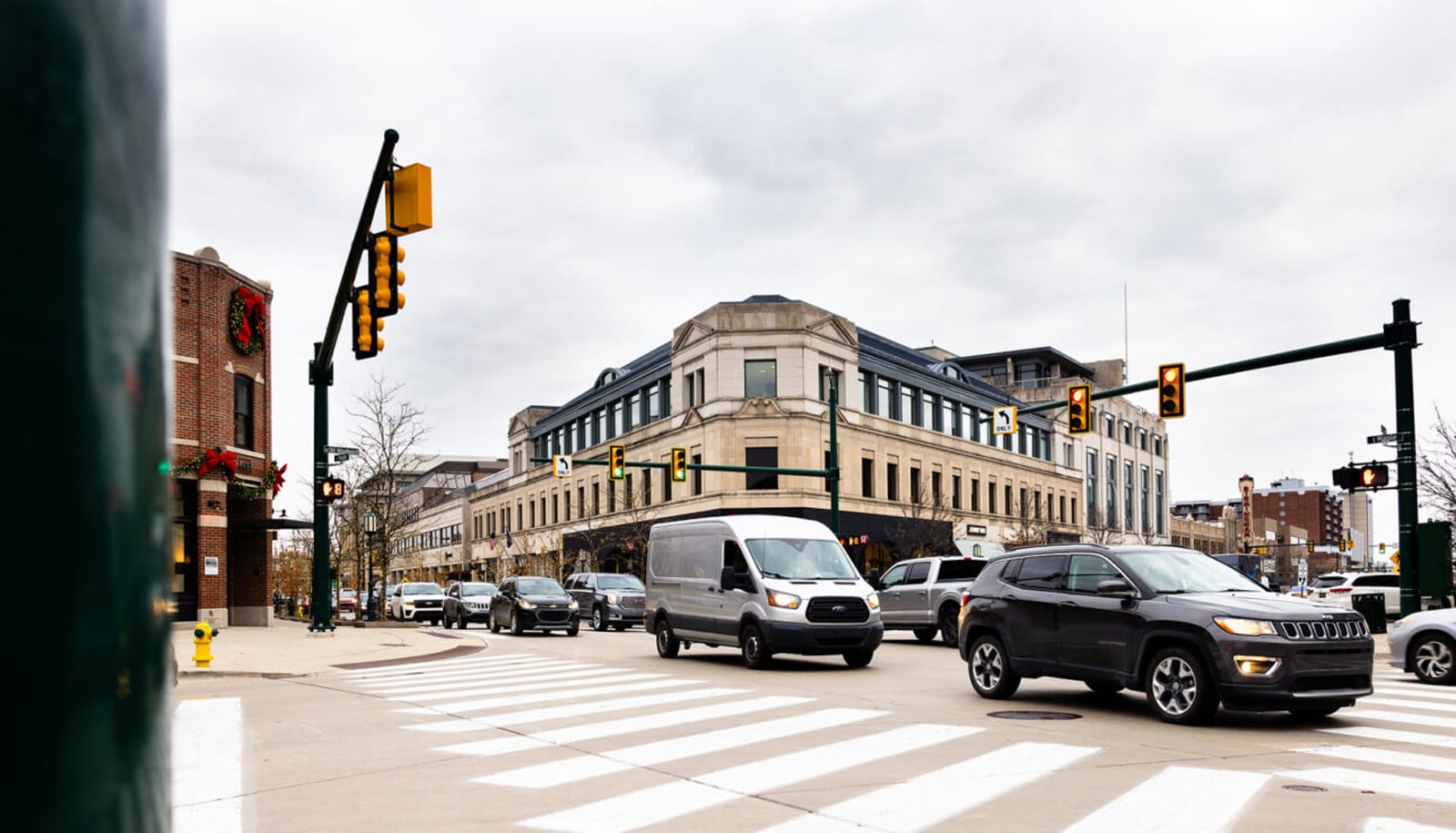
In an 18-month pilot study conducted in Birmingham, Michigan, the team used connected vehicle data insights provided by General Motors to test its system, resulting in a 20 percent to 30 percent decrease in the number of stops at signalized intersections.
It’s the world’s first large-scale, cloud-based traffic signal retiming system, and it represents a major opportunity for communities to recalibrate their signal patterns at a reduced cost.
The University of Michigan system takes GPS data from a percentage of vehicles on the road and extrapolates traffic patterns. For example, a connected vehicle that comes to a stop roughly 100 feet from an intersection strongly indicates that it is behind at least three or four other vehicles.
“While detectors at intersections can provide traffic count and estimated speed, access to vehicle trajectory information, even at low penetration rates, provides more valuable data, including vehicle delay, number of stops and route selection,” said Henry Liu, University of Michigan Professor of Civil Engineering and Director of both the Mcity wirelessly connected automotive proving ground and the Center for Connected and Automated Transportation.
There are roughly 320,000 traffic signals in the U.S. and the annual congestion costs — direct and indirect —associated with those intersections comes out to $22.9 billion. Those costs include time spent waiting at lights, as well as unnecessary energy consumption caused by signal times that could be improved.
Most traffic signals operate on a time-of-day signal timing plan, where preset patterns are in place for morning, afternoon, evening, and overnight. Traffic planners attempt to coordinate those cycles with surrounding intersections to allow cars to flow between intersections with as little stop-and-go travel as possible.
“The reason these signals should be changed more often is that traffic is always changing,” Liu said. “A good example is the traffic patterns we saw in the year before COVID’s arrival and the two years afterward. The morning peak hour changed drastically with so many people working from home. When you see that kind of change you need to retime the signals.”
Optimizing signals to keep up with changes in traffic flows isn’t a simple task. The costs and time involved in doing traffic counts and recalculations mean most municipalities won’t reassess for two to five years, or sometimes decades.
While adaptive signals have been around since the 1970s, detecting vehicles at intersections to reprogram signals almost in real time, their cost has kept them from widespread use. Installation of an adaptive system at a single intersection can cost as much as $50,000, with regular maintenance required — a price tag not all communities can afford. The University of Michigan system for optimization would cost a fraction of that for an adaptive system.
The system, called a probabilistic time-space diagram, allows for a smaller percentage of connected vehicle data to do the same workload as sensors at an adaptive traffic signal. To test its effectiveness, researchers collected data over the course of three weeks in March 2022 from each of Birmingham, Michigan’s 34 signalized intersections — most of which are fixed-time systems.
“What this has done is really solve our data collection issue,” said Gary Piotrowicz, deputy managing director of the Road Commission for Oakland County. “And I could argue that this is going to be the way everybody in the country does it. Once they’ve solidified the system, there’s no reason to do it any other way.”
Transcript
00:00:00 have you ever sat at a red light and wondered why it's taking so long to turn green retiming every traffic light cost about $5,000 right now so that's why for most of the traffic management agencies um traffic signal only R time every two to 5 years or even longer bottom line is the signals aren't operating as efficiently as they can be it creates
00:00:23 more congestion on the roadways and more congestion leads to poor safety Michigan engineering researchers have partnered with Oakland County Road Commission to develop a cheaper faster process for optimizing traffic signals it's a cloud-based system that uses GPS data from connected vehicles piloted in Birmingham Michigan their system was able to decrease
00:00:44 traffic delay by 20% and reduced the number of stops at an intersection by 30% implementation of the system is actually very very simple because the data is there already is on the cloud it's being collected by the car manufacturers and we can help the traffic management agencies to utilize that data to evaluate their traffic signal performance and then help them to
00:01:08 optimize the air traffic signal parameter currently intersections are equipped with either adaptive or fixed traffic signals if the signal is adaptive it can use sensors to detect traffic at an intersection to re time itself and if it's fixed a traffic controller needs to head to the intersection at peak times to count the number of vehicles at a signal and we're
00:01:29 try to develop timing plans that are for 24 hours 7 days a week for 365 days a year with data that just really is not as as good as we'd like it to be vehicle trajectory data provides much more information than just traffic counts instead allowing traffic controllers to see the number of stops vehicle delay and Route selections from only a small number of connected Vehicles the data
00:01:53 can then be fed into the optimization system where they're able to evaluate the performance of the signals and create new timing plant based based off the data what allow us to do is allow us to update the signals more often so instead of maybe once every 5 years or more now we can take a look at this maybe every few months to make sure that we have the
00:02:13 best timings out there in the system that makes the system the most efficient even if we don't change the timings it will confirm to us that what's out there is the best it really benefits the motorist for cities this means traffic signal maintenance much more often and at a fraction of the cost and for you less Tim at red lights and a quicker commute connected Vehicles is everywhere
00:02:35 so it's easy for us to scale the system because we can leverage their data not only in the state of Michigan but elsewhere we're talking about getting 24hour 7 day a week data that's that's automated and it's the best data we've ever had to work with which is really exciting











