ADAS & Autonomous Vehicles - December 2024
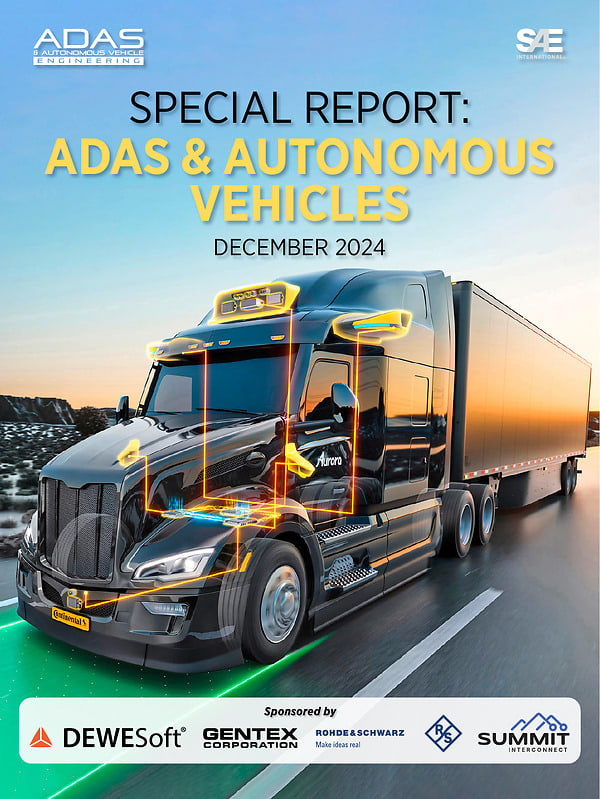
Are today's sensors ready for next‐level automated driving? What will it take to realize software‐defined commercial vehicles? How will generative AI impact the autonomous vehicles market? Look for those answers and more in this compendium of articles from the editors of Automotive Engineering and Truck & Off‐Highway Engineering.
Don't have an account?
Overview
The ADAS & Autonomous Vehicles Special Report for December 2024 provides a comprehensive overview of the latest advancements in vehicle technology, particularly focusing on Advanced Driver Assistance Systems (ADAS) and the development of autonomous vehicles. The report highlights the growing importance of integrating enhanced safety features and sophisticated human-machine interfaces (HMI) in modern commercial and industrial vehicles.
One of the key themes of the report is the increasing complexity of vehicle technologies, which presents a steep learning curve for drivers. As vehicles become more automated, the interaction between humans and machines is evolving, necessitating a reevaluation of HMI designs to ensure usability and safety. The report emphasizes that the integration of data acquisition, point cloud processing, and scanning systems is crucial for the effective functioning of these advanced technologies.
The report also addresses the significant challenges currently facing the transport sector, including severe driver shortages, rising fuel and material costs, and escalating demand for freight transport. These challenges are prompting commercial vehicle manufacturers and industry suppliers to invest heavily in research and development to create innovative solutions that can alleviate these pressures. The report notes that the development of autonomous vehicles is seen as a potential remedy to these issues, as it could reduce reliance on human drivers and improve efficiency in logistics and transportation.
Furthermore, the report discusses the role of partnerships in advancing autonomous vehicle technology. Collaborations between companies, such as Continental and Aurora, are highlighted as essential for developing scalable automated driving systems. These partnerships aim to combine expertise in various fields, including software development, sensor technology, and vehicle manufacturing, to accelerate the deployment of autonomous vehicles on the road.
Another significant aspect covered in the report is the application of biosensor technology in monitoring driver attention and engagement. As vehicles become more automated, ensuring that drivers remain alert and ready to take control when necessary is critical. The report explores how biosensors can provide real-time feedback on driver states, enhancing safety and reducing the risk of accidents.
The report concludes by emphasizing the transformative potential of ADAS and autonomous vehicles in reshaping the future of transportation. As technology continues to evolve, the industry must address the associated challenges, including regulatory hurdles, public acceptance, and the need for robust safety standards. The ongoing development of these technologies promises to enhance safety, improve efficiency, and ultimately change the way we think about mobility.
In summary, the ADAS & Autonomous Vehicles Special Report serves as a vital resource for understanding the current landscape of vehicle technology, the challenges faced by the transport sector, and the innovative solutions being developed to address these issues. It underscores the importance of collaboration and technological advancement in paving the way for a safer and more efficient future in transportation.