

Robotics & Motion Control - June 2025
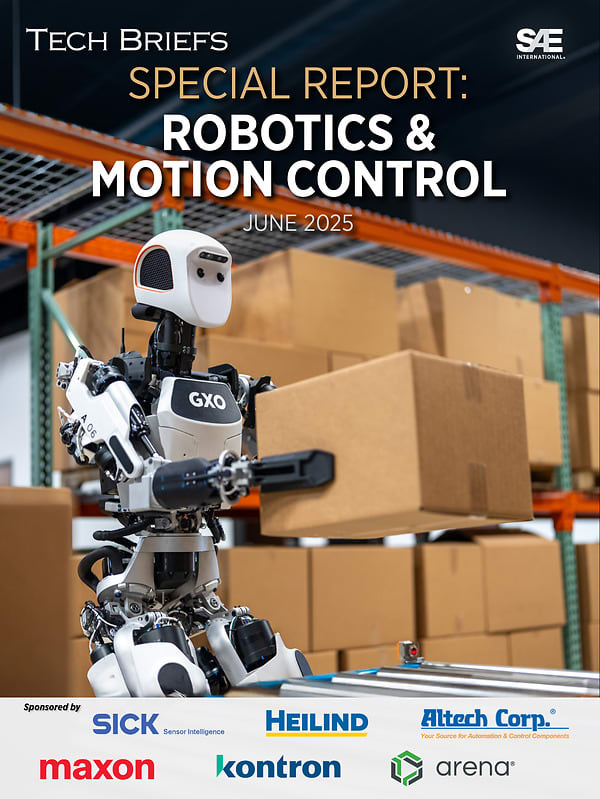
Once a staple of science fiction, humanoid robots are rapidly becoming a reality. Our executive panel weighs in. Get their insights in this compendium of articles from the editors of Tech Briefs and Aerospace & Defense Technology.
Don't have an account?
Overview
The Robotics & Motion Control Special Report from June 2025 presents a comprehensive overview of the latest advancements and trends in the field of robotics, focusing on the transformative impact of technology across various industries.
One of the key features of the report is an exploration of swarm robotics, which is poised to revolutionize traditional manufacturing processes. This section discusses how swarm robotics can enhance efficiency and adaptability in production lines, marking a significant shift in aircraft manufacturing and other sectors. The report emphasizes the potential of these systems to work collaboratively, mimicking natural swarming behaviors to optimize tasks.
Another major highlight is the section on humanoid robots, which are rapidly transitioning from the realm of science fiction to practical applications. Designed to replicate human appearance and behavior, humanoid robots are set to make significant inroads in industries such as manufacturing, logistics, healthcare, hospitality, and customer service. Insights from industry executives, including Melonee Wise of Agility Robotics and Barry Phillips of Apptronik, provide a glimpse into the current state and future outlook for these robots, discussing the challenges they face in achieving mainstream adoption.
The report also addresses the importance of wireless industrial systems, particularly through the lens of the National Institute of Standards and Technology (NIST). While wireless connectivity offers ease of installation, the report highlights that wired systems provide guaranteed reliability due to their simplicity. This discussion underscores the ongoing debate between the benefits of wireless technology and the need for dependable performance in industrial applications.
In addition to these features, the report includes several application briefs that showcase innovative technologies and their implications for the robotics industry. For instance, a brief on collaborative robots (cobots) illustrates how these machines can reduce costs and risks while improving on-time delivery in manufacturing settings. Another brief discusses the use of gyro sensors for monitoring motion on the Martian moon rover, highlighting the intersection of robotics and space exploration.
The report also delves into technical briefs that present cutting-edge research and developments. Topics include enhancing robotic grasping performance using a six degrees of freedom dataset, the creation of 3D-printed soft robotic joints that allow for greater bending angles, and the intriguing concept of insect cyborgs aimed at achieving precision movement. Additionally, the report touches on the innovative idea of using mushrooms to control robots, showcasing the creative approaches being explored in the field.
Overall, the Robotics & Motion Control Special Report serves as a valuable resource for industry professionals, researchers, and enthusiasts alike. It encapsulates the current landscape of robotics, highlighting both the challenges and opportunities that lie ahead. As the industry continues to evolve, the insights and advancements presented in this report will be crucial for understanding the future trajectory of robotics and motion control technologies.











