

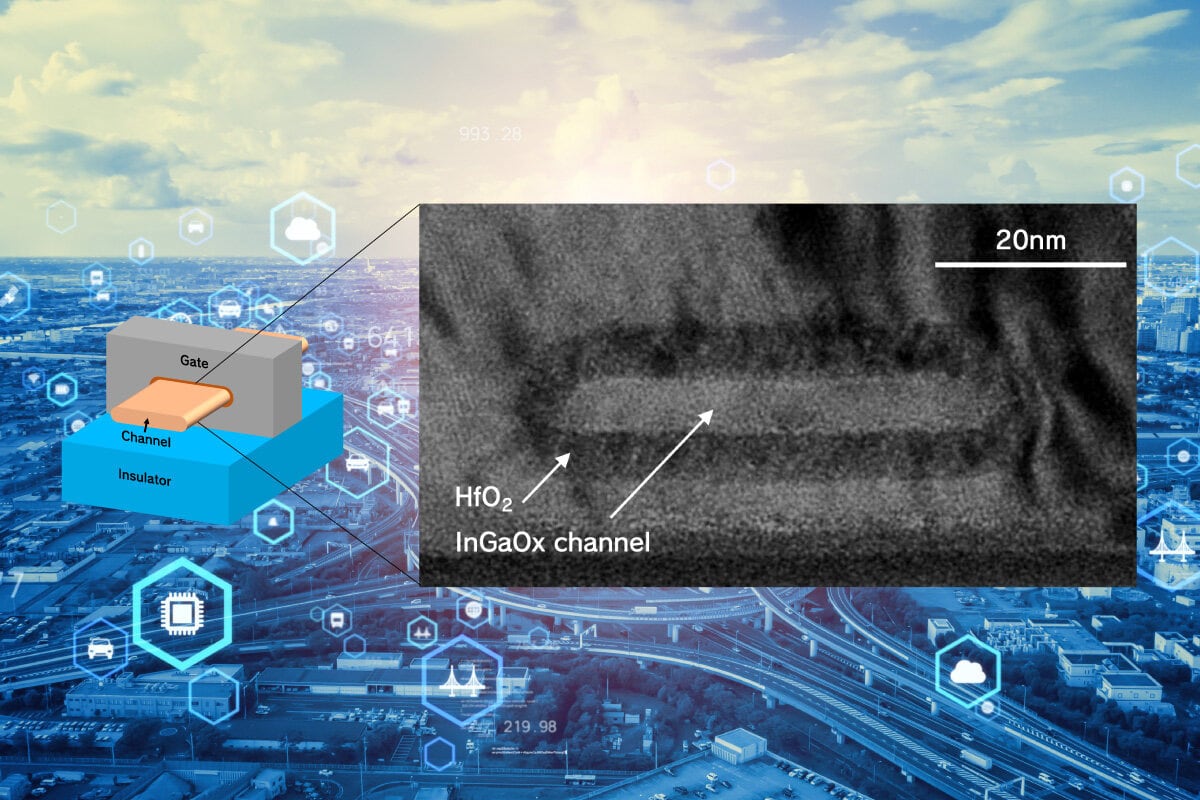
As electronics become smaller, it is becoming increasingly difficult to continue scaling down silicon-based transistors. Now, a research team led by the Institute of Industrial Science, The University of Tokyo, has sought a solution. They have ditched the silicon and instead opted to create a transistor made from gallium-doped indium oxide (InGaOx). This material can be structured as a crystalline oxide, whose orderly crystal lattice is well suited for electron mobility.
“We also wanted our crystalline oxide transistor to feature a 'gate-all-around' structure, whereby the gate, which turns the current on or off, surrounds the channel where the current flows," explained Anlan Chen, lead author of the study. "By wrapping the gate entirely around the channel, we can enhance efficiency and scalability compared with traditional gates."
The researchers knew that they would need to introduce impurities to the indium oxide by doping it with gallium. This would make the material react with electricity in a more favorable way. "Indium oxide contains oxygen-vacancy defects, which facilitate carrier scattering and thus lower device stability," said Masaharu Kobayashi, senior author. "We doped indium oxide with gallium to suppress oxygen vacancies and in turn improve transistor reliability."
The team used atomic-layer deposition to coat the channel region of a gate-all-around transistor with a thin film of InGaOx, one atomic layer at a time. After deposition, the film was heated to transform it into the crystalline structure needed for electron mobility. This process ultimately enabled the fabrication of a gate-all-around metal oxide-based field-effect transistor (MOSFET).
"Our gate-all-around MOSFET, containing a gallium-doped indium oxide layer, achieves a high mobility of 44.5 cm2/Vs," said Dr. Chen. "Crucially, the device demonstrated promising reliability by operating stably under applied stress for nearly three hours. In fact, our MOSFET outperformed similar devices that have previously been reported."
The efforts shown by the team have provided a new transistor design that considers the importance of both materials and structure. The research is a step towards the development of reliable, high-density electronic components suited for applications with high computational demand, such as big data and artificial intelligence. These tiny transistors promise to help next-gen technology run smoothly, making a big difference to our everyday lives.











