


When it comes to plastics applications, cars are rarely the first products that come to mind. However, with modern vehicles containing 1,000 to 1,500 plastic parts — including dashboards, control elements, clips, trim parts, brackets, door panels, bumpers, and radiator grilles — the material is more important for mobility than we might assume. Some of these plastic parts are relevant for the drivers’ safety: for instance, airbag covers must open correctly in an accident and seat belt guides and retractors could cause severe injuries if they break or deform under load. Their quality is vital. At the same time however, cost pressure and new regulations — for instance regarding an increased use of recycled materials that is under way in the European Union — pose new challenges, especially in plastic injection molding. Digital solutions for measurement technology help control and stabilize the complex process and may even lead to increased product quality despite tougher conditions.
To create specific plastic parts, molten plastic is injected into a precisely shaped mold cavity under high pressure in a process called injection molding. The moment the process transitions from the injection (filling) phase to the holding (packing) phase — the so-called switch-over point — is critical for part quality as it determines when the cavity is sufficiently filled. For the ideal process, injection molders must balance out every machine parameter, such as injection speed, holding pressure, injection pressure, and cylinder temperature. The better the process is controlled, the easier it becomes to reduce rejects and lower costs. It is also vital to manage new challenges like the use of recycled materials, where material characteristics might change even within batches.
Controlling the Process in Real-Time with Cavity Pressure Measurements
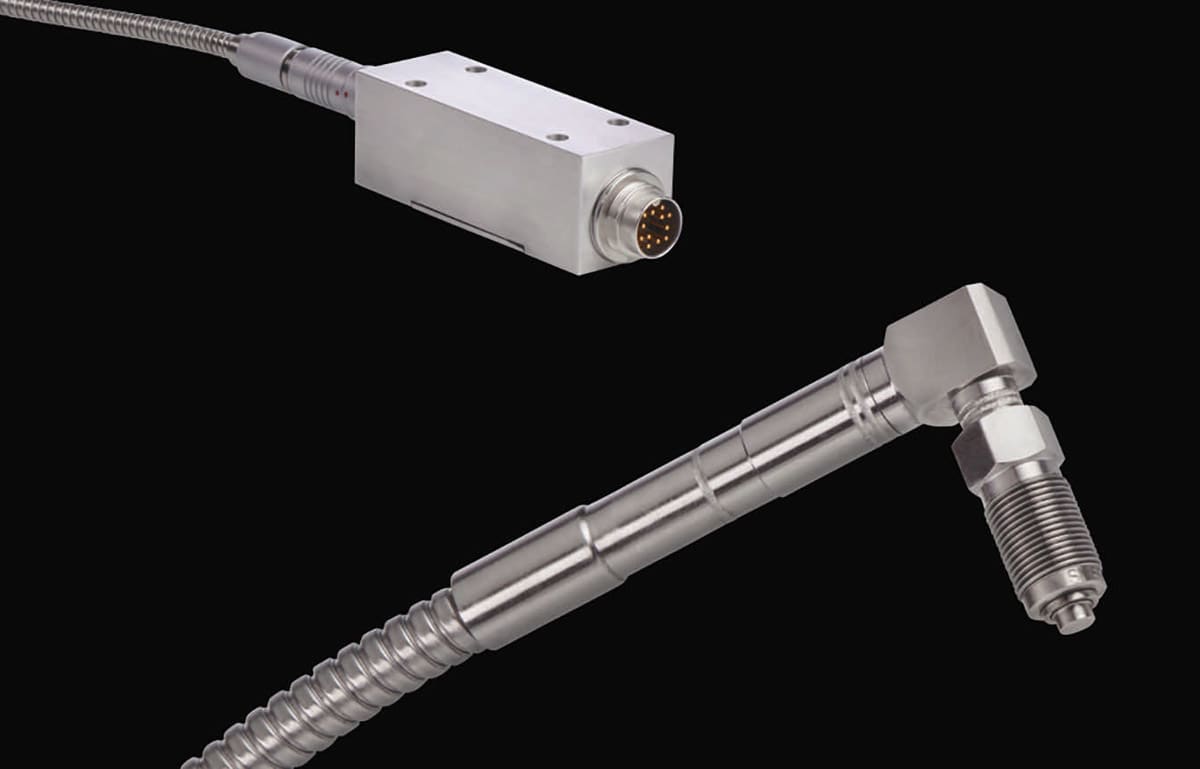
For process control, the cavity pressure profile has long been an essential tool that allows manufacturers to optimize pressures at key points, including the switch-over point. Process monitoring and control systems such as the ComoNeo from Kistler analyze cavity pressure, which is measured with robust piezoelectric sensors. Pressure readings at the various stages of the molding process closely correlate with the quality of the final product. The system creates the profiles by measuring and recording the pressure at each stage of the process.
On the mold side, a ComoNeo unit can accommodate up to 32 cavity pressure sensors and 16 contact temperature sensors. On the machine side, it has 12 digital inputs and 24 digital outputs. This enables comparison of the actual process data with the corresponding machine information such as screw position and machine pressure. The system can store results from 50,000 cycles so that in addition to real-time process monitoring, it can provide data for process analysis and future optimization.
If a mold is moved to a different machine or a mold is changed, the machine settings might have to be modified to maintain the pressure profile that has been shown to lead to producing a part that meets specs. Although usually, only minor adjustments are needed to stabilize the process, these adjustments need to be precisely calculated and continuously monitored. There are several levers which help optimize the process.
Lever 1 — Making Restarting Molds More Efficient
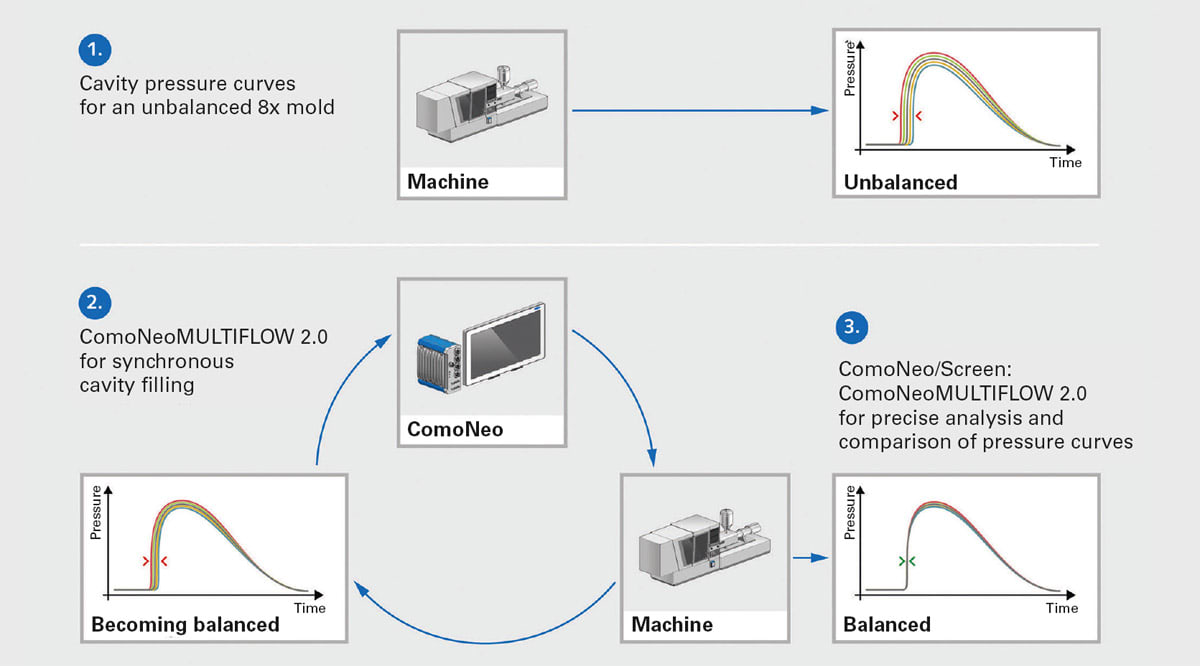
If a mold that had previously been used to produce plastic parts is reused on a different machine or with a different material batch, a solution like Kistler’s ComoNeo Recover ensures that the original process profile can be achieved again as quickly as possible. The process profile is the curve which the system uses to determine the ideal process cycle. The system recovers the original process profile and reconstructs the previously identified optimal cavity pressure curve by adjusting machine parameters like injection speed, switch-over point, and holding-pressure. In this way, the system can compensate for differences in material behavior or in machine performance.
Lever 2 – Reaching the Optimal Switchover Point
If the material characteristics deviate within the same batch from one cycle to the next, they require closed-loop features that intervene during an ongoing cycle, like ComoNeo Switch. They monitor and analyze the cavity pressure in real-time and provide automatic feedback to the machine to adapt the switchover process and reach the optimal switchover point in each individual cycle.
Lever 3 – Avoiding Increased Tool Wear and Underfilling or Overfilling of Cavities
In some cases, deviations in material batches are amplified by different flow behavior in the mold. Differences in viscosity due to longer flow paths can result in underfilled or overfilled cavities. To ensure uniform quality of all parts and avoid increased tool wear, it is important to fill every cavity simultaneously. This is made possible by controlling the hot runner nozzles — a feature offered by the software ComoNeo Multiflow, which compensates for these kinds of irregularities.
Lever 4 – Safeguarding Compliance to Highest Quality Standards
In addition to monitoring and controlling the process in real-time, manufacturers benefit from analyzing their data over longer production runs and time periods. This allows them to perfect their systems and safeguard compliance to the highest quality standards. The innovative data management platform from Kistler for injection molding processes has recently been given a powerful update, AkvisIO 7.0. This measurement technology software can now consolidate and document injection molding data from various sources, with ComoNeo being one of them. Thanks to new interfaces, the latest version of AkvisIO supports the Euromap 77 standard, which makes it possible to integrate even more machine data. Additionally, it is now able to visualize multi-component processes with a histogram feature that makes process trends visible over a longer time span.
Piezoresistive Sensors for Precision
The digitalization of industrial measurement solutions has come a long way. With the help of these levers, plastic injection molders have effective tools at hand to tackle current challenges, be it cost pressure and competitiveness, high product quality, or sustainability requirements. The data analytics produced by real-time monitoring of the various pressures enables plastic injection molders in the automotive and other industries worldwide to save costs, to maintain high part quality, and to ensure compliance with evolving regulatory demands regarding recycling quotas.
This article was written by Daniel Kormann, Head of Business Development Plastics, Kistler Group. For more information, go here .










