

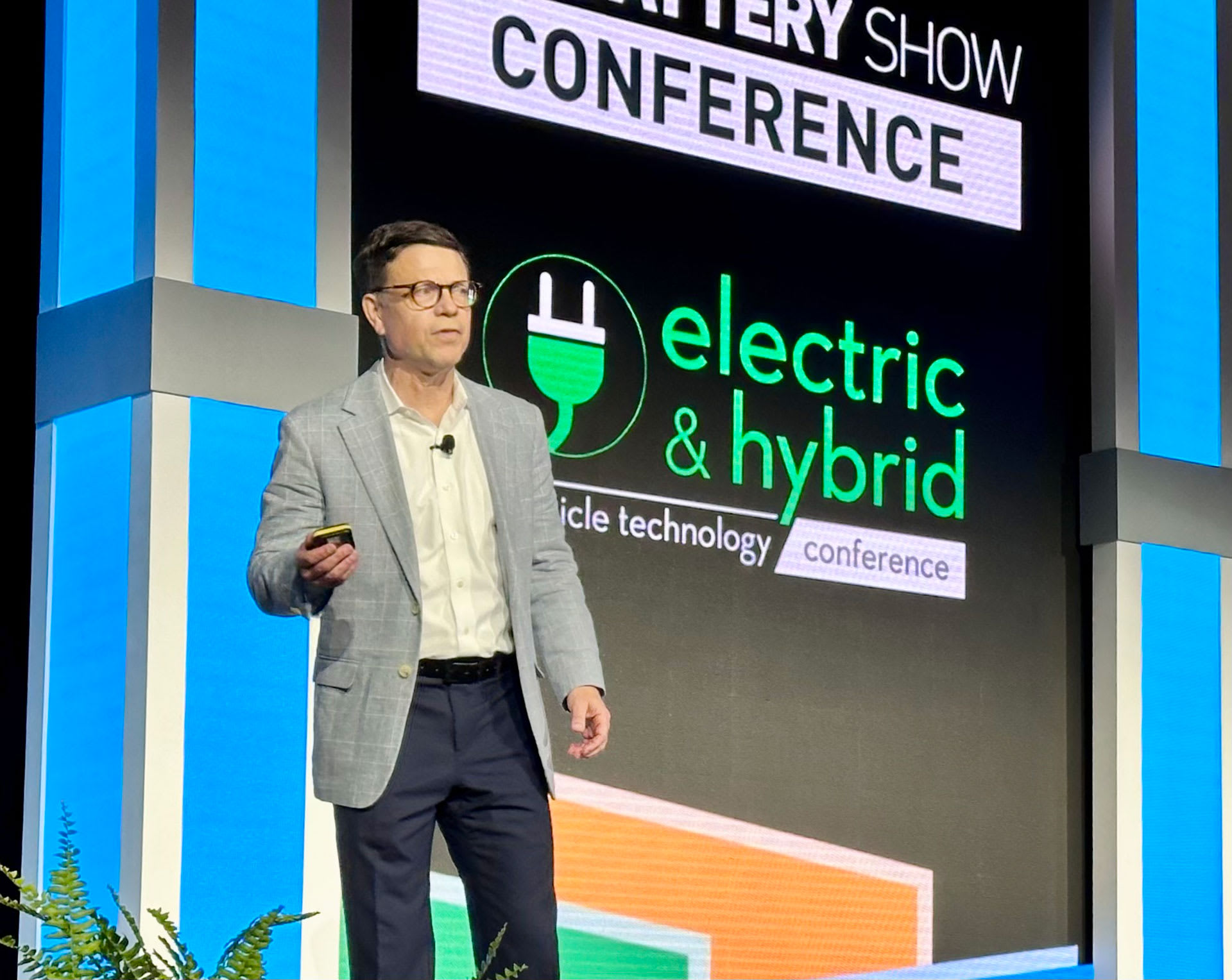
A GM battery executive told an audience at the Battery Show North America audience Tuesday that the company would deploy a lithium manganese-rich (LMR) battery by 2028 in some of its heavier vehicles.
Kurt Kelty, GM’s vice president for battery propulsion and sustainability, was giving a keynote address when he said LMR is “a game changing chemistry for electric trucks and full-size SUVs.”
He walked the audience through recent battery development, saying that the original NMC (nickel manganese cobalt) chemistries used equal amounts of each material. The nickel was for energy density, the cobalt for thermal stability and the manganese provided structural integrity. And it was a solid solution that could and did scale. He said that now “we are focused on balancing energy density with affordability, sustainability and supply chain resilience.”
And one of the fastest ways to reduce cell cost is to reduce the amount of cobalt, the most expensive material, and replace it with nickel. This gave rise to the current widely used tech, the so-called high-nickel chemistries.
The LMR chemistry “dramatically reduces our reliance on nickel and cobalt,” he said, which are replaced with manganese, which is “readily abundant around the world and is affordable.” Put another way, he said, “this makes electrification more accessible, more resilient and more American.”
He outlined GM’s mid-term strategy to use three chemistries depending on the application:
- High-nickel chemistries for applications like giving the Silverado EV a long range.
- Lithium iron phosphate (LFP) batteries would be used for vehicles where affordability is a key factor for owners/drivers.
- LMR, he said, would be used for the majority of the company’s EVs, because it gives the range of high-nickel chemistries at a cost approaching that of LFP cells.
He said the use of prismatic cells, which are larger and hold more energy than small cylindrical cells, will help in the adoption of LMR technology. This, he said, would help build a “cell that'll have 33% more energy density than a similarly sized LFP, but it's at a comparable cost with the LFP.
He cited the Silverado as an example, giving these ranges and benefits:
- High-nickel: 490 miles of range – great for those for whom range is the most important factor
- LFP: Used in the same space, about 350 miles of range but with an enormous savings of $6,000 in cost for the battery pack
- LMR: “Over 400 miles of range, but at a cost similar to that of the LFP.”
Kelty also said GM is rapidly expanding into home and light industrial energy storage, even partnering with Redwood Materials to put pre-used GM batteries to use powering data centers, which are exponentially increasing regional needs. He also said the company is keeping an eye on solid-state battery developments, but that the technology just isn’t mature enough yet to plan into the production pipeline.
For customers who have already switched to driving EVs, he said that by 2030 the company will have installed more than 35,000 fast charging stalls in the United States on top of the 250,000 chargers drivers have access to already.
Kelty also said GM is doing the work to localize its supply chain and make it more sustainable. “We're establishing US-based manufacturing for LMR and LFP battery cells, investing in cathode precursors and active materials, and we're going to bring the electrolyte and the separator manufacturers to North America by the end of the decade,” he said, adding that the company is working to bring production of critical minerals like lithium, manganese and graphite closer to home.
Kelty said that despite United States energy policy seemingly creating headwinds for EV battery and vehicle development, he noticed a sense of optimism among the tech leaders he had run into so far. After all, he said, “EVs are a global industry.”











