

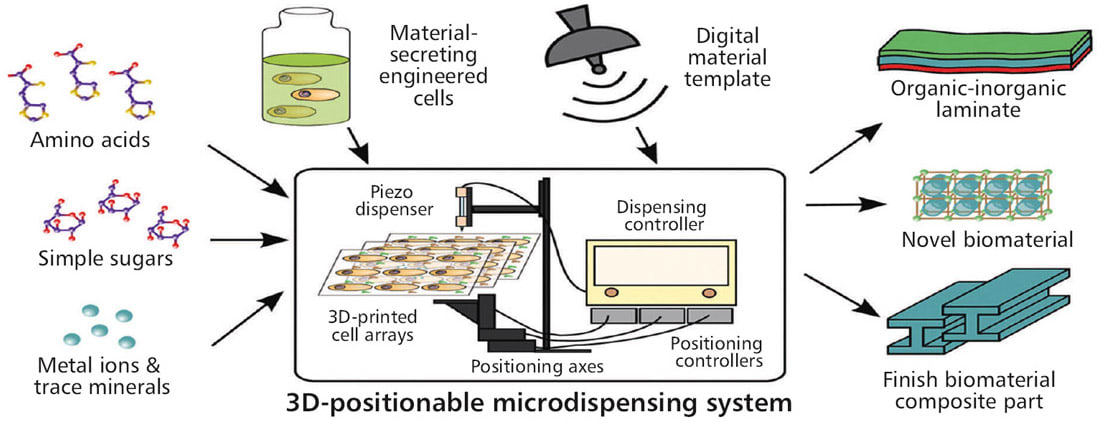
NASA has developed a novel approach for macroscale biomaterial production by combining synthetic biology with 3D printing. Cells are biologically engineered to deposit desired materials, such as proteins or metals, derived from locally available resources. The bioengineered cells build different materials in a specified 3D pattern to produce novel microstructures with precise molecular composition, thickness, print pattern, and shape. Scaffolds and reagents can be used for further control over material product. This innovation provides modern design and fabrication techniques for custom-designed organic or organic-inorganic composite biomaterials produced from limited resources.
Once genes for a desired material type, delivery mode, control method and affinity have been chosen, assembling the genetic components and creating the cell lines can be done with well-established synthetic biology techniques. A 3D microdeposition system is used to make a 3D array of these cells in a precise, microstructure pattern, and shape.
The engineered cells are suspended in a printable ink. The 3D microdeposition system deposits minute droplets of the cells onto a substrates surface in a designed print pattern. Additional printer passes thicken the material. The cell array is fed nutrients and reagents to activate the engineered genes within the cells to create and deposit the desired molecules. These molecules form the designed new material. If desired, the cells may be removed by flushing.
The end product is thus a 3D composite microstructure comprising the novel material. This innovation provides a fast, controlled production of natural, synthetic, and novel biomaterials with minimum resource overhead and reduced pre- and post-processing requirements.
NASA is actively seeking licensees to commercialize this technology. Please contact NASA’s Licensing Concierge at











