

Photonics, Optics & Imaging - January 2026
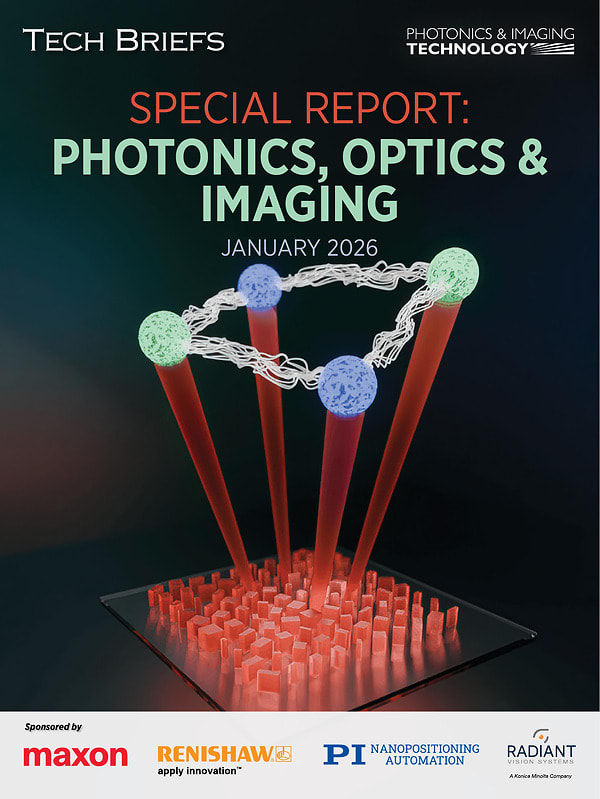
Harvard research breakthrough could speed development of room‐temperature quantum computers…New generation of ultra‐lightweight, high‐res space cameras takes flight…NASA LiDAR advance gives robotic explorers better eyesight. Read about these and other innovations in this compendium of articles from the editors of Tech Briefs and Photonics & Imaging Technology.
Don't have an account?
Overview
The January 2026 special report on Photonics, Optics & Imaging presents cutting-edge advancements across diverse fields including quantum optics, machine vision, laser technology, and imaging systems, highlighting innovations with broad scientific and industrial implications.
A key feature is Harvard University and TU Wien’s novel tunable semiconductor laser based on multiple micro-ring resonators, allowing smooth, wide-range, and precise wavelength tuning from a single chip without mechanical parts. Initially demonstrated in the mid-infrared for quantum cascade lasers, this compact, stable design promises applications in telecommunications, medical diagnostics, and gas sensing by efficiently targeting individual wavelengths with enhanced reliability and scalability.
In quantum optics, a Harvard-led team has pioneered ultra-thin metasurfaces capable of generating complex, entangled photon states. This innovation miniaturizes traditionally bulky quantum optical setups into a single flat device, overcoming scaling challenges and enabling robust, low-loss, and cost-effective quantum operations with potential impact on quantum computing, communications, and sensing at room temperature.
The report details advancements in machine vision, focusing on Vision Link, an AI-powered inspection platform that upgrades existing industrial camera systems without hardware replacement or control logic changes. Vision Link integrates seamlessly with legacy vision infrastructures, providing enhanced defect detection, classification, and real-time analytics to improve manufacturing quality, reduce labor, and support digital transformation through data connectivity and cloud-edge hybrid processing.
In applied technologies, acp systems AG engineered a precise, vision-assisted robotic solution to automate the loading and unloading of fragile solar wafers into PECVD coating carriers. This system compensates for thermal shrinkage and manufacturing variances, achieving sub-millimeter accuracy without wafer damage and significantly boosting productivity.
Additional innovations include NASA’s Space Qualified Rover LiDAR (SQRLi), enhancing autonomous navigation in low-visibility extraterrestrial environments via compact, high-resolution 3D imaging; and Purdue University’s imaging techniques delivering real-time boundary detection from noisy images and single-shot high-dynamic range sensing, impacting fields from autonomous navigation to medical imaging.
Collectively, these developments underscore accelerating progress in photonics and optical engineering, offering scalable, integrated, and highly precise solutions that address long-standing technological trade-offs while opening new frontiers in communication, sensing, manufacturing, and space exploration.










