

Designing The Future Of Safe Electronics - January 2026
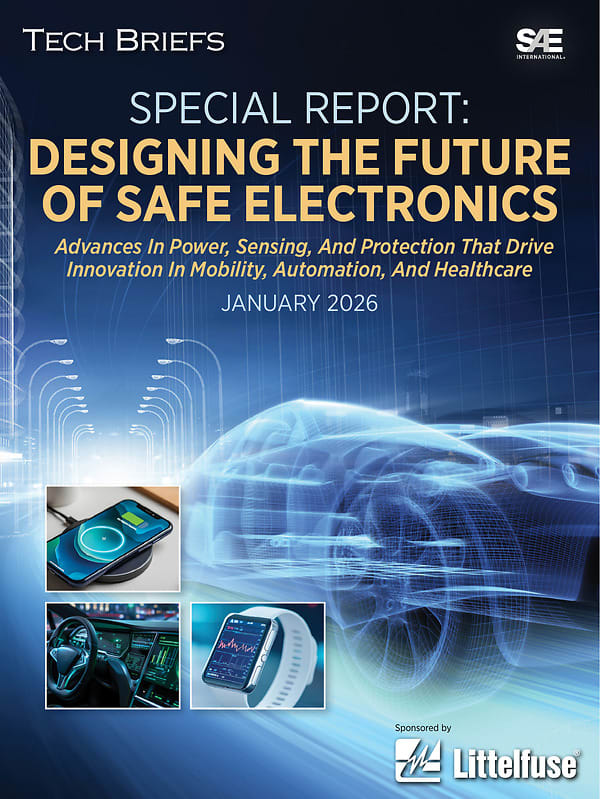
Cybersecurity for tomorrow's software‐defined vehicles…designing reliable fast chargers for next‐gen wearable devices…selecting the right sensor for smart systems. Read about these and other electronics design innovations in this compendium of articles from Littelfuse.
Don't have an account?
Overview
The "Designing the Future of Safe Electronics" Special Report by Littelfuse, Inc. (January 2026) presents cutting-edge advances in power, sensing, and protection technologies that are driving innovation across mobility, automation, and healthcare sectors. It highlights critical design considerations and component solutions enabling safer, smarter, and more reliable electronic systems in vehicles, medical devices, and portable electronics.
Key topics include zonal vehicle architectures that lay the foundation for next-generation automotive electronics, emphasizing modular design and cybersecurity strategies essential for software-defined vehicles. The report underscores the importance of integrating cybersecurity from concept through decommissioning, with standards like ISO/SAE 21434 and UNECE WP.29 ensuring robust risk management, secure OTA updates, and cryptographic agility to prepare for emerging quantum computing threats.
In healthcare, the document details engineering compact, energy-efficient electronic drug delivery pens and low-power wearable medicine injectors. It discusses challenges in achieving precision dosing, battery efficiency, miniaturization, and regulatory compliance. Application-focused components such as low-resistance polymer fuses, integrated protection ICs, and specialized sensors enable devices to operate reliably 24/7 while maintaining small size and low weight. Collaboration with suppliers offering design support and simulation tools is encouraged to accelerate development and streamline certification under international standards (ISO 11608 series, IEC 60601, etc.).
The report also explores advancements in fast charging solutions for next-gen wearable and portable devices. With evolving global standards like USB Power Delivery enabling up to 240W charging, design strategies prioritize balancing high power transfer with circuit protection against overcurrent, overvoltage, and electrostatic discharge. Recommended components include Schottky diodes, TVS diodes, eFuse ICs, and optocouplers to safeguard charging systems.
A dedicated section on sensor selection outlines how engineers can achieve optimal performance, reliability, and scalability by partnering early with suppliers who offer customized design capabilities, simulation, and scalable production. Emphasizing total cost of ownership over initial price, the guide advises balancing technical specifications with supply chain resilience to minimize risk throughout the product lifecycle.
Collectively, the report provides a comprehensive overview of integrating advanced component technologies with expertise and standardized methodologies to innovate and future-proof electronics in critical applications, supporting safety, compliance, and operational excellence.










