

Robotics & Motion Control - December 2025
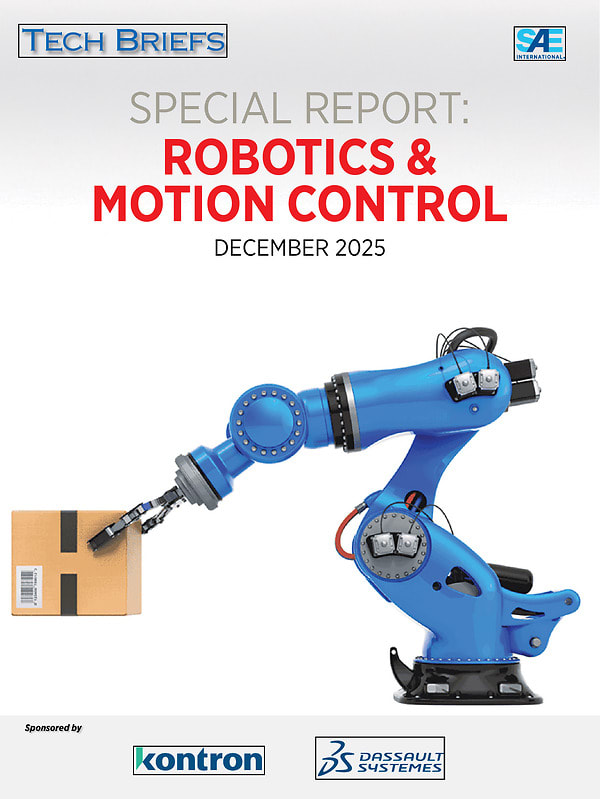
New technology for autonomous building on the moon and Mars…conductive skin gives robots a human touch…soft robots carry loads through the air, climb steep slopes. Read about these innovations and more in this compendium of articles from the editors of Tech Briefs and Motion Design magazines.
Don't have an account?
Overview
This December 2025 special report on Robotics & Motion Control showcases cutting-edge advances that are transforming robotics across industries. Featuring research from renowned institutions like MIT, NASA, Cambridge University, and North Carolina State University, the report highlights breakthroughs in robot perception, manipulation, autonomy, and collaboration.
A key theme is the integration of advanced sensing and simulation to enhance robot adaptability. MIT researchers developed a novel simulation method enabling robots to infer physical properties—such as weight and softness—of objects by internal sensing alone, streamlining manipulation tasks without requiring vision systems. Complementing this, another MIT-NVIDIA collaboration introduced cuTAMP, a parallelized planning algorithm that rapidly generates optimized multi-step motion plans, dramatically accelerating complex tasks like packing or tool use.
On the tactile front, Cambridge and UCL developed a flexible, conductive robotic skin capable of multi-modal sensing—including touch, pressure, temperature, and damage—via a single material, bringing robots closer to human-like sensory perception. Meanwhile, North Carolina State unveiled a novel soft robot powered by infrared light that autonomously moves along aerial tracks, climbs steep slopes, and carries loads over 12 times its weight, demonstrating new modes of soft robotic locomotion.
NASA Ames contributed a modular mobile bipedal robot system designed for autonomous assembly and maintenance of lightweight, lattice-based structures in extraterrestrial environments, enabling flexible, scalable infrastructure construction without human intervention.
The report also explores the evolving role of vision integration in collaborative robots (cobots). Modern cobots increasingly feature on-end-effector cameras and built-in lighting, simplifying calibration and enabling dynamic adaptation to varying parts and layouts without extensive reprogramming. This contrasts with earlier systems that suffered from complex multi-vendor integration and calibration challenges.
Finally, a white paper by Heilind Electronics underscores how advances in AI, edge computing, ruggedized connectors, and 5G/6G connectivity are propelling robotics beyond simple automation toward intelligent, collaborative partners in manufacturing, healthcare, home automation, and more.
Together, these highlights illustrate a robotics landscape marked by increased autonomy, sensory sophistication, real-time planning, and human-robot collaboration, paving the way for smarter, more adaptable robots that unlock new possibilities across sectors.










