

An improved solution for preserving samples of urine has been formulated. This solution preserves a much broader spectrum of analytes in urine than do other urine-preservative solutions here-tofore in use by NASA, and is safe for use by humans. When this solution is used, (1) refrigeration of urine samples is not necessary for preserving them and (2) the solution does not alter the pH values of the samples — two important considerations for collecting and storing urine samples in outer space. By eliminating the need to ship frozen samples, this preservative will enable the collection of urine samples — not only in outer space but also in terrestrial remote settings where it was previously not feasible.
Chlorhexidine gluconate is a water-soluble, bactericidal compound used commercially as a topical anti-infective agent. N-propyl gallate, a commercial food additive, is an antioxidant. The Food and Drug Administration has ruled that both compounds are safe for use by humans at the concentrations necessary to maintain the integrity of urine samples.
To make CPG, one first prepares 20-percent solutions of n-propyl gallate and chlorhexidine gluconate, then mixes these solutions in equal parts. The resulting CPG solution is placed into aliquot tubes to yield a final concentration of 0.4 milligram of CPG per milliliter of urine.
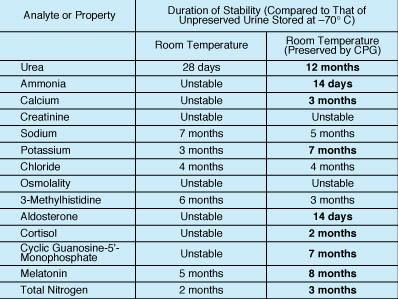
Researchers tested CPG with 17 urine analytes during 12 months, using two separate pooled samples. Unpreserved aliquots from each pool were stored at a temperature of –70 °C as baseline samples. Both preserved and unpreserved aliquots from each pool were also stored at room temperature. Analytes were measured on days 1, 14, and 28 for the first month and then once a month for the next 11 months. The table gives the results of this study. The bold text within the table indicates the instances in which CPG provided extended room-temperature stability.
This work was done by Scott Smith of Johnson Space Center and Jeannie Nillen of Krug Life Sciences, Inc.
This invention is owned by NASA, and a patent application has been filed. Inquiries concerning nonexclusive or exclusive license for its commercial development should be addressed to
the Patent Counsel
Johnson Space Center
(281) 483-4871.
Refer to MSC-22695.











