

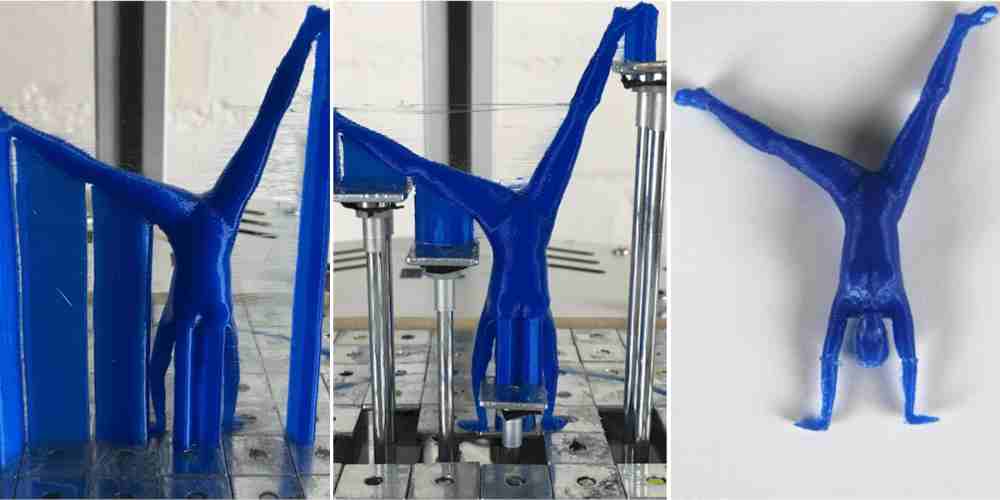
A new, sustainable take on the 3D printer reduces waste by eliminating the need for printed supports.
The additive-manufacturing technology, developed by researchers from USC Viterbi School of Engineering , features a movable platform of rising and falling pins. The small metal tubes prop up layers of a 3D-printed object as needed.
The work, led by Dr. Yong Chen, professor of industrial and systems engineering, and PhD student Yang Xu, has been published in Additive Manufacturing .
Printed stands often balance an object and ensure structural integrity as a printer creates an object layer by layer. The supports, however, must be manually removed after printing, leading to waste.
“When you’re 3D printing complex shapes, half of the time you are building the parts that you need; the other half of the time you’re building the supports," said Chen. "So with this system, we’re not building the supports. "
The research team’s new prototype runs all the metal supports from a single motor that moves a platform. The platform raises groups of metal pins at the same time.
Based on the product design, the program’s software tells the user where they need to add a series of metal tubes into the base of the platform. The position of these tubes then determine which pins will rise to defined heights to best support the 3D-printed product, while also creating the least amount of wastage from printed supports.
At the end of the process, the pins can be easily removed without damaging the object, and reset to the original position for the next printing job.

The system may especially suit large-scale manufacturings in the automotive, aerospace, and yacht industries — businesses that are spending entire days building large-size parts with FDM printers, says Chen.
By reducing your support material, you reduce your time, according to the USC professor.
"If you can save half of that, your manufacturing time [for large-scale 3D printing] could be reduced to half a day," said Chen. "Using our approach could bring a lot of benefits for this type of 3-D printing.”
In a short Q&A with Tech Briefs below, Prof. Chen explains more about the movable approach to 3D printing, and how the rising and falling pins will impact designs.
Tech Briefs: How did this idea come about? (I heard the inspiration was from Legos?)
Prof. Yong Chen: The idea was actually inspired by 3D metal pin art. I have one in my office. It made me think about how we can use it for 3D printing. Later, we figured out a way of using pre-fabricated tubes with standard lengths with magnetics. The metal tubes with standard lengths can be pre-fabricated and given to users, similar to a set of Lego pieces.
Tech Briefs: Does the system automatically know which pins to raise, or does the user decide on the design phase? How is the information delivered on which pins to raise, and to what height? Is it via written instructions or some kind of automated process?
Prof. Yong Chen: Yes, we developed a software system for the reusable metal supports (see the image at the top of the page). It will optimize the layout of the input CAD models on the platform. Accordingly, based on the computation results, the software system will tell the user which tubes to pick from the tube box and insert onto which pin. The length of the selected tube will determine how high the related pin will rise up to.

Tech Briefs: Do the support-pin placements create limitations to what can be designed and built?
Prof. Yong Chen: I do not think it will create limitations on the design. The designer does not need to consider the pin design. Our software will optimize the layout and the related pin design, so the reusable pins will save the building time and support materials. The only difference for different placement is how much it can save (e.g., 30% vs. 25%). The worst scenario is no reusable metal pins are used, and all the supports are 3D-printed using the current approach (i.e., 0% saving).
Tech Briefs: Does the moveable platform have an array of pins, some of which can be raised? How many pins? What spacing? Does the size and spacing of the pins have to be designed anew for each product, especially if the products are different sizes? Different materials?
Prof. Yong Chen: The moveable platform in our prototype is 11 x 9: 99 pins. Each pin is 12.7-mm x 12.7-mm and can be raised up to different heights. They were fixed on size and spacing after the prototype system was built. They can be reused for different shapes and materials.
The platform size is 140 mm x 114 mm. We can make the platform size bigger by putting in more pins. We can also reduce the spacing between pins to have more pins for the same size. One good thing is the same hardware (i.e., one linear stage) can be used.
Tech Briefs: Are the metal rods separate pieces or are they attached to the assembly?
Prof. Yong Chen: The metal rods are separated from each other. They are attached to the three sheets through an inserted tube with a magnetic disc (on the bottom of the tube) or a magnetic ring (on the top of the tube).
Tech Briefs: How can you make sure that the pins don’t adhere to the product?
Prof. Yong Chen: The pin will attach to the 3D-printed supports or parts and will be detached from the metal rod when the 3D-printed part is taken out from the platform. The pin can be peeled away from the built part afterward ( refer to 1:30 of this video .)
Tech Briefs: Do you still use printed supports as well?
Prof. Yong Chen: Yes, you will still need the 3D printed supports, but the amount of them can be reduced. Also, the 3D-printed supports can be much shorter, so the rigidity of the 3D-printed support can be improved.
What do you think? Share your questions and comments below.
Transcript
00:00:00 additive manufacturing processes such as fused filament fabrication stereolithography and direct ink writing require support to print parts with overhang features these additional supports are a waste of material since they need to be removed after the printing process and cannot be reused the printing of supports also lowers
00:00:19 printing efficiency for nozzle-based material extrusion processes inspired by pin art and lego blocks professor yang chen's group at the university of southern california figured out a novel support strategy and designed a programmable and reusable pin support the work is published in the journal additive manufacturing
00:00:37 the main idea is to use a single motor to drive a large number of pens serving as a movable printing platform to different sea heights the pins will be lifted if prefabricated hollow tubes of standard lengths with magnets are inserted from the base into the pin rods for an arbitrary cat model the researchers developed support generation
00:00:56 software that optimizes the part layout on the platform to save material and printing time as much as possible before generating a tool path the software will also tell the user which tube or combined tubes to select from the set and be inserted onto which metal pin when a printing job starts the pins with inserted tubes will move
00:01:14 up by one layer thickness after printing a layer for a metal pin at a certain height 3d printed material can be deposited on its top surface the experimental results of several test cases show an average of nearly 40 percent saving on the printing time and material with increased reliability and
00:01:31 robustness when the printing job is done the pin support can be easily removed from the built parts without damaging fragile features since each pin top is a washer connected by a magnetic ring after peeling off the attached washers the created object is separated from the reusable support the pins can be reset to their initial
00:01:51 positions automatically finally the pin top washers detached from the 3d printed object are inserted back to the pin tips now the reusable support is ready for another printing job the researchers would like to investigate the reusable support for the big area additive manufacturing
00:02:49 which may provide a feasible solution to significantly reduce printing time and may be applied to construction and furniture 3d printing for 3d bio printing the researchers envision a further increased saving on expensive bio-related materials with the reduced pin size the researchers will also extend the reusable support to other am
00:03:07 processes such as projection based stereo lithography and powder based selective laser melting the reusable support could provide a new direction to address support related issues in the future









