Stories
0
10440
30
INSIDER: Motion Control
When robots and humans have to work together, it often leads to problems. Researchers on the CogIMon project want to teach robots to understand the forces during the movement of an...

INSIDER: Medical
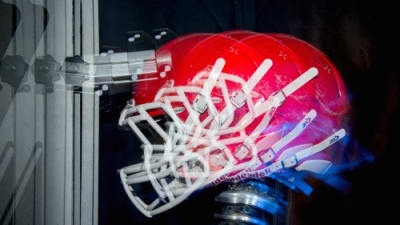
When modern football helmets were introduced, they all but eliminated traumatic skull fractures caused by blunt force impacts. Mounting evidence, however, suggests that...
INSIDER: Materials
Simulations Reveal Near-Frictionless Material
Scientists from Argonne National Laboratory used simulations to identify and improve a new mechanism for reducing friction. The resulting hybrid material exhibited superlubricity at the macroscale.
INSIDER Product: Lighting
Princeton Optronics (Mercerville, NJ) has introduced high-power (8W) 940nm VCSEL arrays for illumination applications. These arrays have an efficiency of >45%, a spectral width of approximately 1nm and a circular beam with...
INSIDER Product: Lighting
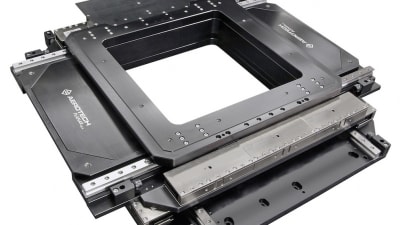
Aerotech’s (Pittsburgh, PA) PlanarDLA integrated, open-frame stages have high dynamics and exceptional geometric performance in a low-profile package. These stages are essential for applications ranging from...
INSIDER Product: Lighting
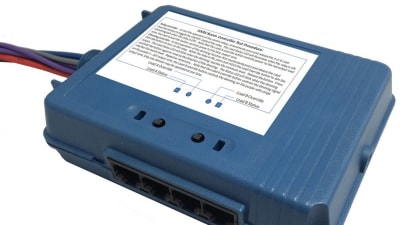
Hubbell Building Automation (Austin, TX) has launched an intelligent lighting control that simplifies installation with auto-configuration. The NXTM Room Controller integrates automatic and manual control of...
INSIDER Product: Lighting
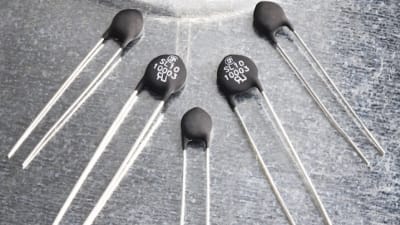
Ametherm (Carson City, NV) recently released a new UL-approved circuit protection thermistor that offers a 277 V rating optimized for applications including LED lighting and ballasts, power factor correction (PFC) circuits, and...
INSIDER Product: Lighting
Mouser Electronics, Inc. (Mansfield, TX) is now stocking LUXEON CoB Compact Range LEDs from Lumileds (San Jose, CA). These LEDs offer high flux densities in a very small light emitting surface (LES), which provides good...

INSIDER Product: Lighting
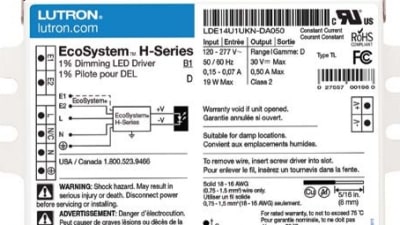
Lutron Electronics (Coopersburg, PA) recently launched the EcoSystem H-Series LED Drivers with models available for LED troffers and linear lighting up to 75W and downlights up to 40W. The EcoSystem H-Series LED Drivers are...
Question of the Week
Is long-term Mars living possible?
This week's Question: A recent study created by the Arizona-based Paragon Space Development Corporation says its life support system could help humans survive on Mars. The proposed Environmental Control and Life Support System, the company says, could extract water from Mars’ rocky material and convert some of...
INSIDER: Nanotechnology
New Nanowires Absorb Light
Harvard University scientists have created nanowires with new useful properties. The wire not only absorbs light at specific wavelengths, but also light from other parts of the spectrum. The technology could have applications in areas ranging from consumer electronics to solar panels.
Question of the Week
Will robots be suitable emotional companions?
This week's Question: In June, Softbank sold its first 1,000 Pepper robots in less than a minute. Using cameras, touch sensors, an accelerometer, and other sensors in its neural network, Pepper has the ability to read (and develop its own) emotions. According to the company's Web site, the social...
INSIDER: Transportation
Nanogenerator Harvests Power from Rolling Tires
A group of University of Wisconsin-Madison engineers and a collaborator from China have developed a nanogenerator that harvests energy from a car's rolling tire friction. The technology ultimately could provide automobile manufacturers with a new way to reuse energy and provide greater vehicle...
INSIDER: Photonics/Optics
Researchers at Rice University have discovered a new way to make ultrasensitive conductivity measurements at optical frequencies on high-speed nanoscale electronic components. The...
INSIDER: Medical
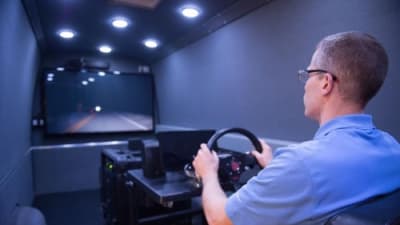
An advanced driving simulator will be used to test a patient’s driving ability after cataract surgery. The trial will help determine if a newly developed artificial lens will be...
INSIDER: Aerospace
The first of five instruments for a spacecraft that will collect a sample from an asteroid and bring it back to Earth has arrived at Lockheed Martin for installation onto NASA’s Origins Spectral...

Question of the Week
Will robo-cabs lower gas emissions?
This week's Question: In last week's Nature Climate Change journal, Lawrence Berkeley National Laboratory researchers reported that, by 2030, traveling by driverless electric taxi could lower greenhouse gas emissions by as much as 90% compared with the same length ride in a privately owned gas-powered car today....
News: Materials
Diamond-Like Coating Application Improves Engine Components
Applying carbon coatings to engine components, such as piston rings and pins, reduces friction and lowers fuel consumption. Using a new laser-based method, researchers at Fraunhofer-Gesellschaft, Munich, Germany, say they can now produce layers of carbon that are almost as hard as...
News: Energy
Researchers Prevent Fires in Next-Gen Lithium Batteries
New research from SLAC National Accelerator Laboratory, Menlo Park, CA, could help remove a major barrier to developing lithium-sulfur and lithium-air batteries. The SLAC engineering team discovered that adding two chemicals to a lithium metal battery's electrolyte prevents the formation of...
INSIDER: Energy
New System Stores Solar Energy at Night
Common solar energy systems today are unable to use the generated energy at night or in cloudy conditions. A University of Texas at Arlington materials science and engineering team has developed a new energy cell that stores large-scale solar energy even when it is dark.
Question of the Week
Will remote-controlled passenger flights take off in the next 5 years?
This week's Question: Last month, the Manassas, VA-based Aurora Flight Sciences Corp. tested its 4100-pound twin-propeller experimental airplane. The Centaur flew without a pilot and within airspace also being used by commercial aircraft. John Langford, the CEO of Aurora, is...
Briefs: Imaging
Image Processing Software Environment (QuIP)
The QuIP interpreter is a software environment for QUick Image Processing that features an interactive scripting language designed to facilitate use by non-expert users through features such as context-sensitive automatic response completion. The package includes a number of script packages that...
Briefs: Imaging
CubeSat-Compatible, High-Resolution, Thermal Infrared Imager
A small, adaptable, and stable thermal imaging system was developed that can be flown on an aircraft, deployed on the International Space Station as an attached payload, launched on a ride-share as an entirely self-contained 3U CubeSat, flown on a small satellite, or be a co-manifested...
Briefs: Imaging
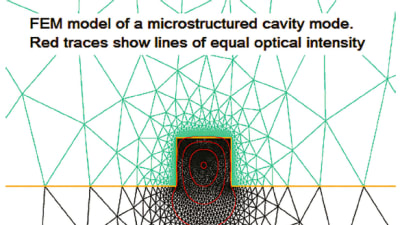
Frequency combs derived from optical microresonators are required to reach an octave in span. This is required for self-referencing a comb. Presently, the frequency comb...
Briefs: Imaging
NASA Vision Workbench (VWB)
VWB is a modular, extensible computer vision framework that supports tasks including automated science and engineering analysis, large satellite image processing, and 2D/3D environment reconstruction. The framework provides a rapid C++ development environment as well as a flexible, multi-platform system to deploy...
Briefs: Imaging
Flight Proving a Heliophysics Soft X-Ray Imager
The interaction between the solar wind and the Earth’s magneto - sphere results in “space weather.” To determine the true nature of the solar wind-magnetosphere interaction, scientists require global measurements of processes occurring at the bow shock, in the magnetosheath, and at the...
Briefs: Imaging
Intensity Interferometry Image Recovery
This software extends the well-known error-reduction Gerchberg-Saxton method to imaging of dark objects, assuming that such an object partially shadows a well-characterized thermal light source, while the shadow cannot be used for inferring the object’s shape. These assumptions are reasonable for a wide...
Briefs: Imaging
Cameras for All-Sky Meteor Surveillance (CAMS) Version 1.3
The CAMS system comprises a deployment of multiple narrow-field, low-light video cameras that completely covers the sky in a mosaic pattern from 30° elevation and above. Two or three such camera batteries separated by many kilometers allow for large atmospheric volume coverage, high...
Top Stories
 Blog: Power

My Opinion: We Need More Power Soon — Is Nuclear the Answer?
 Blog: AR/AI
Aerial Microrobots That Can Match a Bumblebee's Speed
 News: Energy

 Blog: Electronics & Computers

Turning Edible Fungi into Organic Memristors
 Blog: Robotics, Automation & Control

Microscopic Swimming Machines that Can Sense, Respond to Surroundings
 INSIDER: Sensors/Data Acquisition
Webcasts
 Upcoming Webinars: Power

Hydrogen Engines Are Heating Up for Heavy Duty
 Upcoming Webinars: Automotive

Advantages of Smart Power Distribution Unit Design for Automotive...
 Upcoming Webinars: Automotive

Quiet, Please: NVH Improvement Opportunities in the Early Design...
 Upcoming Webinars: Test & Measurement

From Spreadsheets to Insights: Fast Data Analysis Without Complex...
 Upcoming Webinars: Automotive

Battery Abuse Testing: Pushing to Failure
 Upcoming Webinars: Connectivity