

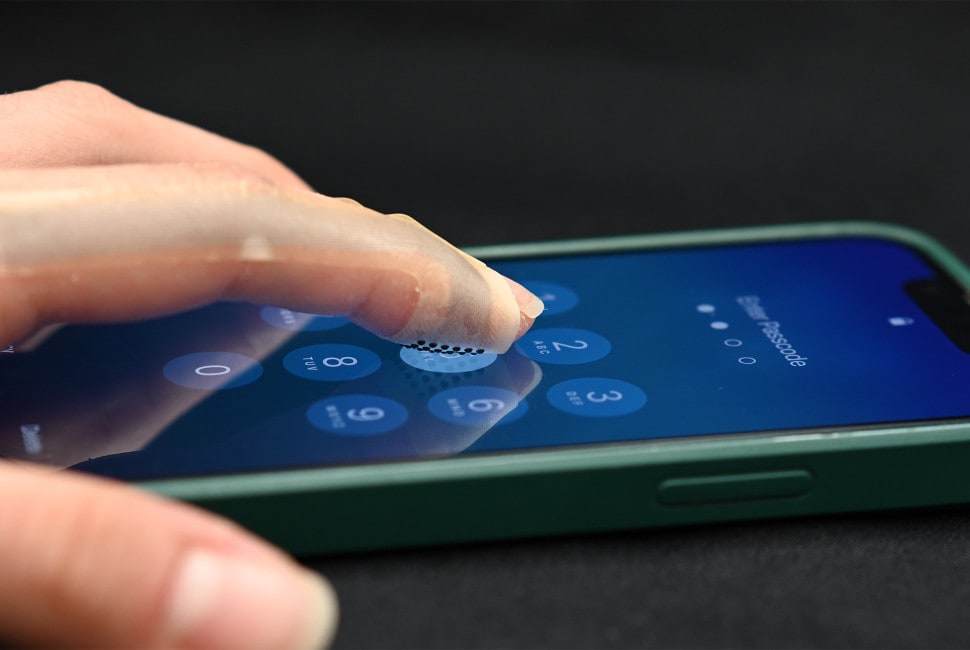
Northwestern University engineers have developed the first haptic device that achieves “human resolution,” meaning it accurately matches the sensing abilities of the human fingertip.
Called VoxeLite, the ultra-thin, lightweight, flexible, wearable device recreates touch sensations with the same clarity, detail, and speed that skin naturally detects. Similar to a bandage, the device gently wraps around a fingertip to give digital touch the same realism people now expect from today’s screens and speakers.
By combining high spatial resolution with a comfortable, wearable form factor, VoxeLite could transform how people interact with digital environments, including more immersive virtual reality systems, assistive technologies for people with vision impairments, human-robot interfaces, and enhanced touchscreens.
The study was published in the journal Science Advances.
“Touch is the last major sense without a true digital interface,” said Northwestern’s Sylvia Tan, who led the study. “We have technologies that make things look and sound real. Now, we want to make textures and tactile sensations feel real. Our device is moving the field toward that goal. We also designed it to be comfortable, so people can wear it for long periods of time without needing to remove it to perform other tasks. It’s like how people wear glasses all day and don’t even think about them.”
“This work represents a major scientific breakthrough in the field of haptics by introducing, for the first time, a technology that achieves ‘human resolution,’” said Senior Author Northwestern’s J. Edward Colgate, Haptics Pioneer. “It has the ability to present haptic information to the skin with both the spatial and temporal resolution of the sensory system.”
Colgate is the Walter P. Murphy Professor of Mechanical Engineering at Northwestern’s McCormick School of Engineering and director of the National Science Foundation Engineering Research Center on Human AugmentatioN via Dexterity (HAND). Colgate and Co-Senior Author Michael Peshkin, the Allen K. and Johnnie Cordell Breed Senior Professor of Design and Professor of Mechanical Engineering at McCormick, are longtime collaborators and pioneers in the field of haptics technology. Tan is a Ph.D. student at Northwestern’s Center for Robotics and Biosystems, where she is advised by Colgate and Peshkin.
Despite decades of progress in high-definition video and true-to-life audio, digital touch has stubbornly lagged behind. Today’s haptic feedback — mostly simple smartphone vibrations — cannot convey the rich, detailed information the fingertips naturally perceive. This is partially because the skin’s spatial and temporal resolution is notoriously difficult to simulate.
“Think of very old motion pictures when the number of frames per second was really low, so movements looked jerky. That’s due to low temporal resolution,” Colgate said. “Or think of early computer displays where images were pixelated. That’s low spatial resolution. Nowadays, both problems are solved for graphical displays. For tactile displays, however, they have been far from solved. In fact, very few researchers have even attempted to tackle both of them together.”
Here is an exclusive Tech Briefs interview, edited for length and clarity, with Tan.
Tech Briefs: What was the biggest technical challenge you faced while developing VoxeLite?
Tan: Finding the right materials and fabrication method that can satisfy all the requirements we wanted for the device.
Tech Briefs: Can you explain in simple terms how it works please?
Tan: VoxeLite consists of an array of tiny points that move independently. As you slide your finger, we precisely control how each point adheres to the surface and stretches the skin on your fingerpad. These motions occur at very high speeds, allowing us to create the sensations of different icons or textures.
Tech Briefs: The article I read says, “For future iterations of the device, the Northwestern team envisions a technology that can be paired with smartphones and tablets…” My question is: Do you have any set plans for such further research/work/etc.? If not, what are your next steps?
Tan: Our next steps are running psychophysical experiments to better understand how people perceive the tactile information VoxeLite can transmit.
Tech Briefs: Do you have any advice for researchers aiming to bring their ideas to fruition?
Tan: Be clear about your goals, but flexible with your plans. I prototype as much as I can, adapt from each failure, and remind myself that difficulty is temporary and the goals are worth pursuing.











