

Food manufacturers are held to strict agency regulations regarding product quality and consistency. Repeatable visual inspections are critical to ensure consumers receive a consistent and safe product. As regulations have increased, machine vision technology has become more intelligent to follow suit — a trend that some machine builders are using to their advantage.
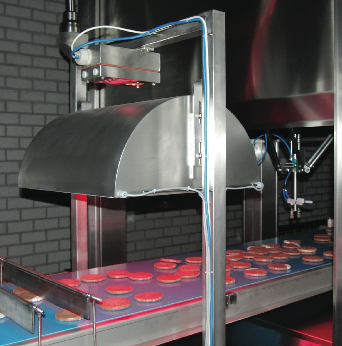
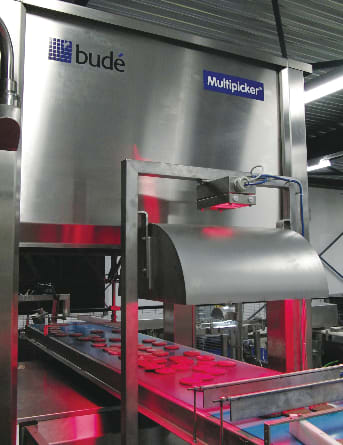
The Multipacker system is used to inspect a product’s quality, including how a product is shaped, oriented, and sized, before it is packaged for distribution. In one application of this technology, Budé employed the Multipacker system to inspect hamburger patties — which are fried, then frozen for preservation — to verify product quality and consistency in color. To complete this inspection, the vision system utilizes the IMPACT software suite, which allows users to develop custom graphical user interfaces and create complex inspections via simplified programming using drag-and-drop icons. The IMPACT M-Series platform also supports Power over Ethernet (PoE), reducing cabling.
“We have worked with other machine vision systems in the past, but we have never had a system that offers as much value and flexibility as the M-Series,” said Marcel Budé, Director of the Budé Group. “PPT VISION’s M40 system allows us to provide visual inspections for all types of food applications, including high-speed robot sorting or multi-camera inspections, while reducing production costs and ensuring the end customer receives only the highest quality product possible,” Budé added.
Vision Competence Center (VCC), the distributor for PPT VISION in Heerlen, Netherlands, helped to deploy the M-Series Embedded Vision System in the Budé Group’s new equipment offering. VCC assisted Budé in quickly solving their vision inspection requirements for the food manufacturing process by providing a simple setup and economical solution.
“Utilizing the same powerful software as current IMPACT smart cameras, the M-Series requires no additional training to program the unit,” said Marcel Heugen, Director of VCC. “Additionally, we were able to keep system costs down for Budé because of shared processing capability and multi-camera expandability. It allows us to inspect and reject the product at multiple locations in the production line, and helps reduce any added value to bad product.”
Equipment using smart cameras and machine vision systems is applied in both food processing and food packaging. Smart cameras inspect for food and food packaging quality to verify correct product shape and size, as well as to verify correct package markings. Smart cameras also guide food products through the production process and identify barcodes and human-readable text on food packages. With these capabilities, vision system cameras — such as the one Budé selected for their food industry equipment — can help assure end-users in the food industry that only the highest-quality products will reach consumers.
This article was contributed by PPT VISION, Bloomington, MN. For more information, Click Here .











