Kopp Glass, Pittsburgh, PA
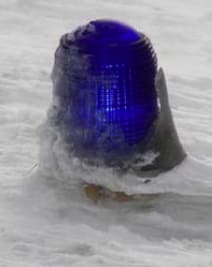
Incandescent lamps have been used as the primary light source in airfield lighting designs for many years. With recent environmental awareness of the general population and government regulation forcing greater energy efficiency, the lighting industry is rapidly transitioning to the use of light-emitting diodes (LEDs). LEDs offer greater energy efficiency by using a greater portion of the input electrical energy for light output, thereby reducing the heat output generated due to electrical losses.
Solution
Design Options
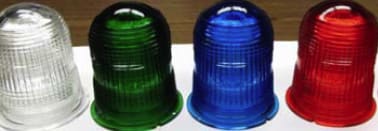
The heated lens can be made in an assortment of color options to meet aviation chromaticity requirements. The prerequisite of a colored LED that meets the aviation chromaticity requirement is essential for the heated lighting application. The heated lens is provided as an annealed glass lens for lighting fixture manufacturer use.
Electrode designs are critical to the efficiency and effectiveness of the lens heating. Kopp Glass has specifically designed the electrode configurations for uniform and efficient heating. The electrode is printed using a highly stable, inert metal that will avoid oxidation. Electricity can be provided using standard wire leads or connectors, depending on the needs of the client.
Engineering Data and Technical Details
Using the colored LED sources provides a greater photopic transmission when using an aviation chromaticity lens as compared to similar lens colors using an incandescent light source. This increased transmission provides the additional opportunity to reduce the electrical power input to the light source. Since there are refractive index differences between the glass lens materials and the TCO coating, transmission losses of 8-10% are likely to be observed in addition to the typical chromaticity associated transmission losses of the lens design.
Powering the TCO lens heater requires an elevated voltage and low current as compared to the electrical supply provided for lighting on the airfield. Power levels of 14-20W will prove adequate to meet the minimum temperature changes outlined in arctic testing methods per FAA Engineering Brief No. 67C.
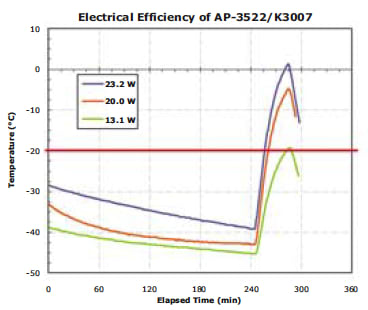
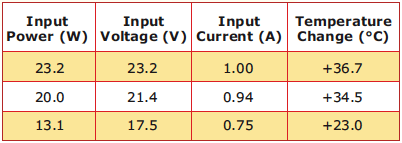
The surface modified lens designs (AP-3861, AP-3522, AP-2562) provide ample heating capacity that is in excess of the minimum temperatures changes required to meet the typical arctic kit testing methods according to the results of internal laboratory testing. Figure 1 illustrates the AP-3522 boundary lens in the Kopp Glass LED blue (K3007) design heating capability and electrical efficiency when exposed to an arctic testing environment. Electrical power inputs used to drive the heated lens boundary application in laboratory testing are provided in Table I.
As demonstrated in Figure 1, laboratory test results indicate the heated lens design is capable of heating beyond requirements if powered appropriately. This temperature change observed upon powering of the lens is dependent upon the electrical resistance of the semiconductive TCO coating and the coated area of a lens.
Conclusion
The Kopp Glass heated glass lens design provides airfield lighting manufacturers alternate ice and frozen precipitation removal options. The heated lens conducts thermal radiation throughout the bulk of the glass, providing uniform and direct heating of the entire lens. This direct heating method avoids the need to heat the entire lighting fixture and open lamp volume, thereby offering the opportunity for additional electrical energy savings.