Compact transducer arrays that measure spatial distributions of force or pressure have been demonstrated as prototypes of tactile sensors to be mounted on fingers and palms of dexterous robot hands. The pressure-or force-distribution feedback provided by these sensors is essential for the further development and implementation of robot-control capabilities for humanlike grasping and manipulation.
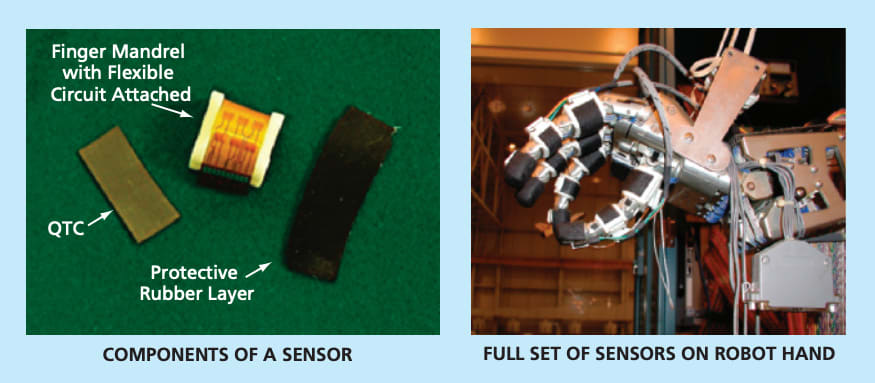
Each electrode defines a tactile sensor point denoted a tactel in analogy to a pixel (picture element) in an image-detecting array of photodetectors. In addition to the electrodes, the sensor includes a ground conductor common to all the elements of the array. The local electrical resistivity of the QTC changes in response to local pressure. By use of simple electronic circuits (e.g., resistive voltage dividers), the local changes of resistance in the tactels are converted to voltages. The voltages can be read by use of external analog-to-digital converter circuitry, then processed into forces or pressures on the tactels. Hence, the processed sensor output indicates the spatial distribution of force or pressure at the spatial resolution of the tactels.
This work was done by Toby B. Martin of Johnson Space Center; David Lussey of Peratech, Ltd.; Frank Gaudiano, Aaron Hulse, Myron A. Diftler, and Dagoberto Rodriguez of Lockheed Martin Corp.; Paul Bielski of Titan Systems Corp.; and Melisa Butzer of Oceaneering Space Systems. For further information, contact the Johnson Commercial Technology Office at (281) 483- 3809. MSC-23608/93