A proof-of-concept device is being developed (see figure) for hydrogen gas production based on water-splitting redox reactions facilitated by cobalt tetra-aryl porphyrins (Co[TArP]) catalysts stacked on carbon nanotubes (CNTs) that are grown on n-doped silicon substrates. The operational principle of the proposed device is based on conversion of photoelectron energy from sunlight into chemical energy, which at a later point, can be turned into electrical and mechanical power.
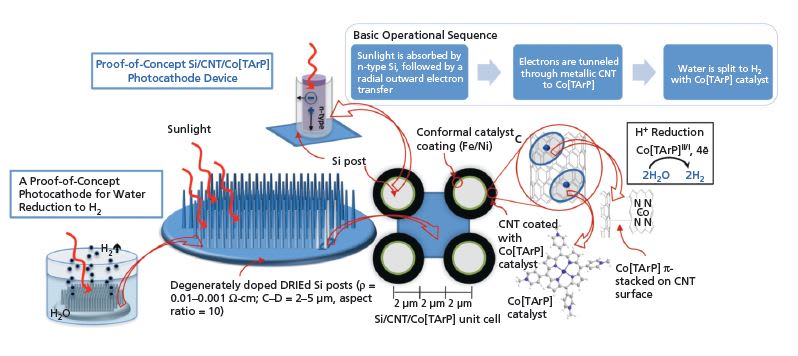
A typical unit cell will then consist of a Si post covered with CNT, providing enhanced surface area for the catalyst. The device will then be dipped into a solution of Co[TArP] to enable coating of CNT with Co(P). The Si/CNT/Co[TArP] assembly then will provide electrons for water splitting and hydrogen gas production. A potential of 1.23 V is needed to split water, and near ideal band gap is approximately 1.4 eV. The combination of doped Si/CNT/Co [TArP] will enable this redox reaction to be more efficient.
This work was done by Xenia Amashukeli, Harish Manohara, Harold F. Greer, Lee J. Hall, Harry B. Gray, and Bryan Subbert of Caltech for NASA’s Jet Propulsion Laboratory. For more information, contact