

A proposed special-purpose infrared imaging system would be a compact, portable, less-expensive alternative to functional magnetic resonance imaging (fMRI) systems heretofore used to study brain function. Whereas a typical fMRI system fills a large room, and must be magnetically isolated, this system would fit into a bicycle helmet.
The system would include an assembly that would be mounted inside the padding in a modified bicycle helmet or other suitable headgear. The assembly would include newly designed infrared photodetectors and dataacquisition circuits on integrated-circuit chips on low-thermal-conductivity supports in evacuated housings (see figure) arranged in multiple rows and columns that would define image coordinates. Each housing would be springloaded against the wearer’s head. The chips would be cooled by a small Stirling Engine mounted contiguous to, but thermally isolated from, the portions of the assembly in thermal contact with the wearer’s head. Flexible wires or cables for transmitting data from the aforementioned chips would be routed to an integrated, multichannel transmitter and thence through the top of the assembly to a patch antenna on the outside of the helmet.
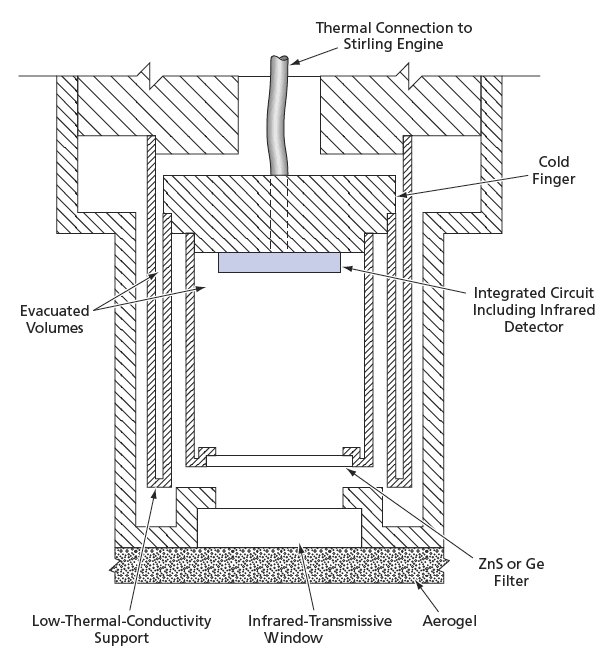
The multiple streams of data from the infrared-detector chips would be sent to a remote site, where they would be processed, by software, into a threedimensional display of evoked potentials that would represent firing neuronal bundles and thereby indicate locations of neuronal activity associated with mental or physical activity. The 3D images will be analogous to current fMRI images. The data would also be made available, in real-time, for comparison with data in local or internationally accessible relational databases that already exist in universities and research centers.
Hence, this system could be used in research on, and for the diagnosis of response from the wearer’s brain to physiological, psychological, and environmental changes in real time. The images would also be stored in a relational database for comparison with corresponding responses previously observed in other subjects.
This work was done by Frederick Mintz, Philip Moynihan, and Sarath Gunapala of Caltech for NASA’s Jet Propulsion Laboratory. For more information, download the Technical Support Package (free white paper) at www.techbriefs.com/tsp under the Bio-Medical category.
In accordance with Public Law 96-517, the contractor has elected to retain title to this invention. Inquiries concerning rights for its commercial use should be addressed to:
Innovative Technology Assets Management
JPL
Mail Stop 202-233
4800 Oak Grove Drive
Pasadena, CA 91109-8099
(818) 354-2240
E-mail: This email address is being protected from spambots. You need JavaScript enabled to view it.
Refer to NPO-43932, volume and number of this NASA Tech Briefs issue, and the page number.
This Brief includes a Technical Support Package (TSP).
Infrared Imaging System for Studying Brain Function
(reference NPO-43932) is currently available for download from the TSP library.
Don't have an account?
Overview
The document is a Technical Support Package from NASA’s Jet Propulsion Laboratory (JPL) concerning an innovative technology titled "Infrared Imaging System for Studying Brain Function," identified by NTR Number 43932. This technology is part of NASA Tech Briefs and is aimed at advancing the understanding of brain function through the use of infrared imaging techniques.
The package emphasizes the potential applications of this technology beyond aerospace, highlighting its relevance in various scientific and commercial fields. It is part of NASA's Commercial Technology Program, which seeks to disseminate the results of aerospace-related developments that may have broader technological implications. The document serves as a resource for those interested in the intersection of aerospace technology and neuroscience, showcasing how advancements in one field can benefit another.
The infrared imaging system is described as a mobile in vivo data collection and diagnosis comparison system, suggesting that it allows for real-time monitoring and analysis of brain activity. This capability could be invaluable for research in neuroscience, medical diagnostics, and potentially therapeutic applications.
The document also includes contact information for further inquiries, directing interested parties to the Innovative Technology Assets Management team at JPL. This team can provide additional information regarding research and technology in this area, indicating NASA's commitment to fostering innovation and collaboration.
Furthermore, the document contains a notice regarding the proprietary nature of the information and the importance of complying with U.S. export regulations. It clarifies that the United States Government does not assume liability for the use of the information provided, nor does it endorse any specific trade names or manufacturers mentioned within the report.
In summary, this Technical Support Package outlines a significant advancement in the use of infrared imaging for studying brain function, emphasizing its potential applications in various fields while providing a pathway for further exploration and collaboration through NASA's resources. The document reflects NASA's ongoing efforts to leverage aerospace technology for broader scientific and commercial benefits.











