

A system that would comprise mobile and stationary electronic hardware and software subsystems has been proposed for collection and automated interpretation of electro-encephalo-graphic (EEG) data from subjects in everyday activities in a variety of environments. By enabling collection of EEG data from mobile subjects engaged in ordinary activities (in contradistinction to collection from immobilized subjects in clinical settings), the system would expand the range of options and capabilities for performing diagnoses.
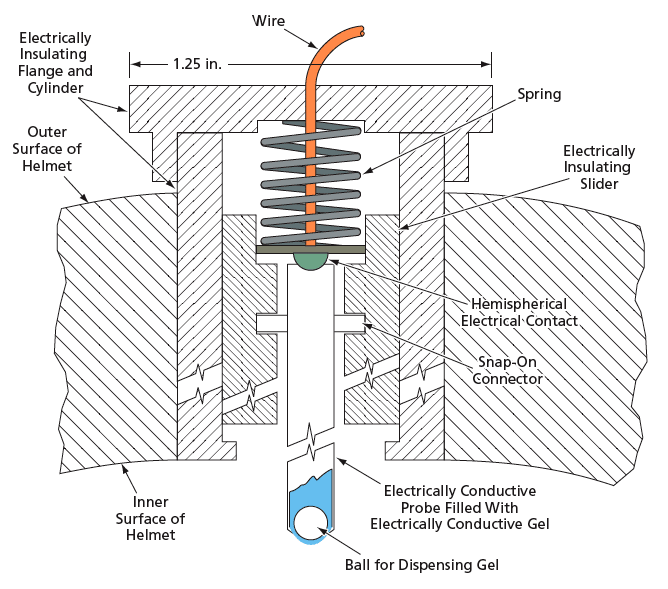
Each subject would be equipped with one of the mobile subsystems, which would include a helmet that would hold “floating electrodes” (see figure) in those positions on the patient’s head that are required in classical EEG data-collection techniques. A bundle of wires would couple the EEG signals from the electrodes to a multi-channel transmitter also located in the helmet. Electronic circuitry in the helmet transmitter would digitize the EEG signals and transmit the resulting data via a multi-directional RF patch antenna to a remote location.
At the remote location, the subject’s EEG data would be processed and stored in a database that would be auto-administered by a newly designed relational database management system (RDBMS). In this RDBMS, in nearly real time, the newly stored data would be subjected to automated interpretation that would involve comparison with other EEG data and concomitant peer-reviewed diagnoses stored in international brain data bases administered by other similar RDBMSs.
This work was done by Frederick Mintz and Philip Moynihan of Caltech for NASA’s Jet Propulsion Laboratory. For more information, download the Technical Support Package (free white paper) at www.techbriefs.com/tsp under the Bio–Medical category.
In accordance with Public Law 96-517, the contractor has elected to retain title to this invention. Inquiries concerning rights for its commercial use should be addressed to:
Innovative Technology Assets Management
JPL
Mail Stop 202-233
4800 Oak Grove Drive
Pasadena, CA 91109-8099
(818) 354-2240
E-mail: This email address is being protected from spambots. You need JavaScript enabled to view it.
Refer to NPO-42386, volume and number of this NASA Tech Briefs issue, and the page number.
This Brief includes a Technical Support Package (TSP).
Mobile Collection and Automated Interpretation of EEG Data
(reference NPO-42386) is currently available for download from the TSP library.
Don't have an account?
Overview
The document is a Technical Support Package from NASA's Jet Propulsion Laboratory (JPL) detailing the innovation titled "Mobile Collection and Automated Interpretation of EEG Data," identified by NTR Number: 42386. This technology focuses on the mobile in vivo collection of electroencephalogram (EEG) data, which is crucial for diagnosing and interpreting brain activity in real-time.
The primary aim of this innovation is to enhance the efficiency and accuracy of EEG data collection and analysis, making it more accessible for various applications, including medical diagnostics and research. The system allows for the automated interpretation of EEG data, which can significantly reduce the time and expertise required to analyze brain activity patterns. This is particularly beneficial in clinical settings where timely diagnosis is critical.
The document emphasizes the broader implications of this technology beyond aerospace, suggesting that the advancements made in this area could have significant scientific, technological, and commercial applications. The mobile aspect of the EEG data collection system is particularly noteworthy, as it enables data gathering in diverse environments, potentially leading to more comprehensive and varied data sets.
Additionally, the Technical Support Package serves as a resource for those interested in the commercial potential of this technology. It is part of NASA's Commercial Technology Program, which aims to disseminate aerospace-related developments that can be applied in other fields. The document encourages collaboration and further exploration of the technology through the NASA Innovative Partnerships Program.
For those seeking more information or assistance regarding this technology, the document provides contact details for the Innovative Technology Assets Management at JPL, including a mailing address, telephone number, and email.
In summary, the Technical Support Package outlines a significant advancement in EEG technology, highlighting its mobile and automated capabilities, and its potential for widespread application in various fields, particularly in healthcare. The document serves as an invitation for further exploration and collaboration in leveraging this innovative technology for broader societal benefits.











