

The use of composites is rapidly growing across many industries, fostering the need for new design, analysis, and optimization technologies. Every industry feels increasing pressure to launch breakthrough products that outperform competitors and meet market needs. For many design applications that require strong, yet lightweight materials, layered composites are ideal. Even so, faster, more frequent product introductions and new technologies cannot compromise ultimate product quality, reliability, and speed to market.

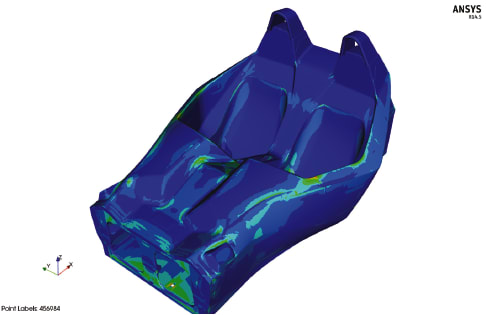
The KTM X-BOW (pronounced cross-bow) is a radical, lightweight production sports car that demonstrates what optimizing design and function using composite structures can deliver. Approved for road traffic, this mid-engine sports car builds on racetrack technology. The body incorporates an innovative monocoque of composite carbon fibers, a pioneering technology previously reserved exclusively for racing vehicles, which provides weight and safety advantages. With a monocoque design, the external skin provides the main structural support — like an eggshell — as opposed to an internal frame. This approach provides the required structural loads using a composite layer design — up to 300 layers in some parts.

The team analyzed the failure behavior of the composite design under different load scenarios before committing to the final design. Because all the major components (including front/rear suspension and seats) are interconnected in a monocoque design, many different load cases were run to analyze static and dynamic loads. For example, the rear-engine mounting points on the aluminum rear frame must handle extreme forces, including torsional forces that occur when accelerating around curves. The unique design for the X-BOW used a torque arm directly connected to the carbon monocoque form.
The first designs of the KTM X-BOW were engineered without using Composite PrepPost. However, once the team applied the software, they reduced the monocoque’s weight — a very important aspect of sports car design — by 20 percent.
This article was written by Martin Perterer, Head of Research and Simulation, KTM Technologies GmbH, Salzburg, Austria. The work was performed by KTM Technologies GmbH with the support of ANSYS channel partner CADFEM. For more information on KTM visit www.ktm-technologies.com or view the recorded webcast here .









