

ecovent Systems — Make Every Room the Right Temperature
Dipul Patel, Yoel Kelman, Nick Lancaster, Shawn Rose, and Brian Bowen
ecovent Systems
Boston, MA

The ecovent system of wireless vents and sensors makes any forced air heating and cooling system smarter by directing conditioned air where it’s needed most. ecovent is easy to install, saves energy, and is ready to make millions of homes much more comfortable.
The system consists of three main components: intelligent wireless vents, advanced sensors, and a mobile app that gives homeowners complete control over their comfort. The sensor suite monitors the real-time climate conditions in every room, and the intelligent vents redirect airflow accordingly. If rooms are unoccupied, there’s no need to heat or cool them, and homeowners can use the app to set custom temperature levels for different floors, rooms, or times of day.
Users plug a sensor suite into any electrical outlet in each room, and replace their existing vents with the ecovent. No special tools are necessary. Once it’s installed, the system immediately begins learning the characteristics of the home and users’ heating and cooling preferences.
ecovent can reduce heating and cooling costs by as much as 50%, and the system can pay for itself in less than three years. By reducing greenhouse gas emissions without sacrificing comfort, ecovent will change the way people think about home heating and cooling.
For more information, visit http://contest.techbriefs.com/sustainable_winner
Honorable Mentions
Direct Solar Energy Conversion to Electricity with Nanometer-Scale Metal-Insulator-Metal Tunnel Diode Serving as a Rectifier in Rectenna Arrays
Nikolai Kislov, Nano CVD Co., Tampa, FL
A Metal-Insulator-Metal tunnel diode serves as a rectifier in rectenna arrays. An optical rectenna operates the same way as a well-known radio antenna at lower frequencies. Rectification, based on electron tunneling between closely positioned metal electrodes, transforms optical radiation of petahertz frequency directly into electrical power. Nano-holes through the thickness of the film substrate act as a self-alignment mask for forming arrays of nanoscale MIMTDs. The inventive design, which enables independent control of both capacitance and resistance, enables high-efficiency, low-cost solar power conversion.
For more information, visit http://contest.techbriefs.com/solar_conversion
Displacing Diesel Consumption with High-Altitude Wind Energy Using a Buoyant Airborne Turbine (BAT)
Ben Glass, Adam Rein, Chris Vermillion, Ryan Holy, and Ephraim Lanford, Altaeros Energies, Somerville, MA
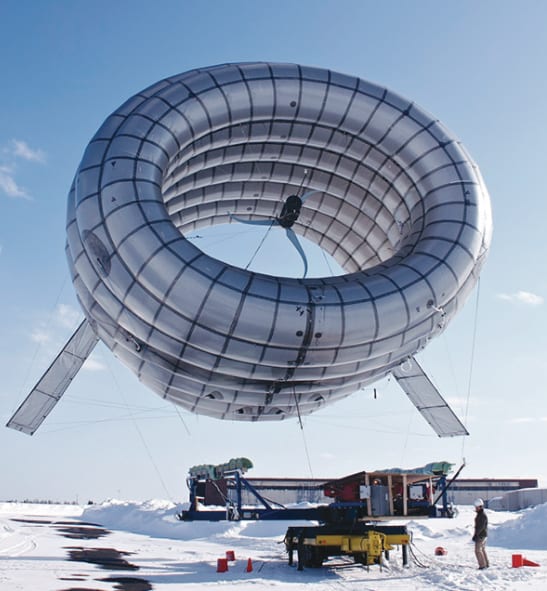 The Buoyant Airborne Turbine (BAT) is a tethered, helium-inflatable shell, adapted from military aerostats, that lifts a three-blade, horizontal-axis wind turbine. The rapidly deployable BAT, which generates 2-3 times the electricity of competing turbines, lifts a wind turbine into stronger, more consistent winds beyond the reach of conventional tower-based turbines.
For more information, visit http://contest.techbriefs.com/turbine











