

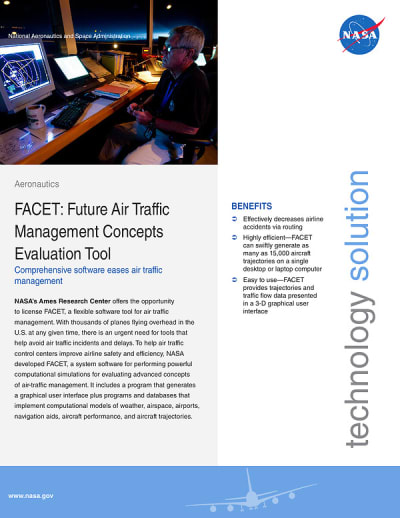
FACET: Future Air Traffic Management Concepts Evaluation Tool
 FACET flexible software helps air traffic control centers improve airline safety and efficiency. It includes programs and databases that implement models of weather, airspace, airports, navigation aids, aircraft performance, and aircraft trajectories.
Dynamic Weather Routes Tool
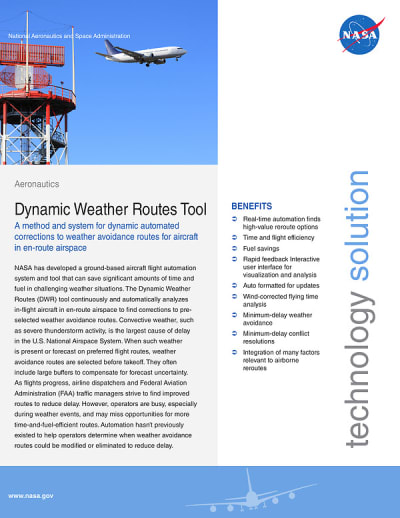
The Dynamic Weather Routes (DWR) ground-based aircraft flight automation system and tool can save significant amounts of time and fuel in challenging weather situations by continuously and automatically analyzing in-flight aircraft in en-route airspace to find corrections to preselected weather avoidance routes.
Cart3D
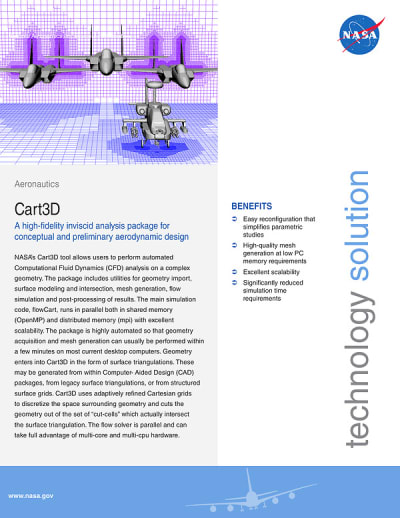
 Cart3D allows users to perform automated Computational Fluid Dynamics (CFD) analysis on a complex geometry. The package includes utilities for geometry import, surface modeling and intersection, mesh generation, flow simulation, and post-processing of results. Geometry acquisition and mesh generation can usually be performed within a few minutes on most current desktop computers.
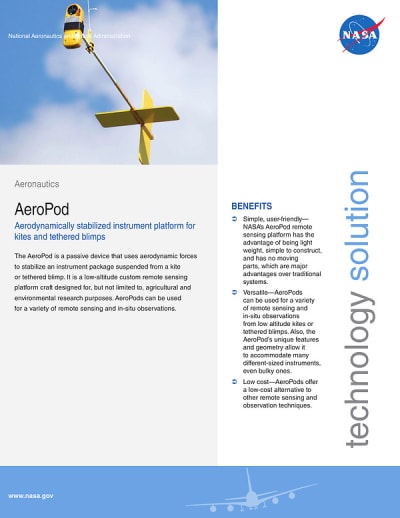
AeroPod
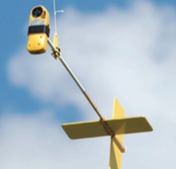 The AeroPod is a passive device that uses aerodynamic forces to stabilize an instrument package suspended from a kite or tethered blimp. It is a low-altitude custom remote sensing platform craft designed for agricultural and environmental research purposes, but can be used for remote sensing applications such as urban pattern mapping.
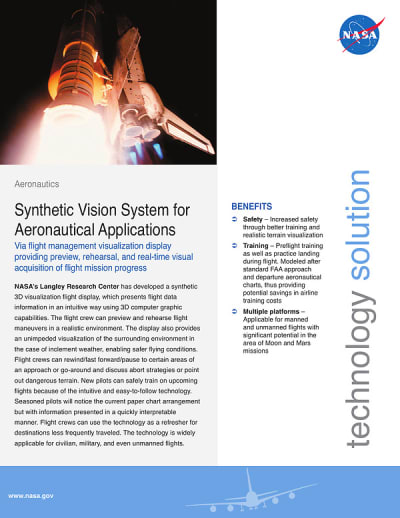
Synthetic Vision System for Aeronautical Applications
A synthetic 3D visualization flight display presents flight data information in an intuitive way using 3D computer graphic capabilities. The flight crew can preview and rehearse flight maneuvers in a realistic environment. The display also provides an unimpeded visualization of the surrounding environment in the case of inclement weather, enabling safer flying conditions.
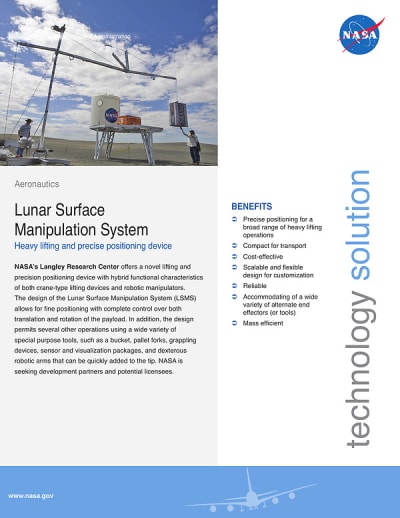
Lunar Surface Manipulation System
 The Lunar Surface Manipulation System (LSMS) is a lifting and precision positioning device that features hybrid functional characteristics of both crane-type lifting devices and robotic manipulators. The design permits several other operations using tools such as a bucket, pallet forks, grappling devices, and robotic arms for home framing, hazardous material cleanup, and firefighting.
Overview
The document outlines NASA's Lunar Surface Manipulation System (LSMS), a versatile technology developed by NASA Langley Research Center to perform multiple functions on the lunar surface. The LSMS addresses the limitations of current in-space operations devices, which are primarily designed for zero-gravity environments and lack the strength needed for planetary surfaces. Unlike traditional cranes that are specialized for lifting, the LSMS functions like a robotic manipulator, allowing for precise control and positioning of payloads without the need for a hoist.
The LSMS features a truss architecture composed of pure compression and tension members, resulting in a lightweight design. Its innovative use of multiple spreaders, akin to spokes in a wheel, ensures high structural efficiency throughout its range of motion. The system is designed to automatically lift off and re-engage tension members as joints articulate, providing a large range of motion while maintaining mechanical advantage. Additionally, the LSMS is equipped with a quick-change device at the tip, enabling automated acquisition of various end effectors or specialized tools, enhancing its versatility for different tasks.
The document also highlights the wide-ranging applications of the LSMS technology, which include construction (home framing and roofing), hazardous cleanup, camera boom operations, inspections, personnel positioning, material handling, pipe laying, and firefighting. These applications demonstrate the potential for the LSMS to be utilized in various industries beyond space exploration.
Furthermore, the document emphasizes NASA's Technology Transfer Program, which aims to maximize the applications of NASA's research for the benefit of U.S. citizens. Through partnerships and licensing agreements with industry, the program seeks to ensure that NASA's technological advancements lead to economic benefits, job creation, and improved quality of life.
In summary, the LSMS represents a significant advancement in lunar operations technology, combining the functionalities of cranes and robotic systems to facilitate a range of tasks on the moon. Its innovative design and broad application potential underscore NASA's commitment to transferring technology for the greater good, paving the way for future exploration and development in space and on Earth.







