

Atomic Oxygen Texturing and Cleaning
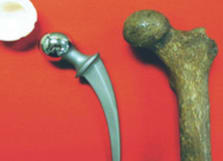 Atomic oxygen oxidizes and removes biologically active contaminants, and reduces the contaminant to an inactive ash. Thus, the contaminant is both sterile and biologically inactive. The resulting surface is entirely free of any bacteria, viruses, prions, cells, or any organic matter. Currently, 3/4 of orthopedic implants have measurable amounts of endotoxins. Atomic oxygen could totally eliminate these endotoxins, greatly reducing chances of post-operative inflammation.
RF Telemetry System for Bio-Microelectromechanical (MEMS) Sensors and Actuators
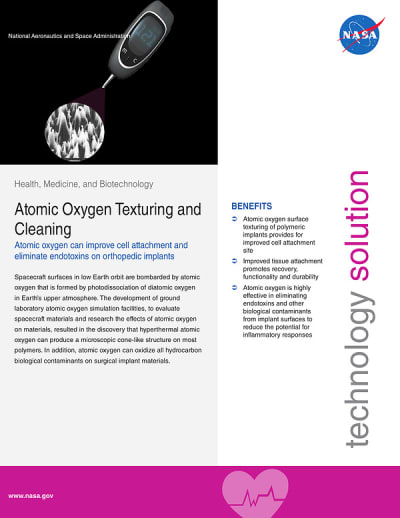
 This wireless technology enables fast inductive powering and data collection from implantable bio-MEMS sensors through electromagnetic coupling. This technology represents a distinct improvement over wired sensing approaches used in health monitoring. This innovation will enable smarter, easier-to-use devices that will allow physicians to monitor patients with chronic conditions in a fast and nonintrusive way.
Overview
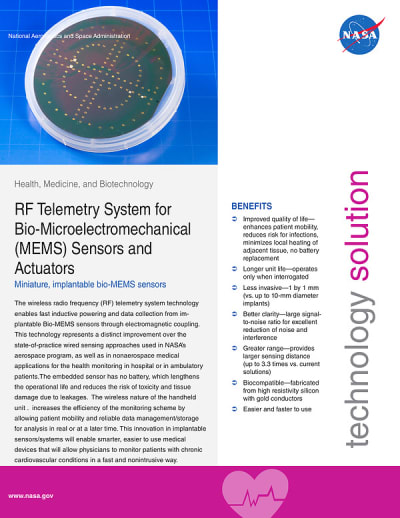
The document outlines NASA's innovative wireless RF telemetry system for implantable Bio-MEMS (Microelectromechanical Systems) sensors and actuators, emphasizing its applications in biomedical fields. The technology features a capacitive MEMS pressure sensor integrated within an inductor that functions both as an inductance and an antenna. This dual functionality allows the sensor to receive and transmit energy, facilitating contactless powering and data collection.
In operation, a handheld unit emits a pulse that interrogates the sensor, inducing a voltage in the spiral inductor. This process generates a decaying sine wave, with the frequency of oscillation determined by the capacitance of the pressure sensor. The system is designed to provide accurate pressure readings, with the frequency offset correlating to pressure differences. This wireless RF telemetry system enhances the versatility of applications, allowing for reconfiguration as a wearable device.
The document highlights several key benefits of this technology, including improved patient mobility, reduced risk of infections, and minimized tissue heating due to the absence of batteries. The sensors are compact, measuring only 1 by 1 mm, compared to traditional implants that can be up to 10 mm in diameter. The system also boasts a high signal-to-noise ratio, ensuring clarity in data transmission and a greater sensing range—up to 3.3 times that of current solutions.
Applications for the technology include monitoring cardiovascular conditions, spinal injuries, hydrocephalus, lactate acid levels, and epilepsy. The biocompatible materials used in the sensors, such as high resistivity silicon and gold conductors, further enhance their safety and effectiveness.
NASA's Technology Transfer Program aims to extend the reach of this technology beyond aerospace applications, promoting partnerships and licensing agreements with industry to benefit the economy and improve quality of life for U.S. citizens. By leveraging NASA's pioneering research, the program seeks to ensure that these advancements in health monitoring can be utilized in both hospital settings and for ambulatory patients, ultimately leading to smarter, easier-to-use medical devices that enhance patient care.







